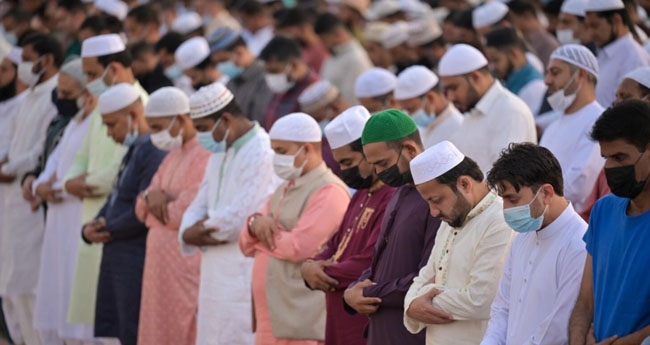
Muslims around the world observe Eid al-Fitr with joy, worry

Agencies
May 2, 2022

eid.jpg

Cairo, May 2: For the Islamic holiday of Eid al-Fitr, the smell of freshly baked orange biscuits and powdered sugar-dusted cookies typically fills the air in Mona Abubakr's home. But due to higher prices, the Egyptian housewife this year made smaller quantities of the sweet treats, some of which she gives as gifts to relatives and neighbours.

The mother of three has also tweaked another tradition this Eid, which began Monday in Egypt and many Muslim-majority countries and marks the end of the Islamic holy month of Ramadan. She bought fewer outfits for her sons to wear during the three-day feast.

“I told them we have to compromise on some things in order to be able to afford other things,” she said.

This year, Muslims around the world are observing Eid al-Fitr — typically marked with communal prayers, celebratory gatherings around festive meals and new clothes — in the shadow of a surge in global food prices exacerbated by the war in Ukraine. Against that backdrop, many are still determined to enjoy the Eid amid easing of coronavirus restrictions in their countries while, for others, the festivities are dampened by conflict and economic hardship.

At the largest mosque in Southeast Asia, tens of thousands of Muslims attended prayers Monday morning. The Istiqlal Grand Mosque in Indonesia's capital Jakarta was shuttered when Islam's holiest period coincided with the start of the coronavirus pandemic in 2020 and was closed to communal prayers last year.

“Words can't describe how happy I am today after two years we were separated by pandemic. Today we can do Eid prayer together again," said Epi Tanjung after he and his wife worshipped at another Jakarta mosque. “Hopefully all of this will make us more faithful.”

The war in Ukraine and sanctions on Russia have disrupted supplies of grain and fertilizer, driving up food prices at a time when inflation was already raging. A number of Muslim-majority countries are heavily reliant on Russia and Ukraine for much of their wheat imports, for instance.

Even before the Russian invasion, an unexpectedly strong global recovery from the 2020 coronavirus recession had created supply chain bottlenecks, causing shipping delays and pushing prices of food and other commodities higher.

In some countries, the fallout from the war in Ukraine is only adding to the woes of those already suffering from turmoil, displacement or poverty.

In Syria's rebel-held northwestern province of Idlib, Ramadan this year was more difficult than Ramadans past. Abed Yassin said he, his wife and three children now receive half the amounts of products — including chickpeas, lentils, rice and cooking oil — which last year they used to get from an aid group. It has made life more difficult.

Syria's economy has been hammered by war, Western sanctions, corruption and an economic meltdown in neighbouring Lebanon where Syrians have billions of dollars stuck in Lebanese banks.

In the Gaza Strip, though streets and markets are bustling, many say they cannot afford much.

“The situation is difficult,” said Um Musab, a mother of five, as she toured a traditional market in Gaza City. “Employees barely make a living but the rest of the people are crushed.”

Mahmoud al-Madhoun, who bought some date paste, flour and oil to make Eid cookies, said financial conditions were going from bad to worse. “However, we are determined to rejoice,” he added.

The Palestinian enclave, which relies heavily on imports, was already vulnerable before the Ukraine war as it had been under a tight Israeli-Egyptian blockade meant to isolate Hamas, its militant rulers.

Afghans are celebrating the first Eid since the Taliban takeover amid grim security and economic conditions. Many were cautious but poured into Kabul's largest mosques for prayers on Sunday, when the holiday started there, amid tight security.

Frequent explosions marred the period leading to Eid. These included fatal bombings, most claimed by the Islamic State affiliate known as IS in Khorasan Province, targeting ethnic Hazaras who are mostly Shiites, leaving many of them debating whether it was safe to attend Eid prayers at mosques.

“We want to show our resistance, that they cannot push us away,” said community leader Dr. Bakr Saeed before Eid. “We will go forward.”

Violence wasn't the only cause for worry. Since the Taliban takeover in August, Afghanistan's economy has been in a freefall with food prices and inflation soaring.

At a charity food distribution centre in Kabul on Saturday, Din Mohammad, a father of 10, said he expected this Eid to be his worst.

“With poverty, no one can celebrate Eid like in the past,” he said. “I wish we had jobs and work so we could buy something for ourselves, not have to wait for people to give us food.”

Muslims follow a lunar calendar, and methodologies, including moon sighting, can lead to different countries — or Muslim communities — declaring the start of Eid on different days.

In Iraq, fewer shoppers than usual appeared to have visited the capital's clothing markets this year. Security issues also plague celebrations, with security forces going on high alert from Sunday to Thursday to avert possible attacks after a suicide bombing in Baghdad last year ahead of another major Islamic holiday killed dozens.

In India, the country's Muslim minority is reeling from vilification by hardline Hindu nationalists who have long espoused anti-Muslim stances, with some inciting against Muslims. Tensions boiled over into violence at Ramadan, including stone-throwing between Hindu and Muslim groups.

Muslim preachers cautioned the faithful to remain vigilant during Eid.

Indian Muslims “are proactively preparing themselves to deal with the worst,” said Ovais Sultan Khan, a rights activist. “Nothing is as it used to be for Muslims in India, including the Eid.”

Still, many Muslims elsewhere rejoiced in reviving rituals disrupted by pandemic restrictions.

Millions of Indonesians have crammed into trains, ferries and buses ahead of Eid as they poured out of major cities to celebrate with their families in villages in the world's most populous Muslim-majority country. The return of the tradition of homecoming caused great excitement after two years of subdued festivities due to pandemic restrictions.

“The longing for (the) Eid celebration in a normal way has finally been relieved today although the pandemic has not yet ended,” said Hadiyul Umam, a resident of Jakarta.

Many in the capital flocked to shopping centres to buy clothes, shoes and sweets before the holiday despite pandemic warnings and food price surges.

Muslims in Malaysia were also in a celebratory mood after their country's borders fully reopened and Covid-19 measures were further loosened. Ramadan bazaars and shopping malls have been filled with shoppers ahead of Eid and many travelled to their hometowns.

“It's a blessing that we can now go back to celebrate,” said sales manager Fairuz Mohamad Talib, who works in Kuala Lumpur. His family will celebrate at his wife's village after two years of being apart due to earlier travel curbs.

There, he said, they will visit neighbours after the Eid prayers, glorifying Allah and sending salutations upon Prophet Muhammad, and sharing food at each stop.

“It's not about feasting but about getting together,” he said ahead of the holiday. With Covid-19 still on his mind, the family will take precautions such as wearing masks during visits. “There will be no handshakes, just fist bumps.” 

Comments

Add new comment

  • Coastaldigest.com reserves the right to delete or block any comments.
  • Coastaldigset.com is not responsible for its readers’ comments.
  • Comments that are abusive, incendiary or irrelevant are strictly prohibited.
  • Please use a genuine email ID and provide your name to avoid reject.
News Network
December 2,2025

Puttur: The long-cherished dream of a government medical college in Puttur has moved a decisive step closer to reality, with the Karnataka State Finance Department granting its official approval for the construction of a new 300-bed hospital.

Puttur MLA Ashok Kumar Rai announced the crucial development to reporters on Monday, confirming that the official communication from the finance department was issued on November 27. This 300-bed facility is intended to be the cornerstone for the establishment of the government medical college, a project announced in the state budget.

Fast-Track Implementation

The MLA outlined an aggressive timeline for the project:

•    A Detailed Project Report (DPR) for the hospital is expected to be ready within 45 days.

•    The tender process for the construction will be completed within two months.

Following the completion of the tender process, Chief Minister Siddaramaiah is scheduled to lay the foundation stone for the project.

"Setting up a medical college in Puttur is a historical decision by the Congress government in Karnataka," Rai stated. The project has an estimated budget allocation of Rs 1,000 crore for the medical college.

Focus on Medical Education Department

The MLA highlighted a key strategic move: requesting the government to implement the hospital construction through the Medical Education Department instead of the Health and Family Welfare Department. This is intended to streamline the entire process of establishing the full medical college, ensuring the facilities—including labs, operation theatres, and other necessary infrastructure—adhere to the strict guidelines set by the Medical Council of India (MCI). The proposed site for the project is in Bannur.

Rai also took the opportunity to address political criticism, stating that the government has fulfilled its promise despite "apprehensions" and "mocking and criticising" from opposition parties who had failed to take similar initiatives when they were in power. "Chief Minister Siddaramaiah has kept his word," he added.

Comments

Add new comment

  • Coastaldigest.com reserves the right to delete or block any comments.
  • Coastaldigset.com is not responsible for its readers’ comments.
  • Comments that are abusive, incendiary or irrelevant are strictly prohibited.
  • Please use a genuine email ID and provide your name to avoid reject.
News Network
December 2,2025

A major upgrade in safety and monitoring is planned for Haj 2026, with every Indian pilgrim set to receive a Haj Suvidha smart wristband linked to the official Haj Suvidha mobile app. The initiative aims to support pilgrims—especially senior citizens—who may struggle with smartphones during the 45-day journey.

What the Smart Wristband Will Do

Officials said the device will come with:
•    Location tracking
•    Pedometer
•    SOS emergency button
•    Qibla compass
•    Prayer timings
•    Basic health monitoring

SP Tiwari, secretary of the UP State Haj Committee, said the goal is to make the pilgrimage safer and more comfortable.

“Most Hajis are elderly and not comfortable with mobile apps,” he said. “The smartwatch will help locate pilgrims who forget their way or cannot communicate their location.”

The wristbands will be monitored by the Consulate General of India in Saudi Arabia, similar to mobile tracking via the Haj Suvidha App.

Free Distribution and Training

•    Smart wristbands will be given free of cost.
•    Training for pilgrims will be conducted between January and February 2026.
•    Sample units will reach state Haj committees soon.
•    Final devices will be distributed as pilgrims begin their journey.

New Rules for Accommodation

Two major decisions have also been finalised for Haj 2026:
1.    Separate rooms for men and women – including married couples. They may stay on the same floor but must occupy different rooms, following stricter Saudi guidelines.
2.    Cooking banned – gas cylinders will not be allowed; all meals will be provided through official catering services arranged by the Haj Committee of India.

These decisions were finalised during a meeting of the Haj Committee of India and state representatives in Mumbai.

Haj Suvidha App Launched Earlier

The government launched the Haj Suvidha App in 2024, offering:

•    Training modules
•    Accommodation and flight details
•    Baggage information
•    SOS and translation tools
•    Grievance redressal

Haj 2026 Quota and Key States

•    India’s total Haj quota for 2026: 1,75,025 pilgrims
•    70% (1,25,000) allotted to the Haj Committee of India
•    30% (around 50,000) reserved for Haj Group Organisers

Uttar Pradesh has the largest allocation (around 30,000 seats), though approximately 18,000 pilgrims are expected to go this year. States with high pilgrim numbers include Kerala, Maharashtra and Gujarat.

Dates of Haj 2026

The pilgrimage is scheduled to take place from 24 May to 29 May, 2026 (tentative).
Haj is one of the five pillars of Islam and is mandatory for Muslims who meet the required conditions.

Comments

Add new comment

  • Coastaldigest.com reserves the right to delete or block any comments.
  • Coastaldigset.com is not responsible for its readers’ comments.
  • Comments that are abusive, incendiary or irrelevant are strictly prohibited.
  • Please use a genuine email ID and provide your name to avoid reject.
News Network
November 24,2025

Mangaluru, Nov 24: The original departure time of 11.10 pm was a distant memory for scores of Dammam-bound passengers at Mangaluru International Airport last Friday night, as their Air India Express flight was abruptly cancelled at the eleventh hour, sparking hours of frustration and chaos.

The flight, IX 885, initially scheduled to depart at 11.10 pm on November 22, was subject to two back-to-back reschedules—first pushed to 11.45 pm and then significantly postponed to 1.40 am—before the final, crushing announcement of cancellation was made. For the travellers, many of whom are likely expatriate workers with tight schedules, the last-minute change marked the beginning of a distressing ordeal.

"There was no drinking water, no food, and absolutely no proper guidance. We were left stranded like refugees," complained a stranded passenger.

According to multiple passenger accounts, the airline's ground staff failed to provide adequate support or essential amenities following the cancellation. Complaints poured in about the total absence of drinking water, food provisions, and any reliable guidance from the carrier's representatives. Travellers alleged they were left stranded for a considerable period, with no immediate arrangements or clear communication offered regarding accommodation or alternative travel to send them back home.

The incident has highlighted serious concerns over the carrier's contingency planning and customer service protocols during flight disruptions at one of India's key international gateways. The airline is yet to issue a comprehensive statement addressing the alleged lapse in passenger care.
 

Comments

Add new comment

  • Coastaldigest.com reserves the right to delete or block any comments.
  • Coastaldigset.com is not responsible for its readers’ comments.
  • Comments that are abusive, incendiary or irrelevant are strictly prohibited.
  • Please use a genuine email ID and provide your name to avoid reject.