Muslims around the world observe Eid al-Fitr with joy, worry

Agencies
May 2, 2022

eid.jpg

Cairo, May 2: For the Islamic holiday of Eid al-Fitr, the smell of freshly baked orange biscuits and powdered sugar-dusted cookies typically fills the air in Mona Abubakr's home. But due to higher prices, the Egyptian housewife this year made smaller quantities of the sweet treats, some of which she gives as gifts to relatives and neighbours.

The mother of three has also tweaked another tradition this Eid, which began Monday in Egypt and many Muslim-majority countries and marks the end of the Islamic holy month of Ramadan. She bought fewer outfits for her sons to wear during the three-day feast.

“I told them we have to compromise on some things in order to be able to afford other things,” she said.

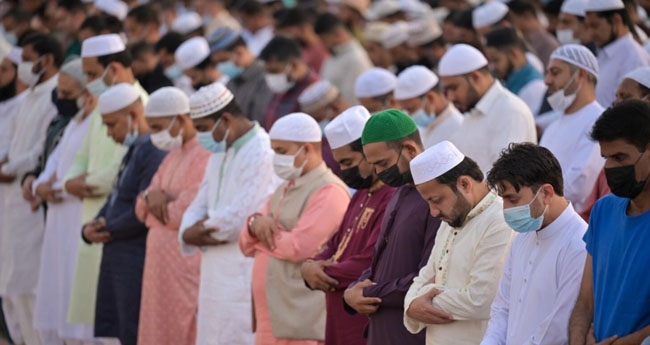
This year, Muslims around the world are observing Eid al-Fitr — typically marked with communal prayers, celebratory gatherings around festive meals and new clothes — in the shadow of a surge in global food prices exacerbated by the war in Ukraine. Against that backdrop, many are still determined to enjoy the Eid amid easing of coronavirus restrictions in their countries while, for others, the festivities are dampened by conflict and economic hardship.

At the largest mosque in Southeast Asia, tens of thousands of Muslims attended prayers Monday morning. The Istiqlal Grand Mosque in Indonesia's capital Jakarta was shuttered when Islam's holiest period coincided with the start of the coronavirus pandemic in 2020 and was closed to communal prayers last year.

“Words can't describe how happy I am today after two years we were separated by pandemic. Today we can do Eid prayer together again," said Epi Tanjung after he and his wife worshipped at another Jakarta mosque. “Hopefully all of this will make us more faithful.”

The war in Ukraine and sanctions on Russia have disrupted supplies of grain and fertilizer, driving up food prices at a time when inflation was already raging. A number of Muslim-majority countries are heavily reliant on Russia and Ukraine for much of their wheat imports, for instance.

Even before the Russian invasion, an unexpectedly strong global recovery from the 2020 coronavirus recession had created supply chain bottlenecks, causing shipping delays and pushing prices of food and other commodities higher.

In some countries, the fallout from the war in Ukraine is only adding to the woes of those already suffering from turmoil, displacement or poverty.

In Syria's rebel-held northwestern province of Idlib, Ramadan this year was more difficult than Ramadans past. Abed Yassin said he, his wife and three children now receive half the amounts of products — including chickpeas, lentils, rice and cooking oil — which last year they used to get from an aid group. It has made life more difficult.

Syria's economy has been hammered by war, Western sanctions, corruption and an economic meltdown in neighbouring Lebanon where Syrians have billions of dollars stuck in Lebanese banks.

In the Gaza Strip, though streets and markets are bustling, many say they cannot afford much.

“The situation is difficult,” said Um Musab, a mother of five, as she toured a traditional market in Gaza City. “Employees barely make a living but the rest of the people are crushed.”

Mahmoud al-Madhoun, who bought some date paste, flour and oil to make Eid cookies, said financial conditions were going from bad to worse. “However, we are determined to rejoice,” he added.

The Palestinian enclave, which relies heavily on imports, was already vulnerable before the Ukraine war as it had been under a tight Israeli-Egyptian blockade meant to isolate Hamas, its militant rulers.

Afghans are celebrating the first Eid since the Taliban takeover amid grim security and economic conditions. Many were cautious but poured into Kabul's largest mosques for prayers on Sunday, when the holiday started there, amid tight security.

Frequent explosions marred the period leading to Eid. These included fatal bombings, most claimed by the Islamic State affiliate known as IS in Khorasan Province, targeting ethnic Hazaras who are mostly Shiites, leaving many of them debating whether it was safe to attend Eid prayers at mosques.

“We want to show our resistance, that they cannot push us away,” said community leader Dr. Bakr Saeed before Eid. “We will go forward.”

Violence wasn't the only cause for worry. Since the Taliban takeover in August, Afghanistan's economy has been in a freefall with food prices and inflation soaring.

At a charity food distribution centre in Kabul on Saturday, Din Mohammad, a father of 10, said he expected this Eid to be his worst.

“With poverty, no one can celebrate Eid like in the past,” he said. “I wish we had jobs and work so we could buy something for ourselves, not have to wait for people to give us food.”

Muslims follow a lunar calendar, and methodologies, including moon sighting, can lead to different countries — or Muslim communities — declaring the start of Eid on different days.

In Iraq, fewer shoppers than usual appeared to have visited the capital's clothing markets this year. Security issues also plague celebrations, with security forces going on high alert from Sunday to Thursday to avert possible attacks after a suicide bombing in Baghdad last year ahead of another major Islamic holiday killed dozens.

In India, the country's Muslim minority is reeling from vilification by hardline Hindu nationalists who have long espoused anti-Muslim stances, with some inciting against Muslims. Tensions boiled over into violence at Ramadan, including stone-throwing between Hindu and Muslim groups.

Muslim preachers cautioned the faithful to remain vigilant during Eid.

Indian Muslims “are proactively preparing themselves to deal with the worst,” said Ovais Sultan Khan, a rights activist. “Nothing is as it used to be for Muslims in India, including the Eid.”

Still, many Muslims elsewhere rejoiced in reviving rituals disrupted by pandemic restrictions.

Millions of Indonesians have crammed into trains, ferries and buses ahead of Eid as they poured out of major cities to celebrate with their families in villages in the world's most populous Muslim-majority country. The return of the tradition of homecoming caused great excitement after two years of subdued festivities due to pandemic restrictions.

“The longing for (the) Eid celebration in a normal way has finally been relieved today although the pandemic has not yet ended,” said Hadiyul Umam, a resident of Jakarta.

Many in the capital flocked to shopping centres to buy clothes, shoes and sweets before the holiday despite pandemic warnings and food price surges.

Muslims in Malaysia were also in a celebratory mood after their country's borders fully reopened and Covid-19 measures were further loosened. Ramadan bazaars and shopping malls have been filled with shoppers ahead of Eid and many travelled to their hometowns.

“It's a blessing that we can now go back to celebrate,” said sales manager Fairuz Mohamad Talib, who works in Kuala Lumpur. His family will celebrate at his wife's village after two years of being apart due to earlier travel curbs.

There, he said, they will visit neighbours after the Eid prayers, glorifying Allah and sending salutations upon Prophet Muhammad, and sharing food at each stop.

“It's not about feasting but about getting together,” he said ahead of the holiday. With Covid-19 still on his mind, the family will take precautions such as wearing masks during visits. “There will be no handshakes, just fist bumps.” 

Comments

Add new comment

  • Coastaldigest.com reserves the right to delete or block any comments.
  • Coastaldigset.com is not responsible for its readers’ comments.
  • Comments that are abusive, incendiary or irrelevant are strictly prohibited.
  • Please use a genuine email ID and provide your name to avoid reject.
News Network
January 20,2026

Mangaluru: In a major step towards strengthening rural innovation, the Office of the Principal Scientific Adviser (PSA) to the Government of India is supporting the establishment of RuTAGe Smart Village Centres (RSVCs) across the country through collaborations with academic institutions, civil society organisations and philanthropic partners.

As part of this national initiative, Nitte (Deemed to be University) will set up the first RSVCs in the region at Nitte GP in Udupi district and at the Nitte Health Centre, Sevanjali Trust, Farangipete, in Dakshina Kannada district. The centres will be inaugurated on January 21. In South India, the programme is being implemented by the Section Infin-8 Foundation (SI-8).

Speaking to reporters on Monday, SI-8 founder-director Vishwas US said experts from Nitte University and SI-8 would work closely with farmers, students, youth and local entrepreneurs to adapt and deploy technologies tailored to local needs.

Project head Prof Iddya Karunasagar, representing Nitte DU, said the RSVCs at Nitte and Farangipete would serve as demonstration hubs for a wide range of agriculture, energy, skill-development and assistive technologies. These include solar dryers for fruits, vegetables and crops; soil-testing solutions; power weeders and women-friendly farm tools; wind-powered devices for rural artisans; grain storage systems; grass-cutting and tree-climbing equipment; and liquid fertiliser production using cowshed waste.

SI-8 CEO Aravind C Kumar said the centres would also provide access to digital and knowledge-based platforms such as ISRO applications, government scheme portals, market linkage tools and gamified learning resources, along with assistive technologies for persons with visual impairments.

Highlighting the broader impact of the initiative, Principal Scientific Adviser Prof Ajay Kumar Sood said it demonstrated how applied research could bridge the rural–urban divide and help create self-reliant, technology-enabled villages.

The initiative has been made possible through philanthropic support from Dr NC Murthy of ACM Business Solutions, LLC, USA. Dr Sapna Poti, Director (Strategic Alliances) at the Office of the Principal Scientific Adviser, said the long-term objective is to build self-sufficient, technology-driven communities capable of generating sustainable livelihoods on their own.

Comments

Add new comment

  • Coastaldigest.com reserves the right to delete or block any comments.
  • Coastaldigset.com is not responsible for its readers’ comments.
  • Comments that are abusive, incendiary or irrelevant are strictly prohibited.
  • Please use a genuine email ID and provide your name to avoid reject.
News Network
January 23,2026

modIKERALA.jpg

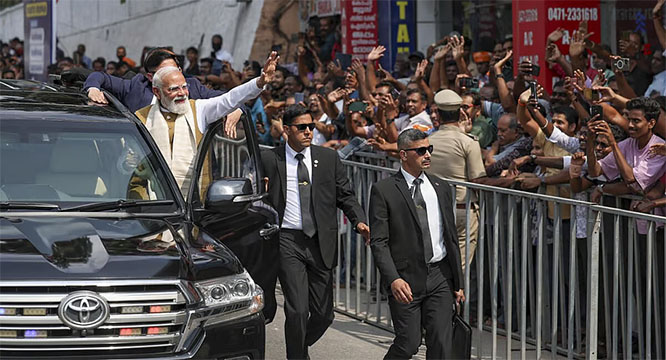
Prime Minister Narendra Modi, during his visit to Thiruvananthapuram on Friday, January 23, indicated that the Bharatiya Janata Party (BJP) is aiming to expand its political footprint in Kerala ahead of the Assembly elections scheduled in the coming months.

Speaking at a BJP-organised public meeting, Modi drew parallels between the party’s early electoral gains in Gujarat and its recent victory in the Thiruvananthapuram Municipal Corporation. The civic body win, which ended decades of Left control, was cited by the Prime Minister as a possible starting point for the party’s broader ambitions in the state.

Recalling BJP’s political trajectory in Gujarat, Modi said the party was largely insignificant before 1987 and received little media attention. He pointed out that the BJP’s first major breakthrough came with its victory in the Ahmedabad Municipal Corporation that year.

“Just as our journey in Gujarat began with one city, Kerala’s journey has also started with a single city,” Modi said, suggesting that the party’s municipal-level success could translate into wider electoral acceptance.

The Prime Minister alleged that successive governments led by the Left Democratic Front (LDF) and the United Democratic Front (UDF) had failed to adequately develop Thiruvananthapuram. He accused both fronts of corruption and neglect, claiming that basic infrastructure and facilities were denied to the capital city for decades.

According to Modi, the BJP’s control of the civic body represents a shift driven by public dissatisfaction with the existing political alternatives. He asserted that the BJP administration in Thiruvananthapuram had begun working towards development, though no specific details or timelines were outlined.

Addressing the gathering at Putharikandam Maidan, Modi said the BJP intended to project Thiruvananthapuram as a “model city,” reiterating his party’s commitment to governance-led change.

The Prime Minister’s visit to Kerala also included the inauguration of several development projects and the flagging off of new train services, as the BJP intensifies its political outreach in the poll-bound state.

Comments

Add new comment

  • Coastaldigest.com reserves the right to delete or block any comments.
  • Coastaldigset.com is not responsible for its readers’ comments.
  • Comments that are abusive, incendiary or irrelevant are strictly prohibited.
  • Please use a genuine email ID and provide your name to avoid reject.
News Network
January 28,2026

ajit.jpg

Mumbai: The sudden death of Maharashtra Deputy Chief Minister Ajit Pawar in a plane crash in his hometown of Baramati has plunged the state into political uncertainty, raising a pressing question for both the Nationalist Congress Party (NCP) and its rival faction, the Nationalist Congress Party (Sharadchandra Pawar): what next?

For the two factions that emerged after the dramatic split of June–July 2023, the moment marks their gravest challenge yet. Many believe the answer now rests with party founder Sharad Pawar.

Sharad Pawar, who founded the NCP in 1999 after parting ways with the Congress over Sonia Gandhi’s foreign origin, has already indicated his intention to step away from electoral politics once his Rajya Sabha term ends in April 2026.

Speaking at a public event in Baramati ahead of his 85th birthday on December 12, 2025, Pawar said he would not contest any further elections. “I have contested 14 elections. The younger generation needs to be given an opportunity,” he said, adding that he would decide later whether to seek another Rajya Sabha term.

Often described as the Bhishma Pitamah of Indian politics, Pawar also spoke of his gradual withdrawal from active leadership. “For the first 30 years, I handled everything. For the next 25–30 years, Ajit Dada handled responsibilities. Now, arrangements must be made for new leadership,” he said.

Ajit Pawar’s death has dramatically altered that transition, especially as he was working towards reunifying the two NCP factions.

“After the developments of June–July 2023 and the 2024 Lok Sabha and Vidhan Sabha elections, there were deep changes within the family and the party. In the last six months, serious efforts were made to reunite. Even workers from both sides wanted unity. This is a massive blow,” a Pawar family insider told DH over phone from Baramati.

Electoral outcomes over the past year reflected the split. In the 2024 Lok Sabha elections, NCP (SP) recorded the best strike rate in Maharashtra, winning eight of the 10 seats it contested. The NCP, by contrast, won just one seat out of four.

However, the trend reversed in the subsequent Vidhan Sabha elections, where the NCP emerged stronger, securing 41 of the 288 seats, while NCP (SP) managed only 10.

Within NCP (SP), Sharad Pawar’s daughter Supriya Sule serves as Working President, followed by leaders such as Rohit Pawar, state president Shashikant Shinde and former state chief Jayant Patil.

In the NCP, Praful Patel is the Working President and Raigad MP Sunil Tatkare heads the state unit. Ajit Pawar’s wife, Sunetra Pawar, is a Rajya Sabha MP, while their sons Parth and Jay are not actively involved in day-to-day politics. Parth Pawar briefly entered electoral politics in 2019 but lost the Lok Sabha election from Maval. Jay Pawar’s political debut was under consideration.

With Ajit Pawar gone, speculation has intensified that a member of the family may be asked to assume a larger role. For now, Sunetra Pawar is expected to play a key coordinating role in party affairs, alongside Patel and Tatkare.

The NCP continues to have several heavyweight leaders, including Chhagan Bhujbal, Hasan Mushrif, Dattatreya Bharne, Manikrao Kokate and Dhananjay Munde.

Ajit Pawar had already begun steps towards reconciliation between the two factions. While they contested the Pune and Pimpri-Chinchwad municipal elections separately, they later decided to fight the zilla parishad elections together under the ‘clock’ symbol—seen as the first formal step towards reunification.

Nagpur meet and party roadmap

Both NCP factions claim adherence to the ideology of ‘Shiv–Shahu–Phule–Ambedkar’. At the Rashtravadi Chintan Shivir held in Nagpur on September 19, 2025, the NCP reaffirmed its commitment to sarva dharma sambhav and discussed strengthening ties with the BJP “for the welfare and development of Maharashtra”.

In recent days, reports had suggested Ajit Pawar might return to the Maha Vikas Aghadi following the party’s poor performance in Pune municipal elections, but these claims were denied.

Big question for Maha Yuti

Ajit Pawar’s death also presents an immediate challenge for the Devendra Fadnavis-led Maha Yuti government. Pawar held crucial portfolios, including Finance, Planning and Excise. With the Budget Session approaching, appointing a new Finance Minister has become urgent.

Beyond numbers and portfolios, Maha Yuti has lost a swift decision-maker known for his administrative grip and political finesse—leaving a vacuum that will not be easy to fill.

Comments

Add new comment

  • Coastaldigest.com reserves the right to delete or block any comments.
  • Coastaldigset.com is not responsible for its readers’ comments.
  • Comments that are abusive, incendiary or irrelevant are strictly prohibited.
  • Please use a genuine email ID and provide your name to avoid reject.