



New Zealand: Jacinda Ardern set to serve second term as PM after landslide victory

News Network
October 17, 2020

New Delhi, Oct 17: Marking a landslide victory in the New Zealand General Elections, incumbent Prime Minister Jacinda Ardern is set to return for her second term as the head of the country. PM Jacinda Ardern, representing New Zealand's liberal labout party, is acing ahead to form for the first time a single party majority government in the country in decades. During her first term in the office, Ardern was in power with the support of the nationalist party.

Ardern’s liberal Labour Party had nearly double the support of its main challenger, the conservative National Party.

Labour was on the cusp of winning an outright majority in Parliament, something that hasn’t happened since New Zealand implemented a proportional voting system 24 years ago. Typically, parties must form alliances to govern, but this time Ardern and Labour may be able to go it alone.

"It's a landslide that looks like our vote is the best it has been since the 1940s," said Labour Minister David Parker. "It's a tremendous accolade first and foremost to the prime minister, but also to the wider Labour team and the Labour movement."

A record number of voters cast early ballots in the two weeks leading up to the election.

On the campaign trail, Ardern was greeted like a rock star by people who crammed into malls and spilled onto streets to cheer her on and get selfies with her.

Her popularity soared earlier this year after she led a successful effort to stamp out the coronavirus. There is currently no community spread of the virus in the nation of 5 million and people are no longer required to wear masks or social distance.

Ardern, 40, won the top job after the 2017 election when Labour formed an alliance with two other parties. The following year, she became only the second world leader to give birth while in office.

She became a role model for working mothers around the world, many of whom saw her as a counterpoint to President Donald Trump. And she was praised for her handling of last year’s attack on two Christchurch mosques, when a white supremacist gunned down 51 Muslim worshippers. She moved quickly to pass new laws banning the deadliest types of semi-automatic weapons.

In late March this year, when only about 100 people had tested positive for COVID-19, Ardern and her health officials put New Zealand into a strict lockdown with a motto of “Go hard and go early.” She shut the borders and outlined an ambitious goal of eliminating the virus entirely rather than just trying to control its spread.

With New Zealand having the advantage of being an isolated island nation, the strategy worked. The country eliminated community transmission for 102 days before a new cluster was discovered in August in Auckland. Ardern swiftly imposed a second lockdown in Auckland and the new outbreak faded away. The only new cases found recently have been among returning travelers, who are in quarantine.

The Auckland outbreak also prompted Ardern to postpone the election by a month and helped increase the early voter turnout.

The National Party’s leader, Judith Collins, is a former lawyer. She served as a minister when National was in power and prides herself on a blunt, no-nonsense approach, a contrast to Ardern’s empathetic style. Collins, 61, was promising sweeping tax cuts in response to the economic downturn caused by the virus.

In the election, voters also had a say on two contentious social issues — whether to legalize marijuana and euthanasia. Polls taken before the election indicated the euthanasia referendum was likely to pass while the marijuana vote remained uncertain. The results of both referendums will be announced Oct. 30.

Comments

Add new comment

  • Coastaldigest.com reserves the right to delete or block any comments.
  • Coastaldigset.com is not responsible for its readers’ comments.
  • Comments that are abusive, incendiary or irrelevant are strictly prohibited.
  • Please use a genuine email ID and provide your name to avoid reject.
News Network
January 23,2026

Mangaluru: The Karnataka Government Polytechnic (KPT), Mangaluru, has achieved autonomous status from the All India Council for Technical Education (AICTE), becoming the first government polytechnic in the country to receive such recognition in its 78-year history. The status was granted by AICTE, New Delhi, and subsequently approved by the Karnataka Board of Technical Education in October last year.

Officials said the autonomy was conferred a few months ago. Until recently, AICTE extended autonomous status only to engineering colleges, excluding diploma institutions. However, with a renewed national focus on skill development, several government polytechnics across India have now been granted autonomy.

KPT, the second-largest polytechnic in Karnataka, was established in 1946 with four branches and has since expanded to offer eight diploma programmes, including computer science and polymer technology. The institution is spread across a 19-acre campus.

Ravindra M Keni, the first dean of the institution, told The Times of India that AICTE had proposed autonomous status for polytechnic institutions that are over 25 years old. “Many colleges applied. In the first round, 100 institutions were shortlisted, which was further narrowed down to 15 in the second round. We have already completed one semester after becoming an autonomous institution,” he said. He added that nearly 500 students are admitted annually across eight three-year diploma courses.

Explaining the factors that helped KPT secure autonomy, Keni said the institution has consistently recorded 100 per cent admissions and placements for its graduates. He also noted its strong performance in sports, with the college emerging champions for 12 consecutive years, along with active student participation in NCC and NSS activities.

Autonomous status allows KPT to design industry-oriented curricula, conduct examinations, prepare question papers, and manage academic documentation independently. The institution can also directly collaborate with industries and receive priority funding from AICTE or the Ministry of Education. While academic autonomy has been granted, financial control will continue to rest with the state government.

“There will be separate committees for examinations, question paper setting, boards of studies, and boards of examiners. The institution will now have the freedom to conduct admissions without government notifications and issue its own marks cards,” Keni said, adding that new academic initiatives would be planned after a year of functioning under the autonomous framework.

Comments

Add new comment

  • Coastaldigest.com reserves the right to delete or block any comments.
  • Coastaldigset.com is not responsible for its readers’ comments.
  • Comments that are abusive, incendiary or irrelevant are strictly prohibited.
  • Please use a genuine email ID and provide your name to avoid reject.
News Network
February 1,2026

Bengaluru: Karnataka Deputy Chief Minister D K Shivakumar on Sunday criticised the Union Budget presented by Finance Minister Nirmala Sitharaman, claiming it offered no tangible benefit to the state.

Though he said he was yet to study the budget in detail, Shivakumar asserted that Karnataka had gained little from it. “There is no benefit for our state from the central budget. I was observing it. They have now named a programme after Mahatma Gandhi, after repealing the MGNREGA Act that was named after him,” he said.

Speaking to reporters here, the Deputy Chief Minister demanded the restoration of MGNREGA, and made it clear that the newly enacted rural employment scheme — VB-G RAM G — which proposes a 60:40 fund-sharing formula between the Centre and the states, would not be implemented in Karnataka.

“I don’t see any major share for our state in this budget,” he added.

Shivakumar, who also holds charge of Bengaluru development, said there were high expectations for the city from the Union Budget. “The Prime Minister calls Bengaluru a ‘global city’, but what has the Centre done for it?” he asked.

He also drew attention to the problems faced by sugar factories, particularly those in the cooperative sector, alleging a lack of timely decisions and support from the central government.

Noting that the Centre has the authority to fix the minimum support price (MSP) for agricultural produce, Shivakumar said the Union government must take concrete steps to protect farmers’ interests.

Comments

Add new comment

  • Coastaldigest.com reserves the right to delete or block any comments.
  • Coastaldigset.com is not responsible for its readers’ comments.
  • Comments that are abusive, incendiary or irrelevant are strictly prohibited.
  • Please use a genuine email ID and provide your name to avoid reject.
News Network
January 23,2026

modIKERALA.jpg

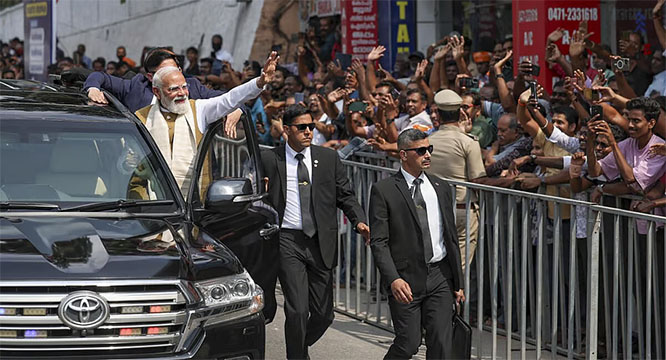
Prime Minister Narendra Modi, during his visit to Thiruvananthapuram on Friday, January 23, indicated that the Bharatiya Janata Party (BJP) is aiming to expand its political footprint in Kerala ahead of the Assembly elections scheduled in the coming months.

Speaking at a BJP-organised public meeting, Modi drew parallels between the party’s early electoral gains in Gujarat and its recent victory in the Thiruvananthapuram Municipal Corporation. The civic body win, which ended decades of Left control, was cited by the Prime Minister as a possible starting point for the party’s broader ambitions in the state.

Recalling BJP’s political trajectory in Gujarat, Modi said the party was largely insignificant before 1987 and received little media attention. He pointed out that the BJP’s first major breakthrough came with its victory in the Ahmedabad Municipal Corporation that year.

“Just as our journey in Gujarat began with one city, Kerala’s journey has also started with a single city,” Modi said, suggesting that the party’s municipal-level success could translate into wider electoral acceptance.

The Prime Minister alleged that successive governments led by the Left Democratic Front (LDF) and the United Democratic Front (UDF) had failed to adequately develop Thiruvananthapuram. He accused both fronts of corruption and neglect, claiming that basic infrastructure and facilities were denied to the capital city for decades.

According to Modi, the BJP’s control of the civic body represents a shift driven by public dissatisfaction with the existing political alternatives. He asserted that the BJP administration in Thiruvananthapuram had begun working towards development, though no specific details or timelines were outlined.

Addressing the gathering at Putharikandam Maidan, Modi said the BJP intended to project Thiruvananthapuram as a “model city,” reiterating his party’s commitment to governance-led change.

The Prime Minister’s visit to Kerala also included the inauguration of several development projects and the flagging off of new train services, as the BJP intensifies its political outreach in the poll-bound state.

Comments

Add new comment

  • Coastaldigest.com reserves the right to delete or block any comments.
  • Coastaldigset.com is not responsible for its readers’ comments.
  • Comments that are abusive, incendiary or irrelevant are strictly prohibited.
  • Please use a genuine email ID and provide your name to avoid reject.