



New Zealand mosque shooter sentenced to life without parole

Agencies
August 27, 2020

Christchurch, Aug 27: The white supremacist who slaughtered 51 worshippers at two New Zealand mosques was sentenced on Thursday to life in prison without the possibility of parole.

The judge imposed the maximum available sentence on 29-year-old Australian gunman Brenton Harrison Tarrant, the first time the sentence has been imposed in New Zealand.

Judge Cameron Mander said Tarrant's crimes were so wicked that a life time in jail could not begin to atone for them. He said they had caused enormous loss and hurt and stemmed from a warped and malignant ideology.

Your actions were inhuman, Mander said. You deliberately killed a 3-year-old infant as he clung to the leg of his father.

The March 2019 attacks targeting people praying at the Al Noor and Linwood mosques shocked New Zealand and prompted new laws banning the deadliest types of semi-automatic weapons. They also prompted global changes to social media protocols after the gunman livestreamed his attack on Facebook.

During the four-day sentencing hearing, 90 survivors and family members recounted the horror of the attacks and the trauma they continue to feel.

Some chose to yell at the gunman and give him the finger. Others called him a monster, a coward, a rat. Some sung verses from the Quran or addressed him in Arabic. A few spoke softly to Tarrant, saying they forgave him.

Tarrant had earlier fired his lawyers and told the judge that he didn't wish to speak at the hearing. A standby lawyer appointed by the court told the judge that Tarrant did not oppose a sentence of life without parole.

Mander noted that Tarrant had recently told assessors that he now rejects his extremist philosophy and considers his attacks abhorrent and irrational. But Mander said the sincerity of that change of heart was questionable and Tarrant had still shown no empathy toward his victims or sorrow for what he had done.

Tarrant in March had pleaded guilty to 51 counts of murder, 40 counts of attempted murder and one count of terrorism, reversing his earlier not guilty pleas.

Prosecutors said Tarrant had flown a drone over the Al Noor mosque and researched the layout as he meticulously planned his attacks. He arrived with six guns including two AR-15s.

Crown prosecutor Mark Zarifeh said he'd aimed to kill as many people as possible.

The offender's actions are a painful and harrowing mark in New Zealand's history, he said.

Tarrant was noticeably thinner in his sentencing hearing than when he was first arrested. He didn't show the brazenness he did at his first court appearance the day after the attacks, when he made a hand gesture sometimes adopted by white supremacists.

Dressed in a gray prison tracksuit, Tarrant showed little emotion during his sentencing. He watched the speakers, occasionally giving a small nod or covering his mouth as he laughed at jokes, often made at his expense.

Sara Qasem spoke Thursday during the four-day hearing about her beloved father Abdelfattah, who was killed in the attacks.

All a daughter ever wants is her dad. I want to go on more road trips with him. I want to smell his garden-sourced cooking. His cologne, she said. I want to hear him tell me more about the olive trees in Palestine. I want to hear his voice. My dad's voice. My baba's voice.

Comments

Add new comment

  • Coastaldigest.com reserves the right to delete or block any comments.
  • Coastaldigset.com is not responsible for its readers’ comments.
  • Comments that are abusive, incendiary or irrelevant are strictly prohibited.
  • Please use a genuine email ID and provide your name to avoid reject.
News Network
January 23,2026

modIKERALA.jpg

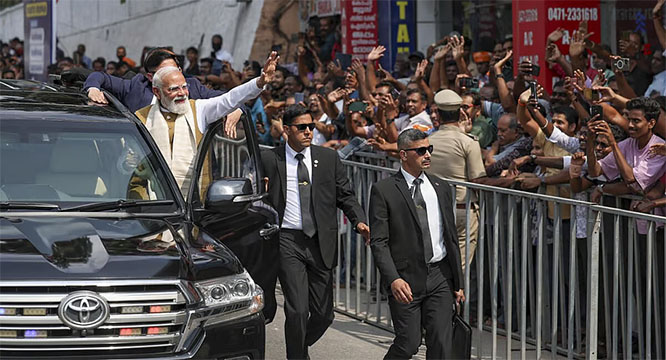
Prime Minister Narendra Modi, during his visit to Thiruvananthapuram on Friday, January 23, indicated that the Bharatiya Janata Party (BJP) is aiming to expand its political footprint in Kerala ahead of the Assembly elections scheduled in the coming months.

Speaking at a BJP-organised public meeting, Modi drew parallels between the party’s early electoral gains in Gujarat and its recent victory in the Thiruvananthapuram Municipal Corporation. The civic body win, which ended decades of Left control, was cited by the Prime Minister as a possible starting point for the party’s broader ambitions in the state.

Recalling BJP’s political trajectory in Gujarat, Modi said the party was largely insignificant before 1987 and received little media attention. He pointed out that the BJP’s first major breakthrough came with its victory in the Ahmedabad Municipal Corporation that year.

“Just as our journey in Gujarat began with one city, Kerala’s journey has also started with a single city,” Modi said, suggesting that the party’s municipal-level success could translate into wider electoral acceptance.

The Prime Minister alleged that successive governments led by the Left Democratic Front (LDF) and the United Democratic Front (UDF) had failed to adequately develop Thiruvananthapuram. He accused both fronts of corruption and neglect, claiming that basic infrastructure and facilities were denied to the capital city for decades.

According to Modi, the BJP’s control of the civic body represents a shift driven by public dissatisfaction with the existing political alternatives. He asserted that the BJP administration in Thiruvananthapuram had begun working towards development, though no specific details or timelines were outlined.

Addressing the gathering at Putharikandam Maidan, Modi said the BJP intended to project Thiruvananthapuram as a “model city,” reiterating his party’s commitment to governance-led change.

The Prime Minister’s visit to Kerala also included the inauguration of several development projects and the flagging off of new train services, as the BJP intensifies its political outreach in the poll-bound state.

Comments

Add new comment

  • Coastaldigest.com reserves the right to delete or block any comments.
  • Coastaldigset.com is not responsible for its readers’ comments.
  • Comments that are abusive, incendiary or irrelevant are strictly prohibited.
  • Please use a genuine email ID and provide your name to avoid reject.
News Network
January 20,2026

iran.jpg

Iranian security and intelligence forces have captured more than 470 individuals in three provinces, identified as key figures behind the recent wave of violent unrest and terrorist activities linked to foreign-backed networks.

The Intelligence Ministry's provincial office in Khorasan Razavi announced on Monday the arrest of 192 armed terrorists, identified as the main agents behind recent riots in the region. 

According to an official statement, the detainees were involved in the killing of several security personnel and civilians, setting fire to mosques, public service facilities, and buses, as well as attacks on military and law enforcement centers.

The seized items from the group include several bulletproof vests, Kalashnikov rifles, hunting weapons, Winchester rifles, and various cold weapons such as daggers, swords, brass knuckles, tactical knives, crossbows, and chains.

Evidence indicates that some of the individuals were tied to hostile movements and terrorist organizations, with links overseas. Others were identified as members of violent criminal gangs, actively taking part in the unrest alongside their associates.

Simultaneously, in the western province of Lorestan, the IRGC announced the arrest of 134 individuals as the main leaders and influential field agents of a US-Israeli terrorist network.

The IRGC statement stated that these individuals formed terrorist cells during the recent unrest, committing "Daesh-like" acts.

They wounded security forces with firearms and cold weapons, and burned and destroyed public and private properties, including mosques, shops, banks, and private and public vehicles.

In the northwestern province of Zanjan, the police reported detaining 150 people identified as principal leaders and agents behind recent riots.

Authorities noted that these individuals were responsible for destroying public and private property and intentionally setting fire to vehicles in the province's squares.

Their crimes include shedding the blood of innocent people, destroying public and private property, attempting to enter military sites, disrupting public order, and spreading terror among citizens.

A variety of cold weapons were reportedly seized from the detainees.

What began late last month as peaceful protests over economic hardship across Iran turned violent after public statements by US and Israeli regime figures encouraged vandalism and disorder.

During the unrest, foreign-backed mercenaries rampaged through cities, killing security forces and civilians and damaging public property.

Comments

Add new comment

  • Coastaldigest.com reserves the right to delete or block any comments.
  • Coastaldigset.com is not responsible for its readers’ comments.
  • Comments that are abusive, incendiary or irrelevant are strictly prohibited.
  • Please use a genuine email ID and provide your name to avoid reject.
News Network
February 1,2026

Bengaluru: Karnataka Deputy Chief Minister D K Shivakumar on Sunday criticised the Union Budget presented by Finance Minister Nirmala Sitharaman, claiming it offered no tangible benefit to the state.

Though he said he was yet to study the budget in detail, Shivakumar asserted that Karnataka had gained little from it. “There is no benefit for our state from the central budget. I was observing it. They have now named a programme after Mahatma Gandhi, after repealing the MGNREGA Act that was named after him,” he said.

Speaking to reporters here, the Deputy Chief Minister demanded the restoration of MGNREGA, and made it clear that the newly enacted rural employment scheme — VB-G RAM G — which proposes a 60:40 fund-sharing formula between the Centre and the states, would not be implemented in Karnataka.

“I don’t see any major share for our state in this budget,” he added.

Shivakumar, who also holds charge of Bengaluru development, said there were high expectations for the city from the Union Budget. “The Prime Minister calls Bengaluru a ‘global city’, but what has the Centre done for it?” he asked.

He also drew attention to the problems faced by sugar factories, particularly those in the cooperative sector, alleging a lack of timely decisions and support from the central government.

Noting that the Centre has the authority to fix the minimum support price (MSP) for agricultural produce, Shivakumar said the Union government must take concrete steps to protect farmers’ interests.

Comments

Add new comment

  • Coastaldigest.com reserves the right to delete or block any comments.
  • Coastaldigset.com is not responsible for its readers’ comments.
  • Comments that are abusive, incendiary or irrelevant are strictly prohibited.
  • Please use a genuine email ID and provide your name to avoid reject.
