Over 5,100 arrested at anti-Putin protests across Russia

Agencies
February 1, 2021

Moscow, Feb 1: Chanting slogans against President Vladimir Putin, tens of thousands took to the streets Sunday across Russia to demand the release of jailed opposition leader Alexei Navalny, keeping up nationwide protests that have rattled the Kremlin. More than 5,100 people were detained by police, according to a monitoring group, and some were beaten.

The massive protests came despite efforts by Russian authorities to stem the tide of demonstrations after tens of thousands rallied across the country last weekend in the largest, most widespread show of discontent that Russia had seen in years. Despite threats of jail terms, warnings to social media groups and tight police cordons, the protests again engulfed cities across Russia's 11 time zones on Sunday.

Navalny's team quickly called another protest in Moscow for Tuesday, when he is set to face a court hearing that could send him to prison for years.

The 44-year-old Navalny, an anti-corruption investigator who is Putin's best-known critic, was arrested on Jan. 17 upon returning from Germany, where he spent five months recovering from nerve-agent poisoning that he blames on the Kremlin. Russian authorities have rejected the accusations. He was arrested for allegedly violating his parole conditions by not reporting for meetings with law enforcement when he was recuperating in Germany.

The United States urged Russia to release Navalny and criticized the crackdown on protests.

The U.S. condemns the persistent use of harsh tactics against peaceful protesters and journalists by Russian authorities for a second week straight, U.S. Secretary of State Antony Blinken said on Twitter.

The Russian Foreign Ministry rejected Blinken's call as crude interference in Russia's internal affairs" and accused Washington of trying to destabilize the situation in the country by backing the protests.

On Sunday, police detained more than 5,000 people in cities nationwide, according to OVD-Info, a group that monitors political arrests, surpassing some 4,000 detentions at the demonstrations across Russia on Jan. 23.

In Moscow, authorities introduced unprecedented security measures in the city center, closing subway stations near the Kremlin, cutting bus traffic and ordering restaurants and stores to stay closed.

Navalny's team initially called for Sunday's protest to be held on Moscow's Lubyanka Square, home to the main headquarters of the Federal Security Service, which Navalny contends was responsible for his poisoning. Facing police cordons around the square, the protest shifted to other central squares and streets.

Police were randomly picking up people and putting them into police buses, but thousands of protesters marched across the city center for hours, chanting Putin, resign! and Putin, thief!" a reference to an opulent Black Sea estate reportedly built for the Russian leader that was featured in a widely popular video released by Navalny's team.

I'm not afraid, because we are the majority," said protester Leonid Martynov. We mustn't be scared by clubs because the truth is on our side."

At one point, crowds of demonstrators walked toward the Matrosskaya Tishina prison where Navalny is being held. They were met by phalanxes of riot police who pushed the march back and chased protesters through courtyards.

Demonstrators continued to march around the Russian capital, zigzagging around police cordons. Officers broke them into smaller groups and detained scores, beating some with clubs and occasionally using tasers.

Over 1,600 people were detained in Moscow, including Navalny's wife, Yulia, who was released after several hours pending a court hearing Monday on charges of taking part in an unsanctioned protest.

Amnesty International said that authorities in Moscow have arrested so many people that the city's detention facilities have run out of space. The Kremlin is waging a war on the human rights of people in Russia, stifling protesters' calls for freedom and change, Natalia Zviagina, the group's Moscow office head, said in a statement.

Several thousand people marched across Russia's second-largest city of St. Petersburg, chanting Down with the czar! and occasional scuffles erupted as some demonstrators pushed back police who tried to make detentions. Over 1,100 were arrested.

Putin says neither he nor any of his close relatives own the property. On Saturday, construction magnate Arkady Rotenberg, a longtime Putin confidant and his occasional judo sparring partner, claimed that he himself owned the property.

Navalny fell into a coma on Aug. 20 while on a flight from Siberia to Moscow and the pilot diverted the plane so he could be treated in the city of Omsk. He was transferred to a Berlin hospital two days later. Labs in Germany, France and Sweden, and tests by the Organization for the Prohibition of Chemical Weapons, established that he was exposed to the Novichok nerve agent.

Russian authorities have refused to open a full-fledged criminal inquiry, claiming lack of evidence that he was poisoned.

Navalny was arrested immediately upon his return to Russia earlier this month and jailed for 30 days on the request of Russia's prison service, which alleged he had violated the probation of his suspended sentence from a 2014 money-laundering conviction that he has rejected as political revenge.

On Thursday, a Moscow court rejected Navalny's appeal to be released, and the hearing Tuesday could turn his 3 1/2-year suspended sentence into one he must serve in prison.

Comments

Add new comment

  • Coastaldigest.com reserves the right to delete or block any comments.
  • Coastaldigset.com is not responsible for its readers’ comments.
  • Comments that are abusive, incendiary or irrelevant are strictly prohibited.
  • Please use a genuine email ID and provide your name to avoid reject.
News Network
January 20,2026

iran.jpg

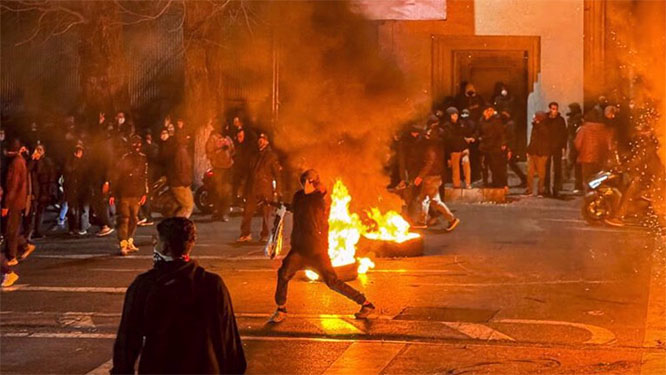
Iranian security and intelligence forces have captured more than 470 individuals in three provinces, identified as key figures behind the recent wave of violent unrest and terrorist activities linked to foreign-backed networks.

The Intelligence Ministry's provincial office in Khorasan Razavi announced on Monday the arrest of 192 armed terrorists, identified as the main agents behind recent riots in the region. 

According to an official statement, the detainees were involved in the killing of several security personnel and civilians, setting fire to mosques, public service facilities, and buses, as well as attacks on military and law enforcement centers.

The seized items from the group include several bulletproof vests, Kalashnikov rifles, hunting weapons, Winchester rifles, and various cold weapons such as daggers, swords, brass knuckles, tactical knives, crossbows, and chains.

Evidence indicates that some of the individuals were tied to hostile movements and terrorist organizations, with links overseas. Others were identified as members of violent criminal gangs, actively taking part in the unrest alongside their associates.

Simultaneously, in the western province of Lorestan, the IRGC announced the arrest of 134 individuals as the main leaders and influential field agents of a US-Israeli terrorist network.

The IRGC statement stated that these individuals formed terrorist cells during the recent unrest, committing "Daesh-like" acts.

They wounded security forces with firearms and cold weapons, and burned and destroyed public and private properties, including mosques, shops, banks, and private and public vehicles.

In the northwestern province of Zanjan, the police reported detaining 150 people identified as principal leaders and agents behind recent riots.

Authorities noted that these individuals were responsible for destroying public and private property and intentionally setting fire to vehicles in the province's squares.

Their crimes include shedding the blood of innocent people, destroying public and private property, attempting to enter military sites, disrupting public order, and spreading terror among citizens.

A variety of cold weapons were reportedly seized from the detainees.

What began late last month as peaceful protests over economic hardship across Iran turned violent after public statements by US and Israeli regime figures encouraged vandalism and disorder.

During the unrest, foreign-backed mercenaries rampaged through cities, killing security forces and civilians and damaging public property.

Comments

Add new comment

  • Coastaldigest.com reserves the right to delete or block any comments.
  • Coastaldigset.com is not responsible for its readers’ comments.
  • Comments that are abusive, incendiary or irrelevant are strictly prohibited.
  • Please use a genuine email ID and provide your name to avoid reject.
News Network
January 23,2026

oscar.jpg

The Voice of Hind Rajab, inspired by the tragic final moments of a young Palestinian girl killed by Israeli fire in Gaza, has been nominated for an Academy Award in the Best International Feature Film category.

Directed by Tunisian filmmaker Kaouther Ben Hania, the film recounts the true story of five-year-old Hind Rajab, who lost her life in January 2024 while fleeing Israeli bombardment with her family.

The film features the real audio of Hind’s desperate call to the Palestinian Red Crescent Society, where she pleaded for help moments before the vehicle she was in was struck by 355 bullets.

The haunting narrative begins with a brief call made from the besieged Tel al-Hawa neighborhood of Gaza, where gunfire and armored vehicles drowned out every sound.

After witnessing the brutal killing of her family, she made a trembling call, her voice reduced to a whisper as she spoke of the massacre and her unbearable loneliness as the sole survivor.

Premiering at the Venice International Film Festival in September 2025, The Voice of Hind Rajab garnered widespread acclaim, receiving a record-setting 23-minute standing ovation and the Silver Lion Grand Jury Prize, the festival’s second-highest honor.

In her acceptance speech, Ben Hania dedicated the film to humanitarian workers and first responders in Gaza, emphasizing that Hind's voice symbolizes countless civilians affected by war.

She aims to give voice to victims often reduced to mere statistics, highlighting the broader suffering of civilians in war zones.

The film’s Oscar nomination underscores its powerful storytelling and ethical approach to depicting real-life tragedy, making it a crucial piece of contemporary cinema.

It serves not only as a narration of individual tragedy but also as an artistic and documentary response to the silence and censorship that often overshadow West Asian struggles and wars.

Using an innovative method she calls docufiction, Ben Hania bridges unvarnished reality and narrative structure, creating a work that is both artistically valuable and socially impactful.

Born in 1977 in Sidi Bouzid—later the epicenter of the Arab revolution—her background profoundly influenced her worldview and artistic approach.

She is a graduate of the Higher School of Audiovisual Arts of Tunis, Pantheon-Sorbonne University, and La Fémis in Paris, where her studies equipped her with the technical and theoretical tools needed to address complex subjects. 

Comments

Add new comment

  • Coastaldigest.com reserves the right to delete or block any comments.
  • Coastaldigset.com is not responsible for its readers’ comments.
  • Comments that are abusive, incendiary or irrelevant are strictly prohibited.
  • Please use a genuine email ID and provide your name to avoid reject.
News Network
January 23,2026

modIKERALA.jpg

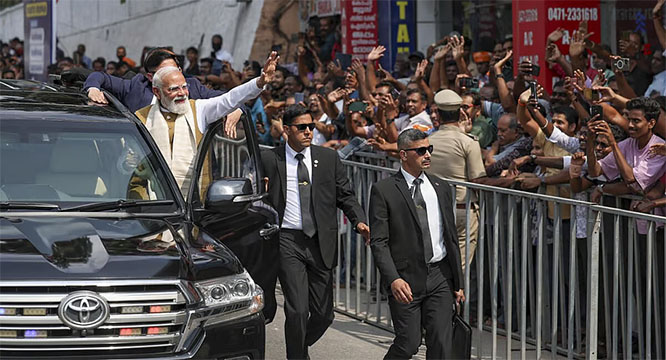
Prime Minister Narendra Modi, during his visit to Thiruvananthapuram on Friday, January 23, indicated that the Bharatiya Janata Party (BJP) is aiming to expand its political footprint in Kerala ahead of the Assembly elections scheduled in the coming months.

Speaking at a BJP-organised public meeting, Modi drew parallels between the party’s early electoral gains in Gujarat and its recent victory in the Thiruvananthapuram Municipal Corporation. The civic body win, which ended decades of Left control, was cited by the Prime Minister as a possible starting point for the party’s broader ambitions in the state.

Recalling BJP’s political trajectory in Gujarat, Modi said the party was largely insignificant before 1987 and received little media attention. He pointed out that the BJP’s first major breakthrough came with its victory in the Ahmedabad Municipal Corporation that year.

“Just as our journey in Gujarat began with one city, Kerala’s journey has also started with a single city,” Modi said, suggesting that the party’s municipal-level success could translate into wider electoral acceptance.

The Prime Minister alleged that successive governments led by the Left Democratic Front (LDF) and the United Democratic Front (UDF) had failed to adequately develop Thiruvananthapuram. He accused both fronts of corruption and neglect, claiming that basic infrastructure and facilities were denied to the capital city for decades.

According to Modi, the BJP’s control of the civic body represents a shift driven by public dissatisfaction with the existing political alternatives. He asserted that the BJP administration in Thiruvananthapuram had begun working towards development, though no specific details or timelines were outlined.

Addressing the gathering at Putharikandam Maidan, Modi said the BJP intended to project Thiruvananthapuram as a “model city,” reiterating his party’s commitment to governance-led change.

The Prime Minister’s visit to Kerala also included the inauguration of several development projects and the flagging off of new train services, as the BJP intensifies its political outreach in the poll-bound state.

Comments

Add new comment

  • Coastaldigest.com reserves the right to delete or block any comments.
  • Coastaldigset.com is not responsible for its readers’ comments.
  • Comments that are abusive, incendiary or irrelevant are strictly prohibited.
  • Please use a genuine email ID and provide your name to avoid reject.