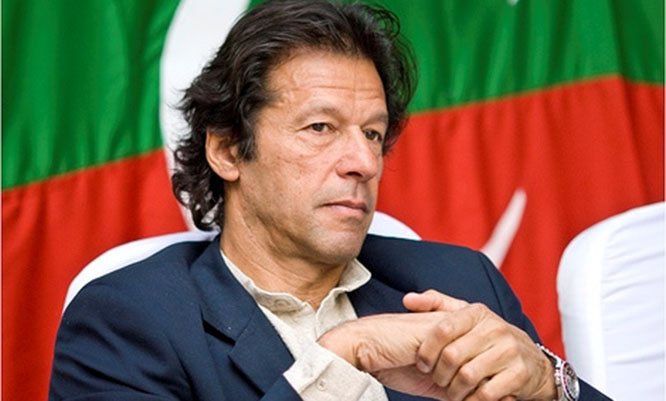
Peace with Pak will give India direct access to Central Asia: Imran Khan

Agencies
March 17, 2021

Pakistan Prime Minister Imran Khan on Wednesday said India will be benefitted economically by having peace with his country as it will be able to directly access resource-rich Central Asia through it.

Delivering the inaugural address at the launch of the two-day Islamabad Security Dialogue, Khan also said that his government after coming to power in 2018 did everything for better ties with India and it was for India to reciprocate.

“India will have to take the first step. Unless they do so, we cannot do much,” he said.

India last month said that it desires normal neighbourly relations with Pakistan in an environment free of terror, hostility and violence. India has said the onus is on Pakistan to create an environment free of terror and hostility.

India has also told Pakistan that "talks and terror" cannot go together and has asked Islamabad to take demonstrable steps against terror groups responsible for launching various attacks on India.

The prime minister discussed Pakistan's vision of comprehensive national security, built on the pillars of traditional and non-traditional security, including his vision for economic prosperity and human welfare.

Khan dwelt at length on the issue of peace in the region, including peace between Pakistan and India, saying "the unresolved Kashmir issue was the biggest hurdle between the two countries."

“If India gives the Kashmiris their right under the UN (resolutions), it will be greatly beneficial for Pakistan as well as for India,” he said and added, “India can access Central Asia after peace.”

Khan said that having a direct route to the Central Asian region will economically benefit India.

Central Asia, in the modern context, generally includes five resource-rich countries -- Kazakhstan, Kyrgyz Republic, Tajikistan, Turkmenistan and Uzbekistan.

Pakistan has been unsuccessfully trying to drum up international support against India for withdrawing Jammu and Kashmir's special status and bifurcating it into two Union territories in August, 2019.

India has categorically told the international community that the scrapping of Article 370 of the Constitution was its internal matter. The Ministry of External Affairs has also underlined that the Union Territory of Jammu and Kashmir is an integral and inalienable part of India.

India and Pakistan had announced on February 25 that they have agreed to strictly observe all agreements on ceasefire along the Line of Control (LoC) in Jammu and Kashmir and other sectors.

Ties between India and Pakistan nosedived after a terror attack on the Pathankot Air Force base in 2016 by terror groups based in the neighbouring country.

Subsequent attacks, including one on Indian Army camp in Uri, further deteriorated the relationship.

The relationship dipped further after India's war planes pounded a Jaish-e-Mohammed terrorist training camp deep inside Pakistan on February 26, 2019 in response to the Pulwama terror attack in which 40 CRPF jawans were killed.

The relations deteriorated after India announced withdrawing special powers of Jammu and Kashmir and bifurcation of the state into two union territories.

Talking about non-traditional threats to Pakistan, Khan said that climate change, food security and a weak economy were among the biggest challenges in the quest to realise the full concept of security.

Khan said his initiative of “Ten billion tree tsunami” was being hailed by the world, while his government was also working to achieve food security.

He acknowledged that improving the national economy was the biggest challenge but his government was trying to reduce trade deficit and control inflation so that the financial condition of common people could improve.

“We cannot become a secure nation when a small rich minority is surrounded by the sea of poor people…National security is achieved when a nation stands up to secure itself,” he said at the dialogue organised by the National Security Division and think-tanks comprising the Advisory Board of National Security Committee.

Khan also praised all-weather ally China for its "successful" handling of poverty and lifting more than 700 million people out of poverty in the last three decades. “It is their big achievement whether you like China or not,” he said.

Khan said that Pakistan’s 25 per cent population was suffering from extreme poverty and another 25 per cent was just slightly better.

He said the government already launched Ehsaas programme to give cash to the poor people and another programme of giving targeted subsidies to the poor was being launched.

Khan also talked about peace in Afghanistan and reiterated support for the ongoing peace process by saying that Pakistan would be the greatest beneficiary of a stable Afghanistan.

The Islamabad Security Dialogue is envisioned as an annual flagship security forum based on the model of major dialogues on security and international policy.

The National Security Division, in collaboration with leading think-tanks that are part of its advisory board, has taken this initiative to provide a platform for critical thinking and robust intellectual discourse on some of the most pressing challenges and opportunities being faced by Pakistan and the wider region, according to an official statement.

The two-day event is being attended virtually by international thinkers and scholars, members from the Federal Cabinet, diplomatic corps, former government officials, academia, think-tanks and civil society members. 

Comments

Add new comment

  • Coastaldigest.com reserves the right to delete or block any comments.
  • Coastaldigset.com is not responsible for its readers’ comments.
  • Comments that are abusive, incendiary or irrelevant are strictly prohibited.
  • Please use a genuine email ID and provide your name to avoid reject.
News Network
November 21,2025

malpe.jpg

Udupi: The Malpe Police have arrested two men from Uttar Pradesh for allegedly sharing classified information related to Indian Navy vessels with individuals in Pakistan, posing a serious threat to national security.

According to a complaint filed by the CEO of Udupi Cochin Shipyard, Malpe—an institution under the Union Ministry of Ports, Shipping and Waterways—the prime accused, Rohit (29), was working as an insulator through subcontractor M/S Shushma Marine Pvt Ltd. He had earlier served at Cochin Shipyard Limited in Kochi, Kerala, where naval ships are under construction.

Udupi SP Hariram Shankar said the accused had unlawfully shared, via WhatsApp, confidential identification numbers of Navy-related ships and other classified details while working in Kerala, allegedly for illegal gains.

After joining the Malpe shipyard unit, Rohit reportedly continued collecting sensitive information through a friend in Kochi and circulated it to unauthorised individuals, violating national security protocols and potentially endangering India’s sovereignty, unity, and integrity.

Based on the complaint, Malpe Police registered a case under Section 152 of the Bharatiya Nyaya Sanhita (BNS) and Sections 3 and 5 of the Official Secrets Act, 1923.

A police team led by Karkala Subdivision Assistant Superintendent of Police Harsha Priyamvada—along with PSI Anil Kumar D, ASI Harish, and PC Ravi Jadhav—conducted the investigation and arrested the two accused, identified as Rohit (29) and Santri (37), both residents of Sultanpur district, Uttar Pradesh.

The duo was produced before the court, which remanded them in judicial custody till December 3. Further investigation is in progress.

Comments

Add new comment

  • Coastaldigest.com reserves the right to delete or block any comments.
  • Coastaldigset.com is not responsible for its readers’ comments.
  • Comments that are abusive, incendiary or irrelevant are strictly prohibited.
  • Please use a genuine email ID and provide your name to avoid reject.
News Network
November 27,2025

imrankhan.jpg

Authorities at Pakistan’s high-security Adiala Jail in Rawalpindi on Wednesday dismissed speculation about the condition of imprisoned former Pakistan Prime Minister Imran Khan, rejecting rumours that he had been moved out of the facility or was in danger. Officials said Khan was in “good health” and described the viral death claims as “baseless.”

“There is no truth to reports about his transfer from Adiala Jail,” the Rawalpindi prison administration said in a statement, according to Geo News. “He is fully healthy and receiving complete medical attention.”

Amid swirling rumours on social media, Imran Khan’s party, Pakistan Tehreek-e-Insaf (PTI), urged the federal government to issue an official clarification and demanded that authorities allow his family to meet him immediately, Dawn reported.

The frenzy began after Khan’s three sisters called for an impartial probe into what they described as a “brutal” police assault on them and other PTI supporters outside Adiala Jail last week. Soon after, several social media handles circulated unverified claims alleging that Khan had been “killed” inside the prison.

The rumours intensified when a handle named “Afghanistan Times” claimed that “credible sources” had confirmed Khan’s “murder” and that his body had been moved out of the jail — allegations that have not been verified by any credible agency.

Imran Khan, PTI’s patron-in-chief, has been lodged in the Rawalpindi prison since August 2023 in multiple cases. For over a month, an undeclared restriction has prevented family members and senior PTI leaders from meeting him. Khyber-Pakhtunkhwa Chief Minister Sohail Afridi has reportedly been denied access despite making seven attempts.

In a letter to Punjab Police Chief Usman Anwar, Khan’s sisters — Noreen Niazi, Aleema Khan, and Dr. Uzma Khan — said they were “peacefully protesting” outside the jail when police allegedly launched an unprovoked assault after streetlights were switched off.

“At 71, I was seized by my hair, thrown to the ground and dragged across the road,” Noreen Niazi said, alleging that other women present were also slapped and manhandled.

Adiala Jail officials reiterated that speculation over Imran Khan’s health was unfounded and insisted that his well-being was being ensured, Geo News reported.

Comments

Add new comment

  • Coastaldigest.com reserves the right to delete or block any comments.
  • Coastaldigset.com is not responsible for its readers’ comments.
  • Comments that are abusive, incendiary or irrelevant are strictly prohibited.
  • Please use a genuine email ID and provide your name to avoid reject.
News Network
November 21,2025

Bengaluru, Nov 21: The Karnataka government is facing pressure to overhaul its employment system after a high-level Cabinet sub-committee recommended the complete phase-out of job outsourcing in government offices, boards, and corporations by March 2028. The move is aimed at tackling a systemic issue that has led to the potential violation of constitutional reservation policies and the exploitation of workers.

The Call for Systemic Change

With over three lakh vacant posts currently being filled through private agencies on an outsource, insource, or daily wage basis, the sub-committee highlighted a significant lapse. "As a result, reservations are not being followed as per the Constitution and state laws. It’s an urgent need to take serious steps to change the system. It has been recommended to completely stop the system of outsourcing by March 2028," the panel stated in a document.

The practice of outsourcing involves private companies hiring workers to perform duties for a government agency. Critics argue this model results in lesser salaries, a lack of social security benefits (otherwise available to permanent government employees), and a failure to adhere to the provisions of Articles 14 and 15 of the Constitution, which guarantee equality before the law and prohibit discrimination.

The 'Bidar Model' as a Stop-Gap Solution

To regulate the current mode of employment and reduce worker exploitation until the 2028 deadline, the government plans to establish workers’ services multi-purpose cooperative societies across all districts, following the successful "Bidar Model."

The Bidar District Services of Labour Multi-purpose Cooperative Society Ltd., which operates under the District Commissioner, is cited as a successful example of providing a measure of social security to outsourced staff. Labour Department officials argue this society ensures workers receive their due wages and statutory facilities like ESI (Employees' State Insurance) and PF (Provident Fund), in exchange for a 1% service fee collected from the employees.

legislative push and Priority Insourcing

The recommendations, led by the sub-committee headed by Law and Parliamentary Affairs Minister H K Patil, are set to be discussed at the next Cabinet meeting. The committee has proposed the introduction of the Karnataka Outsourced Employees (Regulation, Placement and Welfare) Bill 2025.

In a move addressing immediate concerns, Labour Minister Santosh Lad, a member of the sub-committee, has reportedly assured that steps will be taken over the next 2-3 years to insource workers in "life-threatening services" on a priority basis. This includes essential personnel like pourakarmikas (sanitation workers), drivers, electrical staff in the Energy Department, and Health Department staff handling contagious diseases. The transition aims to grant these workers the long-term security and benefits they currently lack under the outsourcing system. 

Comments

Add new comment

  • Coastaldigest.com reserves the right to delete or block any comments.
  • Coastaldigset.com is not responsible for its readers’ comments.
  • Comments that are abusive, incendiary or irrelevant are strictly prohibited.
  • Please use a genuine email ID and provide your name to avoid reject.