



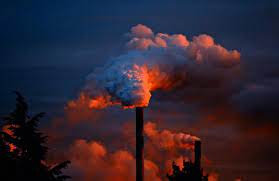
Pollution kills 9 million people a year globally

News Network
May 18, 2022

global.jpg

A new study blames pollution of all types for 9 million deaths a year globally, with the death toll attributed to dirty air from cars, trucks, and industry rising 55 per cent since 2000.

That increase is offset by fewer pollution deaths from primitive indoor stoves and water contaminated with human and animal waste, so overall pollution deaths in 2019 are about the same as in 2015.

The United States is the only fully industrialised country in the top 10 nations for total pollution deaths, ranking 7th with 142,883 deaths blamed on pollution in 2019, sandwiched between Bangladesh and Ethiopia, according to a new study in the journal The Lancet Planetary Health.

Tuesday's pre-pandemic study is based on calculations derived from the Global Burden of Disease database and the Institute for Health Metrics and Evaluation in Seattle.

India and China lead the world in pollution deaths with nearly 2.4 million and almost 2.2 million deaths a year, but the two nations also have the world's largest populations.

When deaths are put on a per population rate, the United States ranks 31st from the bottom at 43.6 pollution deaths per 100,000. Chad and the Central African Republic ranked the highest with rates of about 300 pollution deaths per 100,000, more than half of them due to tainted water, while Brunei, Qatar, and Iceland have the lowest pollution death rates ranging from 15 to 23. The global average is 117 pollution deaths per 100,000 people.

Pollution kills about the same number of people a year around the world as cigarette smoking and second-hand smoke combined, the study said.

“9 million deaths is a lot of deaths,” said Philip Landrigan, director of the Global Public Health Program and Global Pollution Observatory at Boston College.

“The bad news is that it's not decreasing,” Landrigan said. “We're making gains in the easy stuff and we're seeing the more difficult stuff, which is the ambient (outdoor industrial) air pollution and the chemical pollution, still going up.”

It doesn't have to be this way, researchers said.

“They are preventable deaths. Each and every one of them is a death that is unnecessary,” said Dr Lynn Goldman, dean of the George Washington University School of Public Health, who wasn't part of the study. She said the calculations made sense and if anything was so conservative about what it attributed to pollution, that the real death toll is likely higher.

The certificates for these deaths don't say pollution. They list heart disease, stroke, lung cancer, other lung issues and diabetes that are “tightly correlated” with pollution by numerous epidemiological studies, Landrigan said.

To then put these together with actual deaths, researchers look at the number of deaths by cause, exposure to pollution weighted for various factors, and then complicated exposure response calculations derived by large epidemiological studies based on thousands of people over decades of study, he said. It's the same way scientists can say cigarettes cause cancer and heart disease deaths.

“That canon of information constitutes causality,” Landrigan said. “That's how we do it.”

Five outside experts in public health and air pollution, including Goldman, told The Associated Press the study follows mainstream scientific thought
.
Dr Renee Salas, an emergency room doctor and Harvard professor who wasn't part of the study, said “the American Heart Association determined over a decade ago that exposure to (tiny pollution particles) like that generated from the burning of fossil fuels is causal for heart disease and death.”

“While people focus on decreasing their blood pressure and cholesterol, few recognise that the removal of air pollution is an important prescription to improve their heart health,” Salas said.

Three-quarters of the overall pollution deaths came from air pollution and the overwhelming part of that is “a combination of pollution from stationary sources like coal-fired power plants and steel mills on one hand and mobile sources like cars, trucks, and buses. And it's just a big global problem,” said Landrigan, a public health physician. “And it's getting worse around the world as countries develop and cities grow.”

In New Delhi, India, air pollution peaks in the winter months and last year the city saw just two days when the air wasn't considered polluted. It was the first time in four years that the city experienced a clean air day during the winter months.

That air pollution remains the leading cause of death in South Asia reconfirms what is already known, but the increase in these deaths means that toxic emissions from vehicles and energy generation is increasing, said Anumita Roychowdhury, a director at the advocacy group Centre for Science and Environment in New Delhi.

“This data is a reminder of what is going wrong but also that it is an opportunity to fix it,” Roychowdhury said.

Pollution deaths are soaring in the poorest areas, experts said.

“This problem is worst in areas of the world where population is most dense (e.g. Asia) and where financial and government resources to address the pollution problem are limited and stretched thin to address a host of challenges including health care availability and diet as well as pollution,” said Dan Greenbaum, president of the Health Effects Institute, who wasn't part of the study.


Comments

Add new comment

  • Coastaldigest.com reserves the right to delete or block any comments.
  • Coastaldigset.com is not responsible for its readers’ comments.
  • Comments that are abusive, incendiary or irrelevant are strictly prohibited.
  • Please use a genuine email ID and provide your name to avoid reject.
News Network
January 19,2026

New Delhi: Setting speculation to the rest, the CPI(M) has made it clear that it is open to have an electoral understanding with the Congress “to defeat” the Trinamool Congress and the BJP in West Bengal Assembly election even as it is all set to take on the grand old party in Kerala accusing it of “found wanting” in fighting the Hindutva forces.

The CPI(M) also said that it will contest the Tamil Nadu election “with DMK and its allies to defeat the BJP and its allies”, amid a section in the Congress triggering confusion about its participation in the M K Stalin-led coalition over demand over power-sharing and more seats. It is also willing to join hands with Congress and others in Assam and Puducherry to defeat the BJP.

The decisions came at a three-day meeting of the CPI(M) Central Committee in Thiruvananthapuram, which ended on Sunday after reviewing the poll preparations in the poll-bound states.

The CPI(M)'s decision came even as a section led by West Bengal Congress president Subhankar Sarkar is averse to tying up with the Left Front, claiming that their party is not benefitted by the electoral understanding. Both Congress and CPI(M)-led Left Front had electoral understanding in 2016 and 2021 Assembly elections and 2024 Lok Sabha polls.

Congress and the Left Front fought together for the first time in 2016 when Congress won 44 seats and the CPI(M) got 26. In 2021, the Left Front and the Congress drew a blank. In the 2024 Lok Sabha polls, Congress managed to win one seat while the Left did not win any. In the 2019 Lok Sabha polls, both fought against each other with Congress winning two and the Left none.

“In Bengal, the party will work for the defeat of both the TMC and the BJP, which are trying to polarise the society. We will try to rally all the forces that are ready to work against them,” the CPI(M) said in a statement without naming Congress by name. Senior leaders said there is no change in its strategy of pooling all non-BJP, non-TMC votes.

However, the party was critical of the Congress in Kerala where both will fight against each other.

The CPI(M) said it would "expose the BJP-led Union government’s denial of rightful dues to Kerala, the fiscal constraints imposed and the overall attack on federalism" as also "expose the failure of the Congress to effectively counter this attack on federalism, as the largest opposition party in the Parliament".

"The Congress, especially in Kerala, was found wanting in the fight against communal RSS-BJP, ideologically and this will also be exposed before the people," it added.

In Assam, it said, the CPI(M) will work for the mobilisation of all the anti-BJP parties and forces and defeat the rabidly communal and divisive BJP government. The Left parties are cooperating with Congress in the north-eastern state. In Puducherry, it said it will work for the defeat of the BJP alliance government.

Comments

Add new comment

  • Coastaldigest.com reserves the right to delete or block any comments.
  • Coastaldigset.com is not responsible for its readers’ comments.
  • Comments that are abusive, incendiary or irrelevant are strictly prohibited.
  • Please use a genuine email ID and provide your name to avoid reject.
News Network
February 1,2026

Bengaluru, Feb 1: For travelers landing at Kempegowda International Airport (KIA), the sleek, wood-paneled curves of Terminal 2 promise a world-class welcome. But the famed “Garden City” charm quickly withers at the curb. As India’s aviation sector swells to record numbers—handling over 43 million passengers in Bengaluru alone this past year—the “last mile” has turned into a marathon of frustration.

The Bengaluru Logjam: Rules vs Reality

While the city awaits the 2027 completion of the Namma Metro Blue Line, the interim has been chaotic. Recent “decongestion” rules at Terminal 1 have pushed app-based cab pickups to distant parking zones, forcing weary passengers into a 20-minute walk with luggage.

“I landed after ten months away and felt like a stranger in my own city,” says Ruchitha Jain, a Koramangala resident. “My driver couldn’t find me, staff couldn’t guide me, and the so-called ‘Premium’ lane is just a fancy tax on convenience.”

•    The Cost of Distance: A 40-km cab ride can now easily cross ₹1,500, driven by demand pricing and airport surcharges.

•    The Bus Gap: While Vayu Vajra remains a lifeline, its ₹300–₹400 fare is often cited as the most expensive airport bus service in the country.

A National Pattern of Disconnect

The struggle is not unique to Karnataka. From Chennai’s coast to Hyderabad’s plateau, India’s airports tell a familiar story: brilliant runways, broken exits.

City:    Primary Issue   |    Recent Development

Bengaluru:    Cab pickup restrictions & distance  |    App-based taxis shifted to far parking zones; long walks and fare spikes reported

Chennai:    Multi-Level Parking (MLCP) hike  |    Passengers report 40-minute walks to reach cab pickup points

Hyderabad:    “Taxi mafia” & touting  |    Over 440 touting cases reported; security presence intensified

Mumbai:    Fare scams  |     Tourists charged ₹18,000 for just 400 metres, triggering police action

In Hyderabad, travelers continue to battle entrenched local groups that intimidate Uber and Ola drivers, pushing passengers toward overpriced private taxis. Chennai flyers, meanwhile, complain that reaching the designated pickup zones now takes longer than short-haul flights from cities like Coimbatore.

The ‘Budget Day’ Hope

As Finance Minister Nirmala Sitharaman presents the Union Budget 2026 today, the aviation sector is watching closely. With the government’s renewed emphasis on multimodal integration, there is cautious hope for funding toward seamless airport-metro-bus hubs.

The vision is clear: a future where planes, trains, and metros speak the same language. Until then, passengers at KIA—and airports across India—will continue to discover that the hardest part of flying isn’t the thousands of kilometres in the air, but the last few on the ground.

Comments

Add new comment

  • Coastaldigest.com reserves the right to delete or block any comments.
  • Coastaldigset.com is not responsible for its readers’ comments.
  • Comments that are abusive, incendiary or irrelevant are strictly prohibited.
  • Please use a genuine email ID and provide your name to avoid reject.
News Network
January 20,2026

iran.jpg

Iranian security and intelligence forces have captured more than 470 individuals in three provinces, identified as key figures behind the recent wave of violent unrest and terrorist activities linked to foreign-backed networks.

The Intelligence Ministry's provincial office in Khorasan Razavi announced on Monday the arrest of 192 armed terrorists, identified as the main agents behind recent riots in the region. 

According to an official statement, the detainees were involved in the killing of several security personnel and civilians, setting fire to mosques, public service facilities, and buses, as well as attacks on military and law enforcement centers.

The seized items from the group include several bulletproof vests, Kalashnikov rifles, hunting weapons, Winchester rifles, and various cold weapons such as daggers, swords, brass knuckles, tactical knives, crossbows, and chains.

Evidence indicates that some of the individuals were tied to hostile movements and terrorist organizations, with links overseas. Others were identified as members of violent criminal gangs, actively taking part in the unrest alongside their associates.

Simultaneously, in the western province of Lorestan, the IRGC announced the arrest of 134 individuals as the main leaders and influential field agents of a US-Israeli terrorist network.

The IRGC statement stated that these individuals formed terrorist cells during the recent unrest, committing "Daesh-like" acts.

They wounded security forces with firearms and cold weapons, and burned and destroyed public and private properties, including mosques, shops, banks, and private and public vehicles.

In the northwestern province of Zanjan, the police reported detaining 150 people identified as principal leaders and agents behind recent riots.

Authorities noted that these individuals were responsible for destroying public and private property and intentionally setting fire to vehicles in the province's squares.

Their crimes include shedding the blood of innocent people, destroying public and private property, attempting to enter military sites, disrupting public order, and spreading terror among citizens.

A variety of cold weapons were reportedly seized from the detainees.

What began late last month as peaceful protests over economic hardship across Iran turned violent after public statements by US and Israeli regime figures encouraged vandalism and disorder.

During the unrest, foreign-backed mercenaries rampaged through cities, killing security forces and civilians and damaging public property.

Comments

Add new comment

  • Coastaldigest.com reserves the right to delete or block any comments.
  • Coastaldigset.com is not responsible for its readers’ comments.
  • Comments that are abusive, incendiary or irrelevant are strictly prohibited.
  • Please use a genuine email ID and provide your name to avoid reject.