Queen Elizabeth II laid to rest as 11 days of mourning comes to an end with elaborate final farewell

News Network
September 19, 2022

queen.jpg

London Sept 19: Britain said farewell to Queen Elizabeth II on Monday at a state funeral attended by world leaders, before a historic last ceremonial journey through the streets of London packed with sorrowful mourners.

The funeral brought to an end 11 days of national mourning across the United Kingdom that has seen the personal sorrow of the royal family play out in the glare of intense international attention.

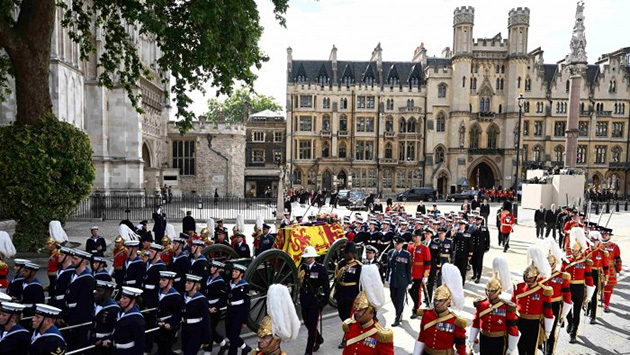
Huge crowds gathered in near silence to watch as the queen's flag-draped coffin, topped with the Imperial State Crown, her orb and sceptre, was carried slowly to a gun carriage from parliament's Westminster Hall where it had lain in state since Wednesday.

To the tune of pipes and drums, the gun carriage -- used at every state funeral since Queen Victoria's in 1901 -- was then drawn by 142 junior enlisted sailors in the Royal Navy to Westminster Abbey.

The thousand-year-old church's tenor bell tolled 96 times at one-minute intervals -- one for every year of her life -- stopping a minute before the service began at 11:00 am (1000 GMT).

In his funeral sermon, Archbishop of Canterbury Justin Welby praised the queen's life of duty and service to the UK and Commonwealth.

"People of loving service are rare in any walk of life. Leaders of loving service are still rarer," he told the 2,000 guests, who included US President Joe Biden and Japan's reclusive Emperor Naruhito.

"But in all cases, those who serve will be loved and remembered," the Anglican leader added, before the coffin was borne on another procession towards her final resting place in Windsor Castle, west of London.

The longest-serving monarch in British history died at Balmoral, her Scottish Highland retreat, on September 8 after a year of declining health.

Her eldest son and successor, King Charles III, dressed in ceremonial military uniform, followed the solemn processions, alongside his three siblings.

Charles's eldest son Prince William accompanied them alongside William's estranged brother, Prince Harry, and other senior royals.

William's two eldest children, George and Charlotte, who are next in line to the throne, also walked behind the coffin inside the abbey.

Late Sunday, Charles, 73, and his wife, Queen Consort Camilla, said they had been "deeply touched" by the public's flood of messages.

"As we all prepare to say our last farewell, I wanted simply to take this opportunity to say thank you," he said.

Britain, a country much changed since the queen's coronation in the same abbey in 1953, has dug deep into its centuries of tradition to honour the only monarch that most of its people have ever known.

"It's once in a lifetime," said student Naomi Thompson, 22, camped out in the crowds at London's Hyde Park.

"It's a moment of history... She's everyone's granny," added engineer Alice Garret, 28.

Others unable to be in London gathered in cinemas and churches around England, Scotland, Wales and Northern Ireland to watch the service and procession on big screens.

Auto engineer Jamie Page, a 41-year-old former soldier, stood on Whitehall to observe the funeral procession, wearing his military medals from service in the Iraq war.

"Sixteen years old, I swore an oath of allegiance to the queen. She's been my boss. She means everything, she was like a gift from God," he said.

But on Charles, the oldest person yet to ascend the British throne, Page added: "Who knows, time will tell."

The funeral lasted just under an hour, brought to an end by a bugler playing "The Last Post", before two minutes of silence and the reworded national anthem, "God Save the King".

After an hour-long procession that was to go past Buckingham Palace, the coffin was to be taken west by road to Windsor Castle, where thousands had lined the route since early morning.

Some 6,000 military personnel have been drafted in to take part in proceedings in what Britain's highest-ranking military officer has called "our last duty for Her Majesty the Queen".

The queen will be buried alongside her father king George VI, her mother queen Elizabeth and sister princess Margaret, reuniting in death the family who once called themselves "us four".

The coffin of her husband, Prince Philip, who died last year aged 99, will also be transferred to lie alongside her.

Elizabeth's funeral could not be more different from Philip's at St George's Chapel, Windsor, in April 2021.

Coronavirus restrictions limited mourners to just 30, led by the queen, a solitary figure in mourning black and a matching facemask.

The contrast was profound on Monday, the abbey packed with dignitaries and some ordinary Britons who were honoured for their military or community service, especially during the Covid pandemic.

"You were fortunate to have had her for 70 years; we all were," Biden said on Sunday after signing a book of condolence. "The world is better for her."

In the abbey pews was Liz Truss, whom the queen appointed as the 15th British prime minister of her reign just two days before her death, in her last major ceremonial duty.

All of Truss's living predecessors were there plus her counterparts and representatives from the 14 Commonwealth countries outside Britain where Charles is also head of state.

Whether they remain constitutional monarchies or become republics is likely to be the defining feature of Charles's reign.

The queen's death has prompted deep reflection about the Britain she reigned over, the legacy of its past, its present state and what the future might hold, as well as the values of lifelong service and duty she came to represent during her 70-year reign.

Hundreds of thousands of people are estimated to have queued, sometimes for up to 25 hours and overnight, to file past the queen's coffin as it lay in state.

Chrissy Heerey, a serving member of the Royal Air Force who joined the marathon queue twice, was the last person through the doors and described the experience as "amazing".

"When they came to me and said, 'right, you're the last person', I said, really?!" she told AFP, before heading off to join the crowds for the coffin's procession through London.

Throughout the procession after the funeral, Big Ben, the giant bell atop the Elizabeth Tower at one end of the Houses of Parliament, tolled and military guns fired at one-minute intervals.

At Windsor, the Sebastopol Bell -- captured in Crimea in 1856 -- and the Curfew Tower Bell also sounded.

A vast television audience was expected to watch the funeral worldwide and live online, in a sign of the enduring fascination with the woman once described as "the last global monarch".

Those lining the streets of London -- already jammed at sunrise on Monday -- said they had to bear witness.

"I will talk about this moment to my children," said Jack Davies, 14, camped out for the procession with his parents at Hyde Park Corner, where the coffin will be transferred from the gun carriage for the drive to Windsor.

"I'll say: 'I was there!'"

At Windsor, the queen's crown, orb and sceptre will be removed and placed on the altar.

The most senior officer of the royal household, the lord chamberlain, breaks his "wand of office" and places it on the coffin, symbolising the end of her reign.

The lead-lined oak casket, draped with the queen's colours, will be lowered into the Royal Vault as a lone bagpiper plays a lament.

A private interment ceremony will take place at the adjoining King George VI Memorial Chapel at 1830 GMT.

Comments

Add new comment

  • Coastaldigest.com reserves the right to delete or block any comments.
  • Coastaldigset.com is not responsible for its readers’ comments.
  • Comments that are abusive, incendiary or irrelevant are strictly prohibited.
  • Please use a genuine email ID and provide your name to avoid reject.
News Network
January 23,2026

Mangaluru: The Karnataka Government Polytechnic (KPT), Mangaluru, has achieved autonomous status from the All India Council for Technical Education (AICTE), becoming the first government polytechnic in the country to receive such recognition in its 78-year history. The status was granted by AICTE, New Delhi, and subsequently approved by the Karnataka Board of Technical Education in October last year.

Officials said the autonomy was conferred a few months ago. Until recently, AICTE extended autonomous status only to engineering colleges, excluding diploma institutions. However, with a renewed national focus on skill development, several government polytechnics across India have now been granted autonomy.

KPT, the second-largest polytechnic in Karnataka, was established in 1946 with four branches and has since expanded to offer eight diploma programmes, including computer science and polymer technology. The institution is spread across a 19-acre campus.

Ravindra M Keni, the first dean of the institution, told The Times of India that AICTE had proposed autonomous status for polytechnic institutions that are over 25 years old. “Many colleges applied. In the first round, 100 institutions were shortlisted, which was further narrowed down to 15 in the second round. We have already completed one semester after becoming an autonomous institution,” he said. He added that nearly 500 students are admitted annually across eight three-year diploma courses.

Explaining the factors that helped KPT secure autonomy, Keni said the institution has consistently recorded 100 per cent admissions and placements for its graduates. He also noted its strong performance in sports, with the college emerging champions for 12 consecutive years, along with active student participation in NCC and NSS activities.

Autonomous status allows KPT to design industry-oriented curricula, conduct examinations, prepare question papers, and manage academic documentation independently. The institution can also directly collaborate with industries and receive priority funding from AICTE or the Ministry of Education. While academic autonomy has been granted, financial control will continue to rest with the state government.

“There will be separate committees for examinations, question paper setting, boards of studies, and boards of examiners. The institution will now have the freedom to conduct admissions without government notifications and issue its own marks cards,” Keni said, adding that new academic initiatives would be planned after a year of functioning under the autonomous framework.

Comments

Add new comment

  • Coastaldigest.com reserves the right to delete or block any comments.
  • Coastaldigset.com is not responsible for its readers’ comments.
  • Comments that are abusive, incendiary or irrelevant are strictly prohibited.
  • Please use a genuine email ID and provide your name to avoid reject.
News Network
January 23,2026

oscar.jpg

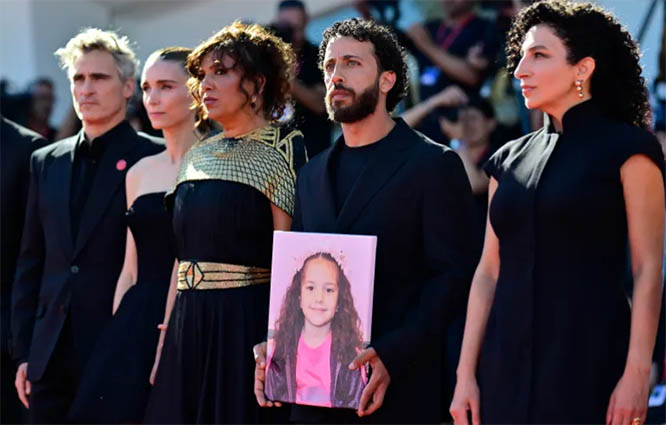
The Voice of Hind Rajab, inspired by the tragic final moments of a young Palestinian girl killed by Israeli fire in Gaza, has been nominated for an Academy Award in the Best International Feature Film category.

Directed by Tunisian filmmaker Kaouther Ben Hania, the film recounts the true story of five-year-old Hind Rajab, who lost her life in January 2024 while fleeing Israeli bombardment with her family.

The film features the real audio of Hind’s desperate call to the Palestinian Red Crescent Society, where she pleaded for help moments before the vehicle she was in was struck by 355 bullets.

The haunting narrative begins with a brief call made from the besieged Tel al-Hawa neighborhood of Gaza, where gunfire and armored vehicles drowned out every sound.

After witnessing the brutal killing of her family, she made a trembling call, her voice reduced to a whisper as she spoke of the massacre and her unbearable loneliness as the sole survivor.

Premiering at the Venice International Film Festival in September 2025, The Voice of Hind Rajab garnered widespread acclaim, receiving a record-setting 23-minute standing ovation and the Silver Lion Grand Jury Prize, the festival’s second-highest honor.

In her acceptance speech, Ben Hania dedicated the film to humanitarian workers and first responders in Gaza, emphasizing that Hind's voice symbolizes countless civilians affected by war.

She aims to give voice to victims often reduced to mere statistics, highlighting the broader suffering of civilians in war zones.

The film’s Oscar nomination underscores its powerful storytelling and ethical approach to depicting real-life tragedy, making it a crucial piece of contemporary cinema.

It serves not only as a narration of individual tragedy but also as an artistic and documentary response to the silence and censorship that often overshadow West Asian struggles and wars.

Using an innovative method she calls docufiction, Ben Hania bridges unvarnished reality and narrative structure, creating a work that is both artistically valuable and socially impactful.

Born in 1977 in Sidi Bouzid—later the epicenter of the Arab revolution—her background profoundly influenced her worldview and artistic approach.

She is a graduate of the Higher School of Audiovisual Arts of Tunis, Pantheon-Sorbonne University, and La Fémis in Paris, where her studies equipped her with the technical and theoretical tools needed to address complex subjects. 

Comments

Add new comment

  • Coastaldigest.com reserves the right to delete or block any comments.
  • Coastaldigset.com is not responsible for its readers’ comments.
  • Comments that are abusive, incendiary or irrelevant are strictly prohibited.
  • Please use a genuine email ID and provide your name to avoid reject.
News Network
January 20,2026

DGP.jpg

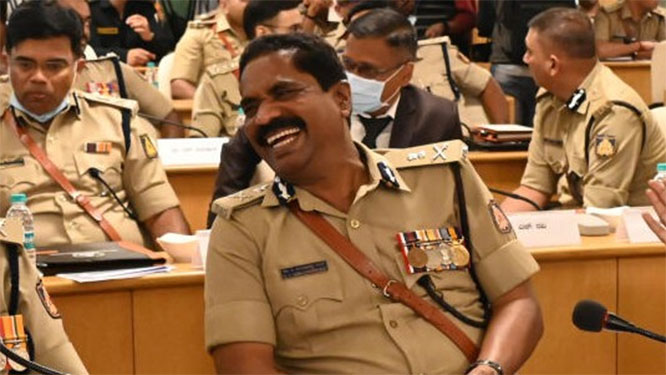
Karnataka DGP (Civil Rights Enforcement) K Ramachandra Rao was suspended with immediate effect, as per a state government order issued on Monday, 19 January. The order cited conduct unbecoming of a government servant and causing embarrassment to the state administration.

The Karnataka government suspended Rao after a purported video showed him in a compromising position with a woman inside his official chamber. The video went viral on social media. Rao rejected the videos outright, terming them "fabricated and false".

Who is K Ramachandra Rao?

Rao is a DGP-rank officer who was heading the Directorate of Civil Rights Enforcement until his suspension. He was promoted to DGP in September 2023 and assumed office in October 2023, the Sunday Guardian reported.

He also served as the Chairman and Managing Director of the Karnataka State Police Housing and Infrastructure Development Corporation Limited.

His stint as the Inspector General of Police (IGP) for the Southern Range was also marred by controversy. In 2014, during a cash seizure near Mysuru’s Yelwal, officials claimed the seized amount was ₹20 lakh, while the accused (Kerala-based merchants) claimed it was around ₹2.27 crore.

Rao, who was present during the seizure, denied all allegations. However, he was transferred soon after.

Allegations of collusion with a businessman surfaced, and a senior police officer was quoted by The Sunday Guardian as saying, “In Rao’s case, the CID has clearly mentioned that there was a great degree of lapse on the part of Rao and a deputy superintendent of police after it was brought to their notice that a few policemen, including a gunman attached to the IGP, were involved in the robbery.”

Rao had denied all wrongdoing in that incident. Despite past controversies, he rose to the state’s top police position, the Sunday Guardian reported.

Ranya Rao’s stepfather

Rao is the stepfather of Kannada actress Harshavardhini Ranya alias Ranya Rao, accused of orchestrating the illegal import of gold worth over ₹12.56 crore from Dubai to India along with two others — businessman Tarun Raju, and jewellery dealer Sahil Jain.

‘Obscene video’ controversy

A viral video showed Rao behaving inappropriately with a woman inside his office while in uniform.

The Karnataka government said in its Monday order that “vide videos and news reports widely broadcast on public news channels and media platforms, it is observed that Dr K Ramachandra Rao has acted in an obscene manner which is unbecoming of a Government Servant and also causing embarrassment to the Government.”

The order said the matter was examined by the state government, which found that the officer's conduct amounted to a violation of Rule 3 of the All India Services (Conduct) Rules, 1968.

The government said it is prima facie satisfied that "it is necessary to place Rao under suspension with immediate effect, pending inquiry".

During the suspension period, Rao will be entitled to subsistence allowance as per Rule 4 of the All India Services (Discipline and Appeal) Rules, 1969.

The order also places restrictions on his movement, stating that during the period of suspension, the officer must not leave headquarters under any circumstances without the written permission of the state government.

Comments

Add new comment

  • Coastaldigest.com reserves the right to delete or block any comments.
  • Coastaldigset.com is not responsible for its readers’ comments.
  • Comments that are abusive, incendiary or irrelevant are strictly prohibited.
  • Please use a genuine email ID and provide your name to avoid reject.