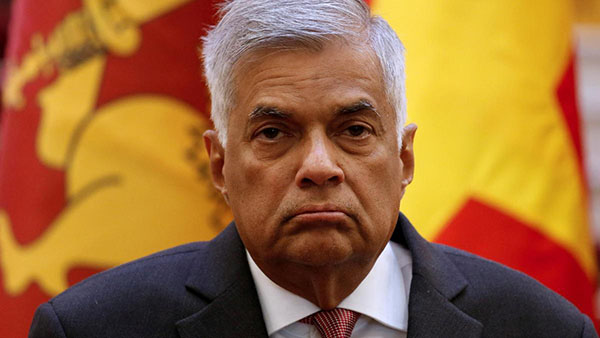
Ranil Wickremesinghe, 73, is back as Sri Lankan PM for 6th time amid economic crisis

News Network
May 12, 2022

Ranil Wickremesinghe.jpg

Colombo, May 12: Ranil Wickremesinghe was sworn in as Sri Lanka's prime minister for the sixth time on Thursday, though the veteran politician has never completed a full term in office.

The 73-year-old's political career appeared to be drawing to a close before this week, when he agreed to helm a unity administration and help steer the South Asian island nation through a crippling economic crisis.

"This is a historic event," Tamil legislator Dharmalingam Sithadthan told AFP in reference to Wickremesinghe's latest return to the top office.

"This shows the desperate situation in our country."

Wickremesinghe is the sole parliamentary representative of the United National Party, a once-powerful political force that was nearly wiped out in Sri Lanka's last elections.

The former lawyer hails from a political family and his uncle Junius Jayewardene served as president for more than a decade.

But Wickremesinghe once told AFP he would have likely pursued a career as a journalist, had the government of the day not nationalised his family's newspaper business in 1973.

He was first appointed premier in 1993 after the assassination of then-president Ranasinghe Premadasa, who was killed in a bomb attack by Tamil Tiger guerrillas during Sri Lanka's decades-long civil war.

Underscoring the dynastic nature of Sri Lanka's politics, Premadasa's son Sajith is the current opposition leader and had also been touted as a possible prime ministerial candidate this week.

Wickremesinghe's first term in office lasted little more than a year.

He returned to power in 2001, earning a reputation for sound economic management after steering the country out of recession.

Conflict with the president saw him sacked before his term was over, and he spent the next decade in the political wilderness.

Wickremasinghe lost two presidential contests and led his party to a string of election defeats, prompting even his own supporters to dub him a "record loser".

He was nonetheless sworn in as prime minister again in 2015 after the election defeat of president Mahinda Rajapaksa after the opposition rallied behind him as a unity candidate against the authoritarian leader.

His "Mr Clean" image was muddied later that year when his administration was rocked by an insider trading scam involving central bank bonds.

A key accused in the multi-million dollar scam was the central bank chief at the time, Arjuna Mahendran, who was Wickremesinghe's schoolmate and choice for the job.

He was accused of cronyism during his tenure and failing to prosecute members of the previous Rajapaksa regime, members of which had been accused of graft, kickbacks and siphoning off public finances.

Political conflict with the powerful Rajapaksa family also threw the country into crisis in 2018, with Mahinda taking over the premiership for six weeks before the Supreme Court ruled it was unconstitutional.

Wickremesinghe returns to office to replace Mahinda Rajapaksa, who resigned on Monday after his supporters attacked anti-government demonstrators, and later had to be rescued from his residence by the military.

He will serve at the pleasure of President Gotabaya Rajapaksa, Mahinda's younger brother, who has fought off calls for his own resignation over the government's mismanagement of the economic crisis.

Wickremesinghe will be taking charge of a bankrupt nation in default of its $51-billion foreign debt and without money to import essential goods.

His status as a pro-West, free-market reformist could smooth bailout negotiations with the International Monetary Fund and foreign creditors.

But he has already warned there will be no quick fix to the nation's unprecedented economic woes.

"The worst is yet to come. We have very high inflation now and hyperinflation is on its way," Wickremesinghe told parliament last week.

"We should start addressing the issues now, we can't put it off any longer," he added. 

Comments

Add new comment

  • Coastaldigest.com reserves the right to delete or block any comments.
  • Coastaldigset.com is not responsible for its readers’ comments.
  • Comments that are abusive, incendiary or irrelevant are strictly prohibited.
  • Please use a genuine email ID and provide your name to avoid reject.
News Network
November 22,2025

gaza.jpg

The Israeli regime’s forces have killed two Palestinian children in the Gaza Strip every day since the ceasefire began in early October, UNICEF has warned.

The UN children’s agency said on Friday that Israeli forces continue to attack Palestinians in Gaza even though the agreement was meant to stop the killing.

“Since 11 October, while the ceasefire has been in effect, at least 67 children have been killed in conflict-related incidents in the Gaza Strip. Dozens more have been injured. That is an average of almost two children killed every day since the ceasefire took effect,” UNICEF spokesperson Ricardo Pires said in Geneva, reminding that each number in the statistics represents a child whose life had ended violently.

“These are not statistics,” he said. “Each child had a story, a family, and a future that was stolen from them.”

Data from Palestinian factions, human rights groups, and government bodies recorded since the US-brokered ceasefire deal went into effect on October 10 show that Israeli forces have carried out numerous attacks, each constituting a separate ceasefire violation.

UNICEF teams say they repeatedly continue to witness heart-wrenching scenes of fearful Palestinian children sleeping outdoors with amputated limbs, while others live as orphans in flooded, makeshift shelters.

“I saw this myself in August. There is no safe place for them. The world cannot normalize their suffering,” Pires said, lamenting that the UN could “do a lot more if the aid that is really needed was entering faster.”

The UNICEF spokesperson warned that with the advent of winter, the risks for hundreds of thousands of displaced children will increase.

He warned, “The stakes are incredibly high” for children as winter acts as a threat multiplier, where children have no heating, no insulation, and few blankets. He said respiratory infections rise.

“Too many children have already paid the highest price,” Pires said. “Too many are still paying it, even under a ceasefire. The world promised them it would stop and that we would protect them.”

“Now we must act like it,” the UNICEF spokesperson added.

Since the Israeli regime launched its genocidal war against Palestinians in Gaza in October 2023, it has killed nearly 70,000 people in the territory, most of them women and children, and injured over 170,000 more, while reducing most of the structures in the enclave to rubble.

Comments

Add new comment

  • Coastaldigest.com reserves the right to delete or block any comments.
  • Coastaldigset.com is not responsible for its readers’ comments.
  • Comments that are abusive, incendiary or irrelevant are strictly prohibited.
  • Please use a genuine email ID and provide your name to avoid reject.
News Network
December 4,2025

Mangaluru: Chaos erupted at Mangaluru International Airport (MIA) after IndiGo flight 6E 5150, bound for Mumbai, was repeatedly delayed and ultimately cancelled, leaving around 100 passengers stranded overnight. The incident highlights the ongoing country-wide operational disruptions affecting the airline, largely due to the implementation of new Flight Duty Time Limitations (FDTL) norms for crew.

The flight was initially scheduled for 9:25 PM on Tuesday but was first postponed to 11:40 PM, then midnight, before being cancelled around 3:00 AM. Passengers expressed frustration over last-minute communication and the lack of clarity, with elderly and ailing travellers particularly affected. “Though the airline arranged food, there was no proper communication, leaving us confused,” said one family member.

An IndiGo executive at MIA cited the FDTL rules, designed to prevent pilot fatigue by limiting crew working hours, as the cause of the cancellation. While alternative arrangements, including hotel stays, were offered, about 100 passengers chose to remain at the airport, creating tension. A replacement flight was arranged but also faced delays due to the same constraints, finally departing for Mumbai around 1:45 PM on Wednesday. Passengers either flew, requested refunds, or postponed their travel.

The Mangaluru delay is part of a broader crisis for IndiGo. The airline has been forced to make “calibrated schedule adjustments”—a euphemism for widespread cancellations and delays—after stricter FDTL norms came into effect on November 1.

While an IndiGo spokesperson acknowledged unavoidable flight disruptions due to technology issues, operational requirements, and the updated crew rostering rules, the DGCA has intervened, summoning senior airline officials to explain the chaos and outline corrective measures.

The ripple effect has been felt across the country, with major hubs like Bengaluru and Mumbai reporting numerous cancellations. The Mangaluru incident underscores the systemic operational strain currently confronting India’s largest carrier, leaving passengers nationwide grappling with uncertainty and delays.

Comments

Add new comment

  • Coastaldigest.com reserves the right to delete or block any comments.
  • Coastaldigset.com is not responsible for its readers’ comments.
  • Comments that are abusive, incendiary or irrelevant are strictly prohibited.
  • Please use a genuine email ID and provide your name to avoid reject.
News Network
November 26,2025

students.jpg

Bengaluru, Nov 26: Karnataka is taking its first concrete steps towards lifting a three-decade-old ban on student elections in colleges and universities. Deputy Chief Minister D.K. Shivakumar announced Wednesday that the state government will form a small committee to study the reintroduction of campus polls, a practice halted in 1989 following incidents of violence.

Speaking at a 'Constitution Day' event organised by the Karnataka Congress, Mr. Shivakumar underscored the move's aim: nurturing new political leadership from the grassroots.

"Recently, (Leader of the Opposition in Lok Sabha) Rahul Gandhi wrote a letter to me and Chief Minister (Siddaramaiah) asking us to think about restarting student elections," Shivakumar stated. "I'm announcing today that we'll form a small committee and seek a report on this."

Student elections were banned in Karnataka in 1989, largely due to concerns over violence and the infiltration of political party affiliates into campus life. The ban effectively extinguished vibrant student bodies and the pipeline of young leaders they often produced.

Mr. Shivakumar, who also serves as the Karnataka Congress president, said that former student leaders will be consulted to "study the pros and cons" of the re-introduction.

Acknowledging the history of the ban, he added, "There were many criminal activities taking place back then. We’ll see how we can conduct (student) elections by regulating such criminal activities."

The Deputy CM reminisced about his own journey, which began on campus. He recalled his political activism at Sri Jagadguru Renukacharya College leading to his first Assembly ticket in 1985 at the age of 23. "That's how student leadership was at the time. Such leadership has gone today. College elections have stopped," he lamented, adding that for many, college elections were "like a big movement" where leaders were forged.

The move, driven by the Congress high command's push to cultivate young talent, will face scrutiny from academics and university authorities who have, in the past, expressed concern that the return of polls could disrupt the peaceful academic environment and turn campuses into political battlegrounds.

Comments

Add new comment

  • Coastaldigest.com reserves the right to delete or block any comments.
  • Coastaldigset.com is not responsible for its readers’ comments.
  • Comments that are abusive, incendiary or irrelevant are strictly prohibited.
  • Please use a genuine email ID and provide your name to avoid reject.