



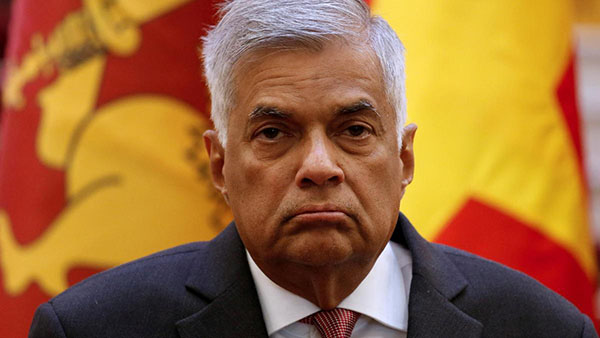
Ranil Wickremesinghe, 73, is back as Sri Lankan PM for 6th time amid economic crisis

News Network
May 12, 2022

Ranil Wickremesinghe.jpg

Colombo, May 12: Ranil Wickremesinghe was sworn in as Sri Lanka's prime minister for the sixth time on Thursday, though the veteran politician has never completed a full term in office.

The 73-year-old's political career appeared to be drawing to a close before this week, when he agreed to helm a unity administration and help steer the South Asian island nation through a crippling economic crisis.

"This is a historic event," Tamil legislator Dharmalingam Sithadthan told AFP in reference to Wickremesinghe's latest return to the top office.

"This shows the desperate situation in our country."

Wickremesinghe is the sole parliamentary representative of the United National Party, a once-powerful political force that was nearly wiped out in Sri Lanka's last elections.

The former lawyer hails from a political family and his uncle Junius Jayewardene served as president for more than a decade.

But Wickremesinghe once told AFP he would have likely pursued a career as a journalist, had the government of the day not nationalised his family's newspaper business in 1973.

He was first appointed premier in 1993 after the assassination of then-president Ranasinghe Premadasa, who was killed in a bomb attack by Tamil Tiger guerrillas during Sri Lanka's decades-long civil war.

Underscoring the dynastic nature of Sri Lanka's politics, Premadasa's son Sajith is the current opposition leader and had also been touted as a possible prime ministerial candidate this week.

Wickremesinghe's first term in office lasted little more than a year.

He returned to power in 2001, earning a reputation for sound economic management after steering the country out of recession.

Conflict with the president saw him sacked before his term was over, and he spent the next decade in the political wilderness.

Wickremasinghe lost two presidential contests and led his party to a string of election defeats, prompting even his own supporters to dub him a "record loser".

He was nonetheless sworn in as prime minister again in 2015 after the election defeat of president Mahinda Rajapaksa after the opposition rallied behind him as a unity candidate against the authoritarian leader.

His "Mr Clean" image was muddied later that year when his administration was rocked by an insider trading scam involving central bank bonds.

A key accused in the multi-million dollar scam was the central bank chief at the time, Arjuna Mahendran, who was Wickremesinghe's schoolmate and choice for the job.

He was accused of cronyism during his tenure and failing to prosecute members of the previous Rajapaksa regime, members of which had been accused of graft, kickbacks and siphoning off public finances.

Political conflict with the powerful Rajapaksa family also threw the country into crisis in 2018, with Mahinda taking over the premiership for six weeks before the Supreme Court ruled it was unconstitutional.

Wickremesinghe returns to office to replace Mahinda Rajapaksa, who resigned on Monday after his supporters attacked anti-government demonstrators, and later had to be rescued from his residence by the military.

He will serve at the pleasure of President Gotabaya Rajapaksa, Mahinda's younger brother, who has fought off calls for his own resignation over the government's mismanagement of the economic crisis.

Wickremesinghe will be taking charge of a bankrupt nation in default of its $51-billion foreign debt and without money to import essential goods.

His status as a pro-West, free-market reformist could smooth bailout negotiations with the International Monetary Fund and foreign creditors.

But he has already warned there will be no quick fix to the nation's unprecedented economic woes.

"The worst is yet to come. We have very high inflation now and hyperinflation is on its way," Wickremesinghe told parliament last week.

"We should start addressing the issues now, we can't put it off any longer," he added. 

Comments

Add new comment

  • Coastaldigest.com reserves the right to delete or block any comments.
  • Coastaldigset.com is not responsible for its readers’ comments.
  • Comments that are abusive, incendiary or irrelevant are strictly prohibited.
  • Please use a genuine email ID and provide your name to avoid reject.
News Network
November 21,2025

Tejas.jpg

An Indian Air Force (IAF) Tejas fighter jet crashed on Friday, November 21, afternoon during its aerial demonstration at the Dubai Air Show, plunging to the ground at around 2:10 pm local time while performing a manoeuvre before thousands of spectators.

The IAF confirmed the incident, stating that a Tejas aircraft participating in the show had crashed and that further details were being gathered. An Air Force spokesperson said more information would be shared after initial assessments.

The crash sent thick black smoke billowing into the sky near the airport, causing panic among visitors, including families and children who had gathered to watch the display. Authorities have not yet confirmed whether the pilot managed to eject before the aircraft went down. Emergency response teams rushed to the scene, and officials have not released information on casualties or damage so far.

The Tejas is a 4.5-generation, multi-role fighter aircraft developed indigenously by Hindustan Aeronautics Limited (HAL). Designed for versatility, it is capable of offensive air support, close combat, ground attack missions and maritime operations. The aircraft family includes single-seat fighters and twin-seat trainers for both the Air Force and Navy.

HAL describes the latest version, the LCA Mk1A, as the most advanced in the series, featuring an AESA radar, an upgraded electronic warfare suite with radar-warning and self-protection jamming, smart multifunction displays, a digital map generator, a combined interrogator–transponder system and a modern radio altimeter. These enhancements significantly improve the aircraft’s combat capability and survivability.

Further updates from IAF and UAE authorities are awaited.

Comments

Add new comment

  • Coastaldigest.com reserves the right to delete or block any comments.
  • Coastaldigset.com is not responsible for its readers’ comments.
  • Comments that are abusive, incendiary or irrelevant are strictly prohibited.
  • Please use a genuine email ID and provide your name to avoid reject.
News Network
November 24,2025

lebanon.jpg

Israel has launched a new act of aggression on a residential neighborhood in Lebanon's capital, Beirut, killing and injuring about two dozen civilians.

The Israeli regime's military said in a statement that its forces carried out a so-called precise strike in a residential apartment in Dahiyeh in the southern suburbs of Beirut on Sunday.

The aggression targeted residential areas, killing at least five people and injuring more than 28 people, Lebanon's Health Ministry said. 

Hezbollah announced the martyrdom of senior Hezbollah commander Haytham Ali Tabatabai and four resistance fighters.

Lebanese President Michel Aoun condemned the airstrike, calling it a clear demonstration of Tel Aviv’s disregard for repeated international calls to halt violations on Lebanese soil.

“Israel refuses to implement international resolutions and all efforts aimed at ending the escalation and restoring stability,” Aoun said, urging the international community to take action to prevent further aggression.

The Palestinian Islamic Jihad movement also condemned the attack, holding the international community accountable. 

“The international community bears responsibility and continues to provide cover for these attacks as long as it does not restrain the occupiers,” said Ali Abu Shahin, a member of the group’s political bureau.

Israeli prime minister Benjamin Netanyahu’s office announced that the Israeli army carried out a strike “in the heart of Beirut."

Netanyahu reportedly approved the operation following recommendations from top Israeli security officials.

Two senior US officials commented on the Israeli strike.

The first official said that Israel did not notify Americans in advance about the attack. "We were informed immediately after the strike was carried out."

The second senior official said that the "US knew for several days that Israel was planning to escalate its strikes in Lebanon, but did not know in advance the timing, location, or target of the strike."

Speaking from the site of the Israeli strike, Lebanese MP Ali Ammar condemned the attack as part of a broader campaign of aggression that has targeted "all of Lebanon since the Washington-sponsored ceasefire."

He stated that "any attack on Lebanon is a violation of red lines; this aggression is part and parcel of the entity that targets Lebanon's dignity, sovereignty, and security of citizens."

Ammar went on to say the resistance is responding with "utmost wisdom, patience, and will confront the enemy at the appropriate time."

"Unfortunately, the enemy is emboldened to commit its aggression by voices within Lebanon that have turned themselves into tools that support its aggression," he added.

The Israeli attack on the southern suburbs of the Lebanese capital is the latest blatant violation of the ceasefire Israel signed with Hezbollah in November 2024, which was intended to end hostilities that had escalated into full-scale war.

An Israeli strike on the Ain al-Hilweh camp near Sidon in southern Lebanon late Tuesday killed at least 14 people. It wounded several others, including young students, according to the Lebanese health ministry.

The military claimed the attack targeted “a Hamas training compound” used to plan and carry out attacks against the regime -- a claim that has frequently been made without evidence.

Hamas rejected the allegations as “a blatant lie aimed at justifying the massacre,” stating it had “no military installations in the Palestinian camps in Lebanon” and that the targeted site was merely “an open sports field.”

According to Lebanese authorities, Israeli attacks have killed approximately 4,000 people and displaced more than 1.2 million residents across the country since October 2023.

Comments

Add new comment

  • Coastaldigest.com reserves the right to delete or block any comments.
  • Coastaldigset.com is not responsible for its readers’ comments.
  • Comments that are abusive, incendiary or irrelevant are strictly prohibited.
  • Please use a genuine email ID and provide your name to avoid reject.
News Network
November 26,2025

students.jpg

Bengaluru, Nov 26: Karnataka is taking its first concrete steps towards lifting a three-decade-old ban on student elections in colleges and universities. Deputy Chief Minister D.K. Shivakumar announced Wednesday that the state government will form a small committee to study the reintroduction of campus polls, a practice halted in 1989 following incidents of violence.

Speaking at a 'Constitution Day' event organised by the Karnataka Congress, Mr. Shivakumar underscored the move's aim: nurturing new political leadership from the grassroots.

"Recently, (Leader of the Opposition in Lok Sabha) Rahul Gandhi wrote a letter to me and Chief Minister (Siddaramaiah) asking us to think about restarting student elections," Shivakumar stated. "I'm announcing today that we'll form a small committee and seek a report on this."

Student elections were banned in Karnataka in 1989, largely due to concerns over violence and the infiltration of political party affiliates into campus life. The ban effectively extinguished vibrant student bodies and the pipeline of young leaders they often produced.

Mr. Shivakumar, who also serves as the Karnataka Congress president, said that former student leaders will be consulted to "study the pros and cons" of the re-introduction.

Acknowledging the history of the ban, he added, "There were many criminal activities taking place back then. We’ll see how we can conduct (student) elections by regulating such criminal activities."

The Deputy CM reminisced about his own journey, which began on campus. He recalled his political activism at Sri Jagadguru Renukacharya College leading to his first Assembly ticket in 1985 at the age of 23. "That's how student leadership was at the time. Such leadership has gone today. College elections have stopped," he lamented, adding that for many, college elections were "like a big movement" where leaders were forged.

The move, driven by the Congress high command's push to cultivate young talent, will face scrutiny from academics and university authorities who have, in the past, expressed concern that the return of polls could disrupt the peaceful academic environment and turn campuses into political battlegrounds.

Comments

Add new comment

  • Coastaldigest.com reserves the right to delete or block any comments.
  • Coastaldigset.com is not responsible for its readers’ comments.
  • Comments that are abusive, incendiary or irrelevant are strictly prohibited.
  • Please use a genuine email ID and provide your name to avoid reject.