Russia becomes 1st country to recognize Taliban as Afghan’s legitimate govt

News Network
July 4, 2025

afghnarussia.jpg

Moscow, July 4: Russia has officially recognized the Taliban government as Afghanistan's rightful government, the first country to do so nearly four years since the extremists took power. The action is a diplomatic victory for the Taliban and underscores Russia's increasing influence in Central Asia and South Asia, the New York Times reported.

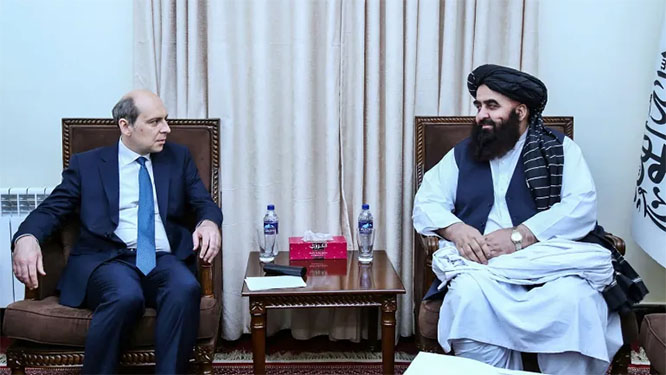
In a statement on X, Afghanistan's Foreign Ministry confirmed that Russian Ambassador Dmitry Zhirnov conveyed the Kremlin's acknowledgement during a meeting in Kabul with Taliban foreign minister Amir Khan Muttaqi. The Russian Foreign Ministry declared the move would provide "impetus to the development of productive bilateral cooperation" in trade, energy, and infrastructure.

A diplomatic win for the Taliban

The formal acknowledgment is a major victory for the Taliban. In spite of repeated attempts at rapprochement, the movement had not managed to gain legitimacy, since Western and most Islamic countries had maintained diplomatic ties at a bare minimum.

However, with time, attitudes have changed globally. With the Taliban firmly in place and with no sign of internal collapse, different countries have begun exploring pragmatic contacts, albeit short of recognition. The Russian step is a continuation of those steps, following China's infrastructure overtures, India's resumption of visa grants, and low-key diplomatic moves by Germany and others.

"Such acknowledgment by Russia provides not only diplomatic legitimacy but also bargaining power for the Taliban to demand more action from unwilling countries," according to Tom Ramage, Brussels-based foreign policy analyst.

The designation is the culmination of heightened ties between Moscow and Kabul over the past few years. In April, Russia's supreme court removed the Taliban from its official list of terrorist organizations, a designation that had been in place more than two decades previously. That move set the stage for more collaboration on security, notably against the Islamic State affiliate ISIS-K, which has become a common threat to both regimes.

ISIS-K launched a vicious attack in March 2024 against a Moscow-region concert hall that killed over 130. The group also targeted the Russian Embassy in Kabul in the past, giving Moscow all the more impetus to assist the Taliban in counterterrorism and intelligence efforts.

Russia's Foreign Ministry emphasized that enhanced cooperation would include energy, agriculture, and transport infrastructure. Moscow is keen on better access to Afghan mineral wealth and trade routes linking Central Asia with South Asia and beyond.

A change in the international landscape

While Russia's move is singular in that it was the only complete recognition, it is one aspect of a broader rebalancing of foreign relations towards Afghanistan. China has pledged to extend its Belt and Road infrastructure projects into the country, and the United Arab Emirates and Iran remain two of Afghanistan's largest trade partners.

Germany, in turn, is considering a deal with the Taliban to deport Afghan nationals residing illegally in Germany. Though not an official recognition, it does acknowledge the de facto rule of the Taliban over the state machinery.

The United States is also firmly opposed to recognition, pointing to the continued oppression of women by the Taliban, such as banning girls from schooling beyond sixth grade and restricting the employment of women. US officials have also rejected any effort to release Afghan central bank funds unless there are concrete human rights guarantees.

A complicated history

Russia's move has a historic significance. The Soviet Union had invaded Afghanistan in 1979 and engaged in a long, harsh conflict with US-supported mujahedeen fighters for a decade, killing almost 15,000 Soviet troops. Now, Moscow is seeking influence in the area through diplomacy, not military might, trying to fill a void left by the United States after it withdrew from the country in 2021.

Foreign Minister Muttaqi welcomed the recognition as "an opportunity for other countries to follow." The Taliban hopes it will lead to greater economic investment and increased legitimacy, though obstacles remain. While Russia welcomed the Taliban, most of the world still denies it legitimacy in its form of government, and aid only comes in under tight controls.

As Moscow makes a comeback as an international player and Kabul looks for partners willing to ignore its human rights abuses, Thursday's statement marks a turning point in the geopolitics of post-US Afghanistan.

Comments

Add new comment

  • Coastaldigest.com reserves the right to delete or block any comments.
  • Coastaldigset.com is not responsible for its readers’ comments.
  • Comments that are abusive, incendiary or irrelevant are strictly prohibited.
  • Please use a genuine email ID and provide your name to avoid reject.
News Network
January 23,2026

Mangaluru: The Karnataka Government Polytechnic (KPT), Mangaluru, has achieved autonomous status from the All India Council for Technical Education (AICTE), becoming the first government polytechnic in the country to receive such recognition in its 78-year history. The status was granted by AICTE, New Delhi, and subsequently approved by the Karnataka Board of Technical Education in October last year.

Officials said the autonomy was conferred a few months ago. Until recently, AICTE extended autonomous status only to engineering colleges, excluding diploma institutions. However, with a renewed national focus on skill development, several government polytechnics across India have now been granted autonomy.

KPT, the second-largest polytechnic in Karnataka, was established in 1946 with four branches and has since expanded to offer eight diploma programmes, including computer science and polymer technology. The institution is spread across a 19-acre campus.

Ravindra M Keni, the first dean of the institution, told The Times of India that AICTE had proposed autonomous status for polytechnic institutions that are over 25 years old. “Many colleges applied. In the first round, 100 institutions were shortlisted, which was further narrowed down to 15 in the second round. We have already completed one semester after becoming an autonomous institution,” he said. He added that nearly 500 students are admitted annually across eight three-year diploma courses.

Explaining the factors that helped KPT secure autonomy, Keni said the institution has consistently recorded 100 per cent admissions and placements for its graduates. He also noted its strong performance in sports, with the college emerging champions for 12 consecutive years, along with active student participation in NCC and NSS activities.

Autonomous status allows KPT to design industry-oriented curricula, conduct examinations, prepare question papers, and manage academic documentation independently. The institution can also directly collaborate with industries and receive priority funding from AICTE or the Ministry of Education. While academic autonomy has been granted, financial control will continue to rest with the state government.

“There will be separate committees for examinations, question paper setting, boards of studies, and boards of examiners. The institution will now have the freedom to conduct admissions without government notifications and issue its own marks cards,” Keni said, adding that new academic initiatives would be planned after a year of functioning under the autonomous framework.

Comments

Add new comment

  • Coastaldigest.com reserves the right to delete or block any comments.
  • Coastaldigset.com is not responsible for its readers’ comments.
  • Comments that are abusive, incendiary or irrelevant are strictly prohibited.
  • Please use a genuine email ID and provide your name to avoid reject.
News Network
January 31,2026

Roy.jpg

Bengaluru: The shooting incident involving CJ Roy, founder of the Confident Group, has once again put the spotlight on a businessman whose life has swung between flamboyant global success and persistent controversy at home.

Though Roy’s business interests extended across continents, his roots lay firmly in Karnataka. An alumnus of Christ School in Bengaluru, he later moved to Tumakuru to pursue an engineering degree. Those familiar with his early years describe him as intensely ambitious, beginning his career as a salesman at a small electronics firm dealing in computers.

Roy’s entry into large-scale real estate came through the Crystal Group, where he worked closely with Latha Namboothiri and rose from manager to director. However, the launch of the Confident Group in 2005 was clouded by industry speculation. Insiders speak of a fallout involving alleged “benami” properties and claims of deception that ultimately led to his independent venture—an episode Roy spent years trying to distance himself from, according to associates.

A tale of two cities

Roy’s professional trajectory diverged sharply across geographies.

In Dubai, he built a reputation as a bold and efficient developer, completing massive luxury residential projects in record time—some reportedly within 11 months. His rapid project delivery and lavish lifestyle in the Emirates earned him admiration and visibility in the real estate sector.

In Bengaluru, however, his image remained far more fractured. Sources say Roy stayed away from the city for several years amid disputes over unpaid dues to vendors and suppliers. Several projects were allegedly stalled, with accusations of unfulfilled commitments to cement and steel suppliers continuing to follow him.

Roy’s return to Bengaluru’s business and social circles began around 2018, marked by a conscious attempt at rebranding. His appointment as Honorary Consul of the Slovak Republic added diplomatic legitimacy, which he complemented with visible CSR initiatives, including ambulance donations and high-profile charity events.

Heavy police presence in Langford Town

Following the incident, police personnel from the Central division were deployed outside the Confident Group building in Langford Town, which also houses the Slovak Honorary Consulate in Bengaluru.

The otherwise busy premises near Hosur Road wore a deserted look on Friday, reflecting the shock and uncertainty that followed the tragedy.

Comments

Add new comment

  • Coastaldigest.com reserves the right to delete or block any comments.
  • Coastaldigset.com is not responsible for its readers’ comments.
  • Comments that are abusive, incendiary or irrelevant are strictly prohibited.
  • Please use a genuine email ID and provide your name to avoid reject.
News Network
January 23,2026

modIKERALA.jpg

Prime Minister Narendra Modi, during his visit to Thiruvananthapuram on Friday, January 23, indicated that the Bharatiya Janata Party (BJP) is aiming to expand its political footprint in Kerala ahead of the Assembly elections scheduled in the coming months.

Speaking at a BJP-organised public meeting, Modi drew parallels between the party’s early electoral gains in Gujarat and its recent victory in the Thiruvananthapuram Municipal Corporation. The civic body win, which ended decades of Left control, was cited by the Prime Minister as a possible starting point for the party’s broader ambitions in the state.

Recalling BJP’s political trajectory in Gujarat, Modi said the party was largely insignificant before 1987 and received little media attention. He pointed out that the BJP’s first major breakthrough came with its victory in the Ahmedabad Municipal Corporation that year.

“Just as our journey in Gujarat began with one city, Kerala’s journey has also started with a single city,” Modi said, suggesting that the party’s municipal-level success could translate into wider electoral acceptance.

The Prime Minister alleged that successive governments led by the Left Democratic Front (LDF) and the United Democratic Front (UDF) had failed to adequately develop Thiruvananthapuram. He accused both fronts of corruption and neglect, claiming that basic infrastructure and facilities were denied to the capital city for decades.

According to Modi, the BJP’s control of the civic body represents a shift driven by public dissatisfaction with the existing political alternatives. He asserted that the BJP administration in Thiruvananthapuram had begun working towards development, though no specific details or timelines were outlined.

Addressing the gathering at Putharikandam Maidan, Modi said the BJP intended to project Thiruvananthapuram as a “model city,” reiterating his party’s commitment to governance-led change.

The Prime Minister’s visit to Kerala also included the inauguration of several development projects and the flagging off of new train services, as the BJP intensifies its political outreach in the poll-bound state.

Comments

Add new comment

  • Coastaldigest.com reserves the right to delete or block any comments.
  • Coastaldigset.com is not responsible for its readers’ comments.
  • Comments that are abusive, incendiary or irrelevant are strictly prohibited.
  • Please use a genuine email ID and provide your name to avoid reject.