



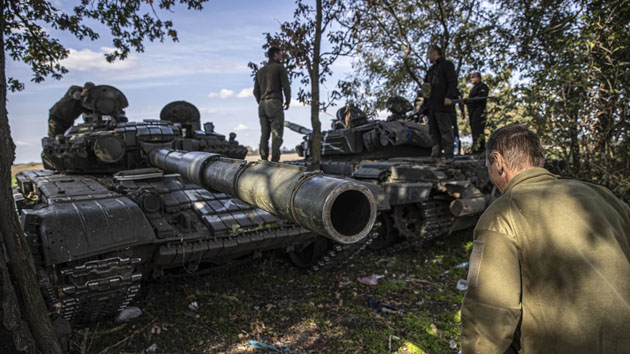
Russia hits Ukraine again, evacuates Kherson, warns of ‘uncontrolled escalation’

Agencies
October 24, 2022

russia.jpg

The strike on the shipbuilding town about 35 km (22 miles) northwest of the front line in Kherson came as Russia ordered 60,000 people to flee the region "to save your lives" in the face of a Ukrainian counter offensive.

Russian Defence Minister Sergei Shoigu discussed the "rapidly deteriorating situation" in phone calls with British, French and Turkish counterparts, the ministry said.

He also spoke by phone with US Defense Secretary Lloyd Austin for the second time in three days. The Pentagon said Austin told Shoigu he "rejected any pretext for Russian escalation."

Shoigu said Ukraine could escalate by using a "dirty bomb", or conventional explosives laced with radioactive material.

Ukrainian Foreign Minister Dmytro Kuleba rejected the accusation, as "absurd" and "dangerous", adding: "Russians often accuse others of what they plan themselves."

In a joint statement after the talks, Britain, France and the United States said they were committed to supporting Ukraine "for as long as it takes" and rejected Russia's warning about a "dirty bomb".

"Our countries made clear that we all reject Russia’s transparently false allegations that Ukraine is preparing to use a dirty bomb on its own territory," they said.

"The world would see through any attempt to use this allegation as a pretext for escalation."

Sunday's missile strike in Mykolaiv wiped out the top floor of the apartment block, sending shrapnel and debris across a plaza and into neighbouring buildings, a Reuters witness said No fatalities were recorded.

"After the first blast, I tried to get out, but the door was stuck," said Oleksandr Mezinov, 50, who was woken from his bed by the blasts. "After a minute or two, there was a second loud blast. Our door was blown into the corridor."

On Sunday, Ukraine's General Staff said anti-aircraft defences had shot down 12 of Russia's Iranian-made Shahed-136 attack drones in the past 24 hours.

Tehran denies supplying the weapons to Russia.

Ukraine's advances in recent weeks around Kherson and in the country's northeast have been met with intensifying Russian missile and drone attacks on civilian infrastructure, which have destroyed about 40 per cent of Ukraine's power system ahead of winter.

Russian troops have withdrawn from parts of the front and occupation authorities are evacuating civilians deeper into Russian-held territory before an expected battle for Kherson, the regional capital on the west bank of the Dnipro river.

Kherson is a gateway to Crimea, which Russia annexed in 2014.

"The situation today is difficult. It's vital to save your lives," Russian Education Minister Sergei Kravtsov said in a video message. "It won't be for long. You will definitely return."

Russia-installed authorities there reported insufficient vessels to ferry people across the river at one point on Sunday, blaming a "sharp increase in the number of people wishing to leave".

About 25,000 people have been evacuated since Tuesday, the Interfax news agency said.

Ukraine's military said it was making gains in the south, taking over at least two villages it said Russia had abandoned.

Russia's defence ministry said on Sunday its forces had kept up attacks on Ukraine's energy and military infrastructure, destroyed a large ammunition depot in the central Cherkasy region, and repelled Ukrainian counter-offensives in the south and east.

Ukrainian President Volodymyr Zelenskiyy said the Russian attacks on energy infrastructure had struck on a "very wide" scale.

With the war about to start its ninth month and winter approaching, the potential for freezing misery loomed.

Volodymyr Kudritskiy, head of Ukraine's national energy company, Ukrenergo, said power had been restored to more than 1.5 million customers after mass weekend attacks on energy targets.

Moscow has acknowledged targeting energy infrastructure but denies targeting civilians in what it calls a "special military operation" in Ukraine.

Ukraine also accused Russia of hampering a deal on grain exports via the Black Sea, saying its ports were working only at 25 per cent to 30 per cent capacity.

The pact, brokered by the United Nations and Turkey in July, paved the way for Ukraine to resume grain exports from Black Sea ports that had been shut since Russia invaded.

Comments

Add new comment

  • Coastaldigest.com reserves the right to delete or block any comments.
  • Coastaldigset.com is not responsible for its readers’ comments.
  • Comments that are abusive, incendiary or irrelevant are strictly prohibited.
  • Please use a genuine email ID and provide your name to avoid reject.
News Network
January 20,2026

iran.jpg

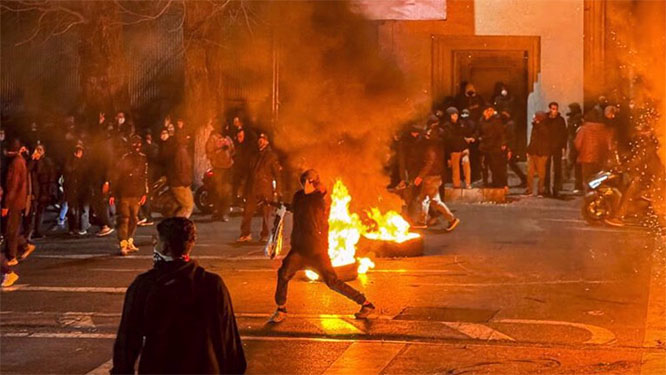
Iranian security and intelligence forces have captured more than 470 individuals in three provinces, identified as key figures behind the recent wave of violent unrest and terrorist activities linked to foreign-backed networks.

The Intelligence Ministry's provincial office in Khorasan Razavi announced on Monday the arrest of 192 armed terrorists, identified as the main agents behind recent riots in the region. 

According to an official statement, the detainees were involved in the killing of several security personnel and civilians, setting fire to mosques, public service facilities, and buses, as well as attacks on military and law enforcement centers.

The seized items from the group include several bulletproof vests, Kalashnikov rifles, hunting weapons, Winchester rifles, and various cold weapons such as daggers, swords, brass knuckles, tactical knives, crossbows, and chains.

Evidence indicates that some of the individuals were tied to hostile movements and terrorist organizations, with links overseas. Others were identified as members of violent criminal gangs, actively taking part in the unrest alongside their associates.

Simultaneously, in the western province of Lorestan, the IRGC announced the arrest of 134 individuals as the main leaders and influential field agents of a US-Israeli terrorist network.

The IRGC statement stated that these individuals formed terrorist cells during the recent unrest, committing "Daesh-like" acts.

They wounded security forces with firearms and cold weapons, and burned and destroyed public and private properties, including mosques, shops, banks, and private and public vehicles.

In the northwestern province of Zanjan, the police reported detaining 150 people identified as principal leaders and agents behind recent riots.

Authorities noted that these individuals were responsible for destroying public and private property and intentionally setting fire to vehicles in the province's squares.

Their crimes include shedding the blood of innocent people, destroying public and private property, attempting to enter military sites, disrupting public order, and spreading terror among citizens.

A variety of cold weapons were reportedly seized from the detainees.

What began late last month as peaceful protests over economic hardship across Iran turned violent after public statements by US and Israeli regime figures encouraged vandalism and disorder.

During the unrest, foreign-backed mercenaries rampaged through cities, killing security forces and civilians and damaging public property.

Comments

Add new comment

  • Coastaldigest.com reserves the right to delete or block any comments.
  • Coastaldigset.com is not responsible for its readers’ comments.
  • Comments that are abusive, incendiary or irrelevant are strictly prohibited.
  • Please use a genuine email ID and provide your name to avoid reject.
News Network
February 1,2026

US President Donald Trump on Saturday claimed that the government of India led by Prime Minister Narendra Modi has made a deal to buy Venezuelan oil, as opposed to purchasing it from Iran.

"We've already made that deal, the concept of the deal," he told reporters on Air Force One.

Trump had imposed 25% tariffs on countries buying Venezuelan oil, including India, in March 2025. He had also hit India with tariffs for buying Russian oil, saying it was "funding" President Vladimir Putin's war against Ukraine.

Trump has said that the US has taken control of the oil-rich Venezuela after capturing former President Nicolas Maduro in January.

A fleet of 18 ships loaded with crude oil bound for refineries in Texas, Louisiana, and Mississippi in January, the most since December 2024, according to a report by the news agency Bloomberg.

Combined crude deliveries to the US will reach about 2,75,000 barrels a day, more than doubling volumes seen in December last year. Shipments to China, which averaged 4,00,000 barrels a day last year, fell to zero in January.

PM Modi, Venezuelan President Agree To Expand Ties

Prime Minister Narendra Modi and Venezuela's acting President Delcy Rodriguez spoke on Friday and agreed to take the bilateral relations to "new heights" in the years ahead.

It was the first phone call between the two leaders since the capture of Maduro and his wife by the US on January 3.

"Spoke with Acting President of Venezuela, Ms. Delcy Rodriguez. We agreed to further deepen and expand our bilateral partnership in all areas, with a shared vision of taking India-Venezuela relations to new heights in the years ahead," PM Modi said in a post on X.

A statement from Prime Minister Modi's office said the two leaders agreed to further expand and deepen the India-Venezuela partnership in all areas, including trade and investment, energy, digital technology, health, agriculture, and people-to-people ties.

They exchanged views on various regional and global issues of mutual interest and underscored the importance of their close cooperation for the Global South, the statement said.

Rodriguez also said that they discussed partnerships in the fields of agriculture, science and technology, mining, and tourism, as well as the pharmaceutical and automotive industries.

Comments

Add new comment

  • Coastaldigest.com reserves the right to delete or block any comments.
  • Coastaldigset.com is not responsible for its readers’ comments.
  • Comments that are abusive, incendiary or irrelevant are strictly prohibited.
  • Please use a genuine email ID and provide your name to avoid reject.
News Network
January 23,2026

Karnataka Governor Thaawarchand Gehlot read only three lines from the 122-paragraph address prepared by the Congress-led state government while addressing the joint session of the Legislature on Thursday, effectively bypassing large sections critical of the BJP-led Union government.

The omitted portions of the customary Governor’s address outlined what the state government described as a “suppressive situation in economic and policy matters” under India’s federal framework. The speech also sharply criticised the Centre’s move to replace the Mahatma Gandhi National Rural Employment Guarantee Act (MGNREGA) with the Viksit Bharat–Guarantee for Rozgar and Ajeevika Mission (Gramin) Act, commonly referred to as the VB-GRAM (G) Act.

Governor Gehlot had earlier conveyed his objection to several paragraphs that were explicitly critical of the Union government. On Thursday, he confined himself to the opening lines — “I extend a warm welcome to all of you to the joint session of the State legislature. I am extremely pleased to address this august House” — before jumping directly to the concluding sentence of the final paragraph.

He ended the address by reading the last line of paragraph 122: “Overall, my government is firmly committed to doubling the pace of the State’s economic, social and physical development. Jai Hind — Jai Karnataka.”

According to the prepared speech, the Karnataka government demanded the scrapping of the VB-GRAM (G) Act, describing it as “contractor-centric” and detrimental to rural livelihoods, and called for the full restoration of MGNREGA. The state government argued that the new law undermines decentralisation, weakens labour protections, and centralises decision-making in violation of constitutional norms.

Key points from the unread sections of the speech:

•    Karnataka facing a “suppressive” economic and policy environment within the federal system

•    Repeal of MGNREGA described as a blow to rural livelihoods

•    VB-GRAM (G) Act accused of protecting corporate and contractor interests

•    New law alleged to weaken decentralised governance

•    Decision-making said to be imposed by the Centre without consulting states

•    Rights of Adivasis, women, backward classes and agrarian communities curtailed

•    Labourers allegedly placed under contractor control

•    States facing mounting fiscal stress due to central policies

•    VB-GRAM (G) Act accused of enabling large-scale corruption

Comments

Add new comment

  • Coastaldigest.com reserves the right to delete or block any comments.
  • Coastaldigset.com is not responsible for its readers’ comments.
  • Comments that are abusive, incendiary or irrelevant are strictly prohibited.
  • Please use a genuine email ID and provide your name to avoid reject.