Sri Lanka President’s brother Basil Rajapaksa stopped at Colombo airport while trying to flee

News Network
July 12, 2022

prezborhter.jpg

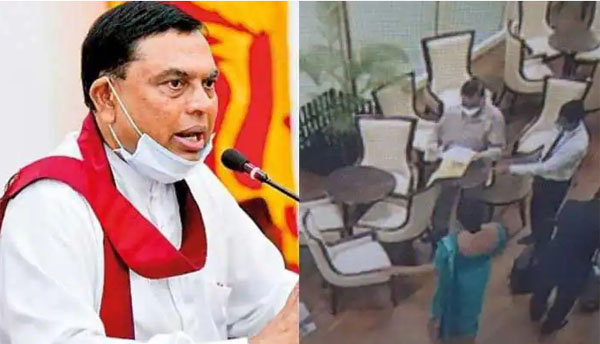
Colombo, July 12: Basil Rajapaksa, Sri Lanka’s former finance minister and younger brother of embattled President Gotabaya Rajapaksa, was turned back at Colombo airport on Tuesday as he attempted to leave the country through the VIP terminal, an immigration officer said, amid mounting anger against the powerful family for mishandling the worst economic crisis.

Basil Rajapaksa, 71, tried to leave the crisis-hit island nation, a day before Speaker of Parliament Mahinda Yapa Abeywardena is expected to publicly announce President Rajapaksa's resignation to the nation.

President Rajapaksa signed on Monday his resignation letter, dated for July 1, and and it was later handed over to a senior government official who will hand it over to the Parliament Speaker.

Basil, a US passport holder, resigned as finance minister in early April as street protests intensified against shortages of fuel, food and other necessities and quit his seat in parliament in June.

The Sri Lanka Immigration and Emigration Officers Association said its members declined to serve Basil at the VIP terminal of Colombo airport.

"Due to the crisis situation in the country, it has been decided to withdraw from activities at the Silk Route/CIP passenger clearance activities until further notice,” the trade union said in a statement, according to Economy Next website.

"We decided to withdraw from serving the silk route passenger clearance terminal from mid night yesterday,” said K.A.S Kanugala, the chairman of the association.

He said the corrupt people were trying to leave the country using the service.

The immigration officials objected to serve him at the VIP clearance line and even the passengers of the Emirates flight to Dubai had objected to his leaving.

Basil is being widely held responsible for the country's worst economic crisis which has heaped misery on the people.

The political uncertainty prevails in Sri Lanka where the distribution of cooking gas has resumed alongside the delivery of fuel to retailers by the Indian Oil Company after a stoppage on Sunday. Long queues are still seen at fuel pumps.

The protesters continue to occupy the three main buildings in the capital, the President’s House, the presidential secretariat and the prime minister’s official residence, Temple Trees.

Police near the Temple Trees said a clash had erupted between two groups of protesters, injuring 6 people.

With President Rajapaksa’s resignation due on Wednesday, Sri Lanka's political parties on Monday initiated steps to form an all-party government and subsequently elect a new President on July 20 to prevent the bankrupt nation sliding further into anarchy.

President Rajapaksa has officially conveyed to Prime Minister Ranil Wickremesinghe that he will resign on July 13 as previously announced, the PM Office said on Monday, days after protesters stormed both leaders’ homes in rage over the government's mishandling of the country's worst economic crisis.

Parties have begun campaigning for the support of possible candidates. The main opposition SJB said they will campaign for the appointment of Sajith Premadasa as the interim President.

Premadasa said on Monday that Sri Lanka’s main opposition the Samagi Jana Balavegaya (SJB) was ready to lead the country at the presidential and prime ministerial level and develop the economy.

Premadasa said his party is ready to lead a programme aimed at bringing stability to the country.

“We will appoint a government headed by a president and a prime minister. There is no other alternative. If anyone opposes this or tries to sabotage it in parliament we will see it as a treacherous act,” he said.

The Sri Lankan Parliament will elect the new president to succeed Rajapaksa on July 20, Speaker Abeywardena announced on Monday.

Under the Sri Lankan Constitution, if both the president and prime minister resign, the Speaker of parliament will serve as acting president for a maximum of 30 days.

The Parliament will elect a new president within 30 days from one of its members, who will hold the office for the remaining two years of the current term.

Sri Lanka, a country of 22 million people, is under the grip of an unprecedented economic turmoil, the worst in seven decades, leaving millions struggling to buy food, medicine, fuel and other essentials.

Schools have been suspended and fuel has been limited to essential services. Patients are unable to travel to hospitals due to the fuel shortage and food prices are soaring.

Trains have reduced in frequency, forcing travelers to squeeze into compartments and even sit precariously on top of them as they commute to work.

In several major cities, including Colombo, hundreds are forced to stand in line for hours to buy fuel, sometimes clashing with police and the military as they wait.

The country, with an acute foreign currency crisis that resulted in foreign debt default, had announced in April that it is suspending nearly USD 7 billion foreign debt repayment due for this year out of about USD 25 billion due through 2026. Sri Lanka's total foreign debt stands at USD 51 billion. 

Comments

Add new comment

  • Coastaldigest.com reserves the right to delete or block any comments.
  • Coastaldigset.com is not responsible for its readers’ comments.
  • Comments that are abusive, incendiary or irrelevant are strictly prohibited.
  • Please use a genuine email ID and provide your name to avoid reject.
News Network
November 27,2025

siddDKS.jpg

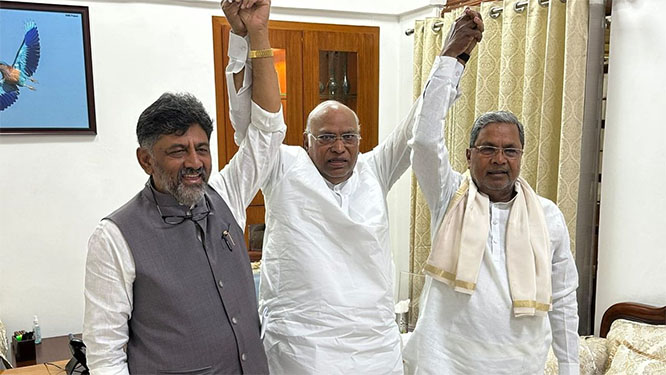
Congress president Mallikarjun Kharge on Thursday announced that he will convene a high-level meeting in New Delhi with senior leaders — including Rahul Gandhi, Karnataka Chief Minister Siddaramaiah and Deputy Chief Minister D.K. Shivakumar — to resolve the escalating leadership turmoil in Karnataka and “put an end to the confusion.”

Kharge said the discussions would focus on the way forward for the ruling party, as rumours of a possible leadership change continue to swirl. The speculation has intensified after the Congress government crossed the halfway mark of its five-year term on November 20, reviving talk of an alleged 2023 “power-sharing agreement” between Siddaramaiah and Shivakumar.

“After reaching Delhi, I will call three or four important leaders and hold discussions. Once we talk, we will decide how to move ahead and end this confusion,” Kharge told reporters in Bengaluru, according to PTI.

When asked specifically about calling Siddaramaiah and Shivakumar to Delhi, he responded: “Certainly, we should call them. We will discuss with them and settle the issue.”

He confirmed that Rahul Gandhi, the Chief Minister, the Deputy Chief Minister and other senior members would be part of the deliberations. “After discussing with everyone, a decision will be made,” he said.

Meanwhile, Siddaramaiah held a separate strategy meeting at his Bengaluru residence with ministers and leaders seen as his close confidants, including G. Parameshwara, Satish Jarkiholi, H.C. Mahadevappa, K. Venkatesh and K.N. Rajanna.
Signalling calm, the Chief Minister told reporters, “Will go to Delhi if the high command calls.”

Shivakumar echoed a similar stance, saying he too would head to the national capital if summoned by the party leadership.

Comments

Add new comment

  • Coastaldigest.com reserves the right to delete or block any comments.
  • Coastaldigset.com is not responsible for its readers’ comments.
  • Comments that are abusive, incendiary or irrelevant are strictly prohibited.
  • Please use a genuine email ID and provide your name to avoid reject.
News Network
December 5,2025

indigoCEO.jpg

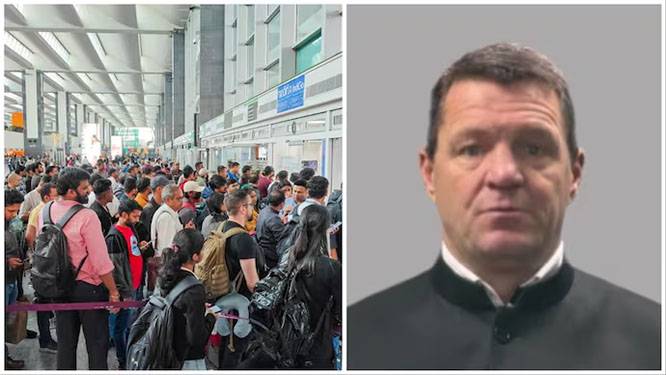
New Delhi, Dec 5: IndiGo CEO Pieter Elbers issued a public apology this evening after more than a thousand flights were cancelled today, making it the "most severely impacted day" in terms of cancellations. The biggest airline of the country cancelled "more than half" of its daily number of flights on Friday, said Elbers. He also said that even though the crisis will persist on Saturday, the airline anticipates fewer than 1,000 flight cancellations.

"Full normalisation is expected between December 10 and 15, though IndiGo cautions that recovery will take time due to the scale of operations," the IndiGo CEO said. 

IndiGo operates around 2,300 domestic and international flights daily.

Pieter Elbers, while apologising for the major inconvenience due to delays and cancellations, said the situation is a result of various causes.

The crisis at IndiGo stems from new regulations that boost pilots' weekly rest requirements by 12 hours to 48 and allow only two night-time landings per week, down from six. IndiGo has attributed the mass cancellations to "misjudgment and planning gaps".

Elbers also listed three lines of action that the airline will adopt to address the issue.

"Firstly, customer communication and addressing your needs, for this, messages have been sent on social media. And just now, a more detailed communication with information, refunds, cancellations and other customer support measures was sent," he said.

The airline has also stepped up its call centre capacity.

"Secondly, due to yesterday's situation, we had customers stranded mostly at the nation's largest airports. Our focus was for all of them to be able to travel today itself, which will be achieved. For this, we also ask customers whose flights are cancelled not to come to the airports as notifications are sent," the CEO said.

"Thirdly, cancellations were made for today to align our crew and planes to be where they need to start tomorrow morning afresh. Earlier measures of the last few days, regrettable, have proven not to be enough, but we have decided today to reboot all our systems and schedules, resulting in the highest numbers of cancellations so far, but imperative for progressive improvements starting from tomorrow," he added.

As airports witnessed chaotic scenes, the Directorate General of Civil Aviation (DGCA) stepped in to grant IndiGo a temporary exemption from stricter night duty rules for pilots. It also allowed substitution of leaves with a weekly rest period. 

Civil Aviation Minister Ram Mohan Naidu has said a high-level inquiry will be ordered and accountability will be fixed.

Comments

Add new comment

  • Coastaldigest.com reserves the right to delete or block any comments.
  • Coastaldigset.com is not responsible for its readers’ comments.
  • Comments that are abusive, incendiary or irrelevant are strictly prohibited.
  • Please use a genuine email ID and provide your name to avoid reject.
News Network
November 22,2025

gaza.jpg

The Israeli regime’s forces have killed two Palestinian children in the Gaza Strip every day since the ceasefire began in early October, UNICEF has warned.

The UN children’s agency said on Friday that Israeli forces continue to attack Palestinians in Gaza even though the agreement was meant to stop the killing.

“Since 11 October, while the ceasefire has been in effect, at least 67 children have been killed in conflict-related incidents in the Gaza Strip. Dozens more have been injured. That is an average of almost two children killed every day since the ceasefire took effect,” UNICEF spokesperson Ricardo Pires said in Geneva, reminding that each number in the statistics represents a child whose life had ended violently.

“These are not statistics,” he said. “Each child had a story, a family, and a future that was stolen from them.”

Data from Palestinian factions, human rights groups, and government bodies recorded since the US-brokered ceasefire deal went into effect on October 10 show that Israeli forces have carried out numerous attacks, each constituting a separate ceasefire violation.

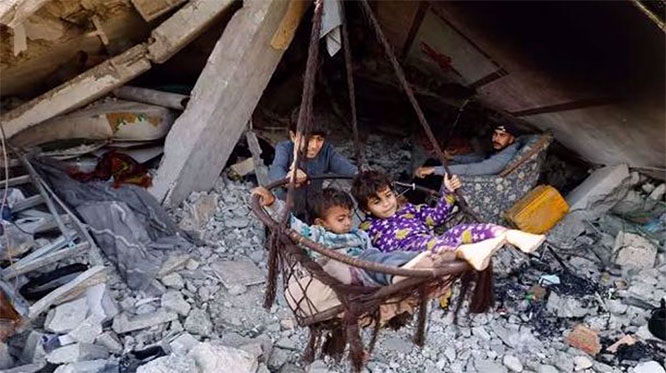
UNICEF teams say they repeatedly continue to witness heart-wrenching scenes of fearful Palestinian children sleeping outdoors with amputated limbs, while others live as orphans in flooded, makeshift shelters.

“I saw this myself in August. There is no safe place for them. The world cannot normalize their suffering,” Pires said, lamenting that the UN could “do a lot more if the aid that is really needed was entering faster.”

The UNICEF spokesperson warned that with the advent of winter, the risks for hundreds of thousands of displaced children will increase.

He warned, “The stakes are incredibly high” for children as winter acts as a threat multiplier, where children have no heating, no insulation, and few blankets. He said respiratory infections rise.

“Too many children have already paid the highest price,” Pires said. “Too many are still paying it, even under a ceasefire. The world promised them it would stop and that we would protect them.”

“Now we must act like it,” the UNICEF spokesperson added.

Since the Israeli regime launched its genocidal war against Palestinians in Gaza in October 2023, it has killed nearly 70,000 people in the territory, most of them women and children, and injured over 170,000 more, while reducing most of the structures in the enclave to rubble.

Comments

Add new comment

  • Coastaldigest.com reserves the right to delete or block any comments.
  • Coastaldigset.com is not responsible for its readers’ comments.
  • Comments that are abusive, incendiary or irrelevant are strictly prohibited.
  • Please use a genuine email ID and provide your name to avoid reject.