Sri Lanka President’s brother Basil Rajapaksa stopped at Colombo airport while trying to flee

News Network
July 12, 2022

prezborhter.jpg

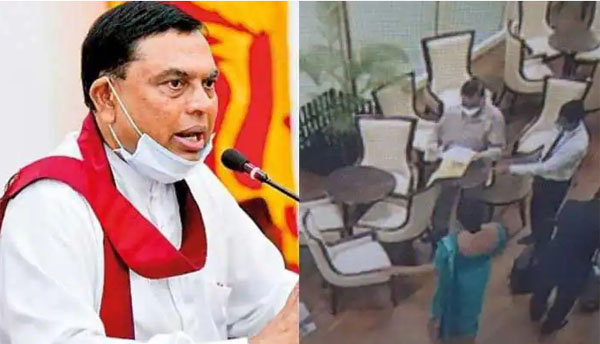
Colombo, July 12: Basil Rajapaksa, Sri Lanka’s former finance minister and younger brother of embattled President Gotabaya Rajapaksa, was turned back at Colombo airport on Tuesday as he attempted to leave the country through the VIP terminal, an immigration officer said, amid mounting anger against the powerful family for mishandling the worst economic crisis.

Basil Rajapaksa, 71, tried to leave the crisis-hit island nation, a day before Speaker of Parliament Mahinda Yapa Abeywardena is expected to publicly announce President Rajapaksa's resignation to the nation.

President Rajapaksa signed on Monday his resignation letter, dated for July 1, and and it was later handed over to a senior government official who will hand it over to the Parliament Speaker.

Basil, a US passport holder, resigned as finance minister in early April as street protests intensified against shortages of fuel, food and other necessities and quit his seat in parliament in June.

The Sri Lanka Immigration and Emigration Officers Association said its members declined to serve Basil at the VIP terminal of Colombo airport.

"Due to the crisis situation in the country, it has been decided to withdraw from activities at the Silk Route/CIP passenger clearance activities until further notice,” the trade union said in a statement, according to Economy Next website.

"We decided to withdraw from serving the silk route passenger clearance terminal from mid night yesterday,” said K.A.S Kanugala, the chairman of the association.

He said the corrupt people were trying to leave the country using the service.

The immigration officials objected to serve him at the VIP clearance line and even the passengers of the Emirates flight to Dubai had objected to his leaving.

Basil is being widely held responsible for the country's worst economic crisis which has heaped misery on the people.

The political uncertainty prevails in Sri Lanka where the distribution of cooking gas has resumed alongside the delivery of fuel to retailers by the Indian Oil Company after a stoppage on Sunday. Long queues are still seen at fuel pumps.

The protesters continue to occupy the three main buildings in the capital, the President’s House, the presidential secretariat and the prime minister’s official residence, Temple Trees.

Police near the Temple Trees said a clash had erupted between two groups of protesters, injuring 6 people.

With President Rajapaksa’s resignation due on Wednesday, Sri Lanka's political parties on Monday initiated steps to form an all-party government and subsequently elect a new President on July 20 to prevent the bankrupt nation sliding further into anarchy.

President Rajapaksa has officially conveyed to Prime Minister Ranil Wickremesinghe that he will resign on July 13 as previously announced, the PM Office said on Monday, days after protesters stormed both leaders’ homes in rage over the government's mishandling of the country's worst economic crisis.

Parties have begun campaigning for the support of possible candidates. The main opposition SJB said they will campaign for the appointment of Sajith Premadasa as the interim President.

Premadasa said on Monday that Sri Lanka’s main opposition the Samagi Jana Balavegaya (SJB) was ready to lead the country at the presidential and prime ministerial level and develop the economy.

Premadasa said his party is ready to lead a programme aimed at bringing stability to the country.

“We will appoint a government headed by a president and a prime minister. There is no other alternative. If anyone opposes this or tries to sabotage it in parliament we will see it as a treacherous act,” he said.

The Sri Lankan Parliament will elect the new president to succeed Rajapaksa on July 20, Speaker Abeywardena announced on Monday.

Under the Sri Lankan Constitution, if both the president and prime minister resign, the Speaker of parliament will serve as acting president for a maximum of 30 days.

The Parliament will elect a new president within 30 days from one of its members, who will hold the office for the remaining two years of the current term.

Sri Lanka, a country of 22 million people, is under the grip of an unprecedented economic turmoil, the worst in seven decades, leaving millions struggling to buy food, medicine, fuel and other essentials.

Schools have been suspended and fuel has been limited to essential services. Patients are unable to travel to hospitals due to the fuel shortage and food prices are soaring.

Trains have reduced in frequency, forcing travelers to squeeze into compartments and even sit precariously on top of them as they commute to work.

In several major cities, including Colombo, hundreds are forced to stand in line for hours to buy fuel, sometimes clashing with police and the military as they wait.

The country, with an acute foreign currency crisis that resulted in foreign debt default, had announced in April that it is suspending nearly USD 7 billion foreign debt repayment due for this year out of about USD 25 billion due through 2026. Sri Lanka's total foreign debt stands at USD 51 billion. 

Comments

Add new comment

  • Coastaldigest.com reserves the right to delete or block any comments.
  • Coastaldigset.com is not responsible for its readers’ comments.
  • Comments that are abusive, incendiary or irrelevant are strictly prohibited.
  • Please use a genuine email ID and provide your name to avoid reject.
News Network
January 23,2026

Mangaluru: The Karnataka Government Polytechnic (KPT), Mangaluru, has achieved autonomous status from the All India Council for Technical Education (AICTE), becoming the first government polytechnic in the country to receive such recognition in its 78-year history. The status was granted by AICTE, New Delhi, and subsequently approved by the Karnataka Board of Technical Education in October last year.

Officials said the autonomy was conferred a few months ago. Until recently, AICTE extended autonomous status only to engineering colleges, excluding diploma institutions. However, with a renewed national focus on skill development, several government polytechnics across India have now been granted autonomy.

KPT, the second-largest polytechnic in Karnataka, was established in 1946 with four branches and has since expanded to offer eight diploma programmes, including computer science and polymer technology. The institution is spread across a 19-acre campus.

Ravindra M Keni, the first dean of the institution, told The Times of India that AICTE had proposed autonomous status for polytechnic institutions that are over 25 years old. “Many colleges applied. In the first round, 100 institutions were shortlisted, which was further narrowed down to 15 in the second round. We have already completed one semester after becoming an autonomous institution,” he said. He added that nearly 500 students are admitted annually across eight three-year diploma courses.

Explaining the factors that helped KPT secure autonomy, Keni said the institution has consistently recorded 100 per cent admissions and placements for its graduates. He also noted its strong performance in sports, with the college emerging champions for 12 consecutive years, along with active student participation in NCC and NSS activities.

Autonomous status allows KPT to design industry-oriented curricula, conduct examinations, prepare question papers, and manage academic documentation independently. The institution can also directly collaborate with industries and receive priority funding from AICTE or the Ministry of Education. While academic autonomy has been granted, financial control will continue to rest with the state government.

“There will be separate committees for examinations, question paper setting, boards of studies, and boards of examiners. The institution will now have the freedom to conduct admissions without government notifications and issue its own marks cards,” Keni said, adding that new academic initiatives would be planned after a year of functioning under the autonomous framework.

Comments

Add new comment

  • Coastaldigest.com reserves the right to delete or block any comments.
  • Coastaldigset.com is not responsible for its readers’ comments.
  • Comments that are abusive, incendiary or irrelevant are strictly prohibited.
  • Please use a genuine email ID and provide your name to avoid reject.
News Network
January 23,2026

modIKERALA.jpg

Prime Minister Narendra Modi, during his visit to Thiruvananthapuram on Friday, January 23, indicated that the Bharatiya Janata Party (BJP) is aiming to expand its political footprint in Kerala ahead of the Assembly elections scheduled in the coming months.

Speaking at a BJP-organised public meeting, Modi drew parallels between the party’s early electoral gains in Gujarat and its recent victory in the Thiruvananthapuram Municipal Corporation. The civic body win, which ended decades of Left control, was cited by the Prime Minister as a possible starting point for the party’s broader ambitions in the state.

Recalling BJP’s political trajectory in Gujarat, Modi said the party was largely insignificant before 1987 and received little media attention. He pointed out that the BJP’s first major breakthrough came with its victory in the Ahmedabad Municipal Corporation that year.

“Just as our journey in Gujarat began with one city, Kerala’s journey has also started with a single city,” Modi said, suggesting that the party’s municipal-level success could translate into wider electoral acceptance.

The Prime Minister alleged that successive governments led by the Left Democratic Front (LDF) and the United Democratic Front (UDF) had failed to adequately develop Thiruvananthapuram. He accused both fronts of corruption and neglect, claiming that basic infrastructure and facilities were denied to the capital city for decades.

According to Modi, the BJP’s control of the civic body represents a shift driven by public dissatisfaction with the existing political alternatives. He asserted that the BJP administration in Thiruvananthapuram had begun working towards development, though no specific details or timelines were outlined.

Addressing the gathering at Putharikandam Maidan, Modi said the BJP intended to project Thiruvananthapuram as a “model city,” reiterating his party’s commitment to governance-led change.

The Prime Minister’s visit to Kerala also included the inauguration of several development projects and the flagging off of new train services, as the BJP intensifies its political outreach in the poll-bound state.

Comments

Add new comment

  • Coastaldigest.com reserves the right to delete or block any comments.
  • Coastaldigset.com is not responsible for its readers’ comments.
  • Comments that are abusive, incendiary or irrelevant are strictly prohibited.
  • Please use a genuine email ID and provide your name to avoid reject.
News Network
January 23,2026

oscar.jpg

The Voice of Hind Rajab, inspired by the tragic final moments of a young Palestinian girl killed by Israeli fire in Gaza, has been nominated for an Academy Award in the Best International Feature Film category.

Directed by Tunisian filmmaker Kaouther Ben Hania, the film recounts the true story of five-year-old Hind Rajab, who lost her life in January 2024 while fleeing Israeli bombardment with her family.

The film features the real audio of Hind’s desperate call to the Palestinian Red Crescent Society, where she pleaded for help moments before the vehicle she was in was struck by 355 bullets.

The haunting narrative begins with a brief call made from the besieged Tel al-Hawa neighborhood of Gaza, where gunfire and armored vehicles drowned out every sound.

After witnessing the brutal killing of her family, she made a trembling call, her voice reduced to a whisper as she spoke of the massacre and her unbearable loneliness as the sole survivor.

Premiering at the Venice International Film Festival in September 2025, The Voice of Hind Rajab garnered widespread acclaim, receiving a record-setting 23-minute standing ovation and the Silver Lion Grand Jury Prize, the festival’s second-highest honor.

In her acceptance speech, Ben Hania dedicated the film to humanitarian workers and first responders in Gaza, emphasizing that Hind's voice symbolizes countless civilians affected by war.

She aims to give voice to victims often reduced to mere statistics, highlighting the broader suffering of civilians in war zones.

The film’s Oscar nomination underscores its powerful storytelling and ethical approach to depicting real-life tragedy, making it a crucial piece of contemporary cinema.

It serves not only as a narration of individual tragedy but also as an artistic and documentary response to the silence and censorship that often overshadow West Asian struggles and wars.

Using an innovative method she calls docufiction, Ben Hania bridges unvarnished reality and narrative structure, creating a work that is both artistically valuable and socially impactful.

Born in 1977 in Sidi Bouzid—later the epicenter of the Arab revolution—her background profoundly influenced her worldview and artistic approach.

She is a graduate of the Higher School of Audiovisual Arts of Tunis, Pantheon-Sorbonne University, and La Fémis in Paris, where her studies equipped her with the technical and theoretical tools needed to address complex subjects. 

Comments

Add new comment

  • Coastaldigest.com reserves the right to delete or block any comments.
  • Coastaldigset.com is not responsible for its readers’ comments.
  • Comments that are abusive, incendiary or irrelevant are strictly prohibited.
  • Please use a genuine email ID and provide your name to avoid reject.