



Sri Lanka protesters storm PM's office defying emergency after President flees abroad

News Network
July 13, 2022

protesters.jpg

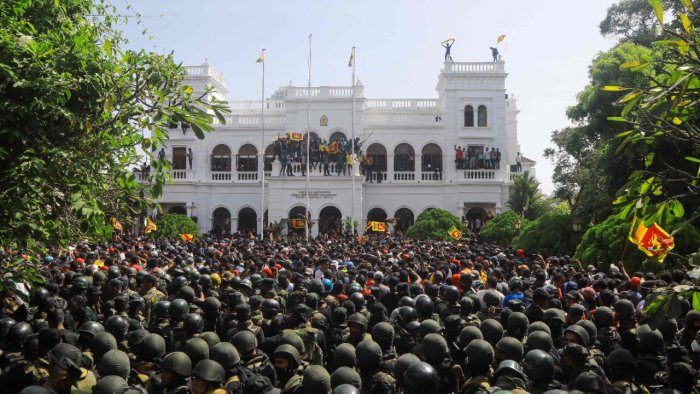
Colombo, July 13: Protesters in Sri Lanka defied tear gas, water cannon and a state of emergency to storm the prime minister's office on Wednesday after the president fled overseas, with the crowd demanding both men step down in the face of an economic crisis.

In a televised statement Prime Minister Ranil Wickremesinghe said he had instructed the military and police to do "what is necessary to restore order".

But footage showed armed security personnel standing by in the grounds of his office as protesters, some holding national flags, milled and took pictures.

Other demonstrators at one point broke into state television studios, as the country's months-long political and economic crisis appeared to be moving towards a climax.

President Gotabaya Rajapaksa promised at the weekend to resign on Wednesday after escaping his own official residence in Colombo just before tens of thousands of protesters overran it.

As president, Rajapaksa enjoys immunity from arrest, and he is believed to have wanted to go abroad before stepping down to avoid the possibility of being detained. The 73-year-old, his wife and two bodyguards took a military aircraft to the neighbouring Maldives, immigration sources told the press.

Hours later, with no formal announcement he was stepping down, thousands of demonstrators mobbed the office of Wickremesinghe -- whom Rajapaksa named as acting president during his absence -- demanding both officeholders should go.

"Go home Ranil, Go home Gota," they shouted.

Tear gas and water cannon fired by police and the declaration of both a nationwide state of emergency and a curfew failed to disperse them and the crowd poured into the building.

Wickremesinghe, also 73, would automatically become acting president if Rajapaksa steps down, but has himself announced his willingness to resign if consensus is reached on forming a unity government.

"We can't tear up our constitution," he said in his statement. "We can't allow fascists to take over. We must end this fascist threat to democracy," he said, adding that the official buildings occupied by protesters must be returned to state control.

The protesters' actions were a repeat of the capture of President Gotabaya Rajapaksa's home and office on Saturday, when Wickremesinghe's private home was also set ablaze.

The prime minister's office confirmed that Rajapaksa had left the country, but said it had no schedule for any presidential resignation announcement.

The succession process could take between three days -- the minimum time needed for parliament to elect an MP to serve out Rajapaksa's term, which ends in November 2024 -- and a maximum of 30 days allowed under the statute.

Rajapaksa is accused of mismanaging the economy to a point where the country ran out of foreign exchange to finance even the most essential imports, leading to severe hardships for its 22 million people.

Earlier Wednesday, smiling Sri Lankans again thronged the corridors of the president's official residence after his departure, with young couples walking around hand in hand in a mood of quiet celebration.

"People are very happy, because these people robbed our country," said retired civil servant Kingsley Samarakoon, 74.

"They've stolen too much money, billions and billions."

But he held little hope for an immediate improvement in Sri Lanka's plight.

"How are people going to run the country without money?" he asked. "It's a problem."

Sri Lanka defaulted on its $51 billion foreign debt in April and is in talks with the IMF for a possible bailout.

 The island has nearly exhausted its already scarce supplies of petrol. The government has ordered the closure of non-essential offices and schools to reduce commuting and save fuel.

The departure of Rajapaksa, 73 and once known as "The Terminator", had been stymied for more than 24 hours in a humiliating standoff with immigration personnel in Colombo.

He had wanted to fly to Dubai on a commercial flight, but staff at Bandaranaike International withdrew from VIP services and insisted that all passengers had to go through public counters.

On arrival in the Maldives on Wednesday, Rajapaksa was driven to an undisclosed location under police escort, an airport official in the capital Male said.

His youngest brother Basil, who resigned in April as finance minister, missed his own Emirates flight to Dubai on Tuesday after a tense standoff of his own with airport staff.

The leader of the main opposition Samagi Jana Balawegaya party, Sajith Premadasa, who lost the 2019 presidential election to Rajapaksa, has said he will stand for the presidency.

Premadasa is the son of former president Ranasinghe Premadasa, who was assassinated in a Tamil rebel suicide bombing in May 1993. 

Comments

Add new comment

  • Coastaldigest.com reserves the right to delete or block any comments.
  • Coastaldigset.com is not responsible for its readers’ comments.
  • Comments that are abusive, incendiary or irrelevant are strictly prohibited.
  • Please use a genuine email ID and provide your name to avoid reject.
News Network
February 1,2026

US President Donald Trump on Saturday claimed that the government of India led by Prime Minister Narendra Modi has made a deal to buy Venezuelan oil, as opposed to purchasing it from Iran.

"We've already made that deal, the concept of the deal," he told reporters on Air Force One.

Trump had imposed 25% tariffs on countries buying Venezuelan oil, including India, in March 2025. He had also hit India with tariffs for buying Russian oil, saying it was "funding" President Vladimir Putin's war against Ukraine.

Trump has said that the US has taken control of the oil-rich Venezuela after capturing former President Nicolas Maduro in January.

A fleet of 18 ships loaded with crude oil bound for refineries in Texas, Louisiana, and Mississippi in January, the most since December 2024, according to a report by the news agency Bloomberg.

Combined crude deliveries to the US will reach about 2,75,000 barrels a day, more than doubling volumes seen in December last year. Shipments to China, which averaged 4,00,000 barrels a day last year, fell to zero in January.

PM Modi, Venezuelan President Agree To Expand Ties

Prime Minister Narendra Modi and Venezuela's acting President Delcy Rodriguez spoke on Friday and agreed to take the bilateral relations to "new heights" in the years ahead.

It was the first phone call between the two leaders since the capture of Maduro and his wife by the US on January 3.

"Spoke with Acting President of Venezuela, Ms. Delcy Rodriguez. We agreed to further deepen and expand our bilateral partnership in all areas, with a shared vision of taking India-Venezuela relations to new heights in the years ahead," PM Modi said in a post on X.

A statement from Prime Minister Modi's office said the two leaders agreed to further expand and deepen the India-Venezuela partnership in all areas, including trade and investment, energy, digital technology, health, agriculture, and people-to-people ties.

They exchanged views on various regional and global issues of mutual interest and underscored the importance of their close cooperation for the Global South, the statement said.

Rodriguez also said that they discussed partnerships in the fields of agriculture, science and technology, mining, and tourism, as well as the pharmaceutical and automotive industries.

Comments

Add new comment

  • Coastaldigest.com reserves the right to delete or block any comments.
  • Coastaldigset.com is not responsible for its readers’ comments.
  • Comments that are abusive, incendiary or irrelevant are strictly prohibited.
  • Please use a genuine email ID and provide your name to avoid reject.
News Network
January 20,2026

Mangaluru: In a major step towards strengthening rural innovation, the Office of the Principal Scientific Adviser (PSA) to the Government of India is supporting the establishment of RuTAGe Smart Village Centres (RSVCs) across the country through collaborations with academic institutions, civil society organisations and philanthropic partners.

As part of this national initiative, Nitte (Deemed to be University) will set up the first RSVCs in the region at Nitte GP in Udupi district and at the Nitte Health Centre, Sevanjali Trust, Farangipete, in Dakshina Kannada district. The centres will be inaugurated on January 21. In South India, the programme is being implemented by the Section Infin-8 Foundation (SI-8).

Speaking to reporters on Monday, SI-8 founder-director Vishwas US said experts from Nitte University and SI-8 would work closely with farmers, students, youth and local entrepreneurs to adapt and deploy technologies tailored to local needs.

Project head Prof Iddya Karunasagar, representing Nitte DU, said the RSVCs at Nitte and Farangipete would serve as demonstration hubs for a wide range of agriculture, energy, skill-development and assistive technologies. These include solar dryers for fruits, vegetables and crops; soil-testing solutions; power weeders and women-friendly farm tools; wind-powered devices for rural artisans; grain storage systems; grass-cutting and tree-climbing equipment; and liquid fertiliser production using cowshed waste.

SI-8 CEO Aravind C Kumar said the centres would also provide access to digital and knowledge-based platforms such as ISRO applications, government scheme portals, market linkage tools and gamified learning resources, along with assistive technologies for persons with visual impairments.

Highlighting the broader impact of the initiative, Principal Scientific Adviser Prof Ajay Kumar Sood said it demonstrated how applied research could bridge the rural–urban divide and help create self-reliant, technology-enabled villages.

The initiative has been made possible through philanthropic support from Dr NC Murthy of ACM Business Solutions, LLC, USA. Dr Sapna Poti, Director (Strategic Alliances) at the Office of the Principal Scientific Adviser, said the long-term objective is to build self-sufficient, technology-driven communities capable of generating sustainable livelihoods on their own.

Comments

Add new comment

  • Coastaldigest.com reserves the right to delete or block any comments.
  • Coastaldigset.com is not responsible for its readers’ comments.
  • Comments that are abusive, incendiary or irrelevant are strictly prohibited.
  • Please use a genuine email ID and provide your name to avoid reject.
News Network
January 23,2026

Karnataka Governor Thaawarchand Gehlot read only three lines from the 122-paragraph address prepared by the Congress-led state government while addressing the joint session of the Legislature on Thursday, effectively bypassing large sections critical of the BJP-led Union government.

The omitted portions of the customary Governor’s address outlined what the state government described as a “suppressive situation in economic and policy matters” under India’s federal framework. The speech also sharply criticised the Centre’s move to replace the Mahatma Gandhi National Rural Employment Guarantee Act (MGNREGA) with the Viksit Bharat–Guarantee for Rozgar and Ajeevika Mission (Gramin) Act, commonly referred to as the VB-GRAM (G) Act.

Governor Gehlot had earlier conveyed his objection to several paragraphs that were explicitly critical of the Union government. On Thursday, he confined himself to the opening lines — “I extend a warm welcome to all of you to the joint session of the State legislature. I am extremely pleased to address this august House” — before jumping directly to the concluding sentence of the final paragraph.

He ended the address by reading the last line of paragraph 122: “Overall, my government is firmly committed to doubling the pace of the State’s economic, social and physical development. Jai Hind — Jai Karnataka.”

According to the prepared speech, the Karnataka government demanded the scrapping of the VB-GRAM (G) Act, describing it as “contractor-centric” and detrimental to rural livelihoods, and called for the full restoration of MGNREGA. The state government argued that the new law undermines decentralisation, weakens labour protections, and centralises decision-making in violation of constitutional norms.

Key points from the unread sections of the speech:

•    Karnataka facing a “suppressive” economic and policy environment within the federal system

•    Repeal of MGNREGA described as a blow to rural livelihoods

•    VB-GRAM (G) Act accused of protecting corporate and contractor interests

•    New law alleged to weaken decentralised governance

•    Decision-making said to be imposed by the Centre without consulting states

•    Rights of Adivasis, women, backward classes and agrarian communities curtailed

•    Labourers allegedly placed under contractor control

•    States facing mounting fiscal stress due to central policies

•    VB-GRAM (G) Act accused of enabling large-scale corruption

Comments

Add new comment

  • Coastaldigest.com reserves the right to delete or block any comments.
  • Coastaldigset.com is not responsible for its readers’ comments.
  • Comments that are abusive, incendiary or irrelevant are strictly prohibited.
  • Please use a genuine email ID and provide your name to avoid reject.