Syrup from India caused mass child deaths in Gambia, confirms panel of experts

News Network
May 24, 2023

syrup.jpg

Tainted syrup medicine imported from India was the cause of an outbreak of kidney failure that killed more than 60 children in the West African nation of Gambia last year, according to a report by a team of international experts.

The report, submitted to the Gambian health ministry earlier this year and not yet made public, is the most definitive statement yet on the cause of the episode. It contradicts the official position of Indian authorities, who insist that the country’s products weren’t to blame. A director for the Gambian ministry of health didn’t respond to calls and an emailed request for comment.

Although the committee was able to establish that a child drank the contaminated medicine from an Indian drugmaker, Maiden Pharmaceuticals Ltd., in only 22 deaths from so-called acute kidney injury, or AKI, it said that symptoms in 30 others were consistent with the poison’s effects and no other cause could be found. It lacked enough information on 13 more cases. 

“The outbreak of AKI in children in the Gambia is attributable to medicines contaminated with DEG/EG,” the committee concluded, referring to the two contaminants, diethylene glycol and ethylene glycol.

Last year’s outbreak sparked concerns about the quality of generic medicine from India, an export powerhouse that calls itself the “pharmacy of the world.” Those concerns intensified this year when exported syrups from two other Indian manufacturers were found to be tainted in the same way, leading in one case to about 20 deaths in Uzbekistan.

“We have made our stand clear that as per our testing, the product had no issue,” said Rajeev Raghuvanshi, the Indian drug controller general, in a text message to Bloomberg. He referred further questions to the health ministry, which didn’t respond to requests for comment. A representative of Maiden also didn’t respond to inquiries.

India’s central government this week imposed a new regulation requiring cough syrup to be tested by a government lab before it can be exported.

Products from Maiden, a small New Delhi firm, fell under suspicion in Gambia last September, when health officials investigating the outbreak arranged tests of several drugs given to children prior to their deaths. Three labs in three different countries would eventually confirm the presence of the contaminants in Maiden products, the committee said in its report. 

The World Health Organization issued a public alert in October and Gambia recalled the drugs.

“After the poisonous medicines were withdrawn, there were no further cases,” said Kalle Hoppu, one of the committee members, in an email to Bloomberg. He called that “a very definitive sign that this outbreak was caused by these medicines.” Hoppu is a former director of the Poison Information Center at Helsinki University Hospital in Finland.

Indian authorities have defended the drugs. In December, the Indian drug controller general at the time, V.G. Somani, told the WHO that his organization’s own tests of Maiden drugs found no contamination. He went on to accuse the agency of acting on flimsy evidence and having “adversely impacted the image of Indian pharmaceutical products across the globe.” As recently as March, the Indian government said in a statement that the drugs weren’t tainted and didn’t kill anyone. 

Earlier reports by a Gambian parliamentary committee and by the U.S. Centers for Disease Control and Prevention both pointed to the Maiden drugs as the most plausible explanation for the outbreak. But the report by the 11-member expert committee was the first charged specifically with establishing the cause. 

The panel was set up by Gambia’s health ministry and consisted of five clinicians from local hospitals, two WHO officials, and four consultants from Senegal, Finland, and the UK. It was chaired by Abdou Niang, a nephrologist and professor at Cheikh Anta Diop University in Senegal. Members met for a week in December, and Hoppu said the report was submitted to the health ministry sometime around February. It’s unclear why the report has not been made public.

At the time the committee convened in December, Gambian authorities had logged 70 deaths of children suffering from AKI. Of those, the committee couldn’t get detailed information on 13, and it concluded that one death wasn’t consistent with AKI. That left 56 deaths that it examined in detail. The children in this group were about two years old on average, the committee report said.

In only four of the 56 cases did the committee find a possible alternative or contributing cause, such as Covid-19 or severe malaria. That left the 22 it tied to consumption of Maiden drugs, and 30 others where consumption of the drugs wasn’t established but the symptoms were consistent with exposure to the contaminants and no alternative cause was found. The report noted that parents can’t always recall the brand of medications they give their children. 

Comments

Add new comment

  • Coastaldigest.com reserves the right to delete or block any comments.
  • Coastaldigset.com is not responsible for its readers’ comments.
  • Comments that are abusive, incendiary or irrelevant are strictly prohibited.
  • Please use a genuine email ID and provide your name to avoid reject.
News Network
November 30,2025

airportmetro.jpg

Udupi: The pontiffs of Sri Paryaya Puttige Mutt, the sacred seat of Jagadguru Shrimad Madhvacharya Moola Samsthanam, have submitted a proposal to the Prime Minister seeking comprehensive development for Udupi district. 

Proposal for International Airport

A key request is the establishment of an international airport. Highlighting that around 1,000 acres of land are available and suitable, the pontiffs noted that the existing Mangalore Airport provides limited international connectivity. They suggested the airport be developed under a Public-Private Partnership (PPP) or as a Greenfield Airport to boost trade, education, healthcare, and spiritual tourism.

Metro and Rapid Transit Connectivity

The proposal also calls for Metro Rail or Rapid Transit between Mangaluru and Udupi. The 55 km coastal stretch experiences heavy daily commuter traffic, causing congestion. The district administration is ready to prepare an initial project report for a Mass Rapid Transit corridor and requested inclusion under national urban mobility programmes to ensure safe, green, and time-efficient regional transport.

Port and Coastal Development

The pontiffs urged the development of an international-standard port with a cruise terminal along Udupi’s coast. They also requested fast-tracking of pending coastal tourism projects and revising Coastal Regulation Zone (CRZ) norms to encourage sustainable infrastructure and hospitality investment.

IT, AI and Technological Infrastructure

Support was sought for an IT and AI Innovation Park with incubation facilities under Digital India and Startup India initiatives. The proposal also emphasized the need for strengthened data security and cloud computing infrastructure to boost India’s technological independence.

Sports and Education Initiatives

The pontiffs requested national sports status for Kambala, along with financial and infrastructure support. They also sought the establishment of an AIIMS in Udupi, a new IIT campus, and approval for an IIM to promote higher education in the district.

Representation to the Prime Minister

Sri Sugunendra Tirtha Pontiff and Sri Sushrendra Tirtha Swamiji represented the pontiffs in submitting the comprehensive development proposal to the Prime Minister during his recent visit.

Comments

Add new comment

  • Coastaldigest.com reserves the right to delete or block any comments.
  • Coastaldigset.com is not responsible for its readers’ comments.
  • Comments that are abusive, incendiary or irrelevant are strictly prohibited.
  • Please use a genuine email ID and provide your name to avoid reject.
Agencies
November 22,2025

indiapak.jpg

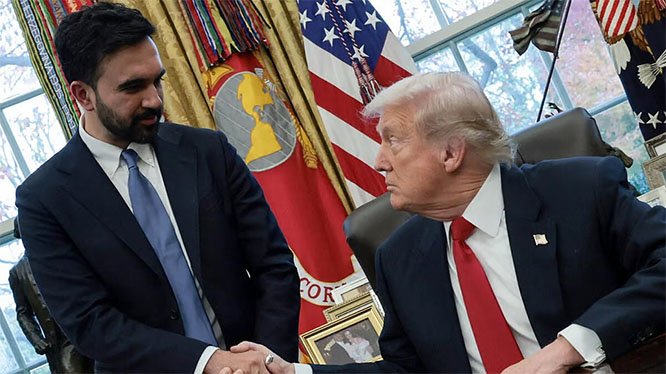
New York/Washington: US President Donald Trump has again claimed to have solved the conflict between India and Pakistan, repeating his assertion during a meeting with New York City Mayor-elect Zohran Mamdani in the Oval Office.

Mamdani flew to Washington DC for his first meeting with Trump in the White House on Friday. Trump said he “enjoyed” the meeting, which he described as “great.”

During remarks in the Oval Office, with Mamdani standing next to him, Trump repeated his claim that he solved the May conflict between India and Pakistan.

"I did eight peace deals of countries, including India and Pakistan,” he said.

On Wednesday, Trump had said he threatened to put 350 per cent tariffs on India and Pakistan if they did not end their conflict, repeating his claim that he solved the fighting between the nuclear-armed neighbours and that Prime Minister Narendra Modi had called him to say “we're not going to go to war.”

Since May 10, when Trump announced on social media that India and Pakistan had agreed to a “full and immediate” ceasefire after a “long night” of talks mediated by Washington, he has repeated his claim over 60 times that he “helped settle” the tensions between India and Pakistan.

India has consistently denied any third-party intervention. India launched Operation Sindoor on May 7, targeting terror infrastructure in Pakistan and Pakistan-occupied Kashmir in retaliation for the April 22 Pahalgam attack that killed 26 civilians. India and Pakistan reached an understanding on May 10 to end the conflict after four days of intense cross-border drone and missile strikes.

Mamdani emerged victorious in the closely-watched battle for New York City Mayor, becoming the first South Asian and Muslim to be elected to sit at the helm of the largest city in the US.

He had been the front-runner in the NYC Mayoral election for months and defeated Republican nominee Curtis Sliwa and political heavyweight former New York State Governor Andrew Cuomo, who ran as an independent candidate and was officially endorsed by Trump just hours before the elections.

Indian-descent Mamdani is the son of renowned filmmaker Mira Nair and Columbia University professor Mahmood Mamdani. He was born and raised in Kampala, Uganda and moved to New York City with his family when he was 7. Mamdani became a naturalised US citizen only recently, in 2018.

Comments

Add new comment

  • Coastaldigest.com reserves the right to delete or block any comments.
  • Coastaldigset.com is not responsible for its readers’ comments.
  • Comments that are abusive, incendiary or irrelevant are strictly prohibited.
  • Please use a genuine email ID and provide your name to avoid reject.
News Network
November 22,2025

gaza.jpg

The Israeli regime’s forces have killed two Palestinian children in the Gaza Strip every day since the ceasefire began in early October, UNICEF has warned.

The UN children’s agency said on Friday that Israeli forces continue to attack Palestinians in Gaza even though the agreement was meant to stop the killing.

“Since 11 October, while the ceasefire has been in effect, at least 67 children have been killed in conflict-related incidents in the Gaza Strip. Dozens more have been injured. That is an average of almost two children killed every day since the ceasefire took effect,” UNICEF spokesperson Ricardo Pires said in Geneva, reminding that each number in the statistics represents a child whose life had ended violently.

“These are not statistics,” he said. “Each child had a story, a family, and a future that was stolen from them.”

Data from Palestinian factions, human rights groups, and government bodies recorded since the US-brokered ceasefire deal went into effect on October 10 show that Israeli forces have carried out numerous attacks, each constituting a separate ceasefire violation.

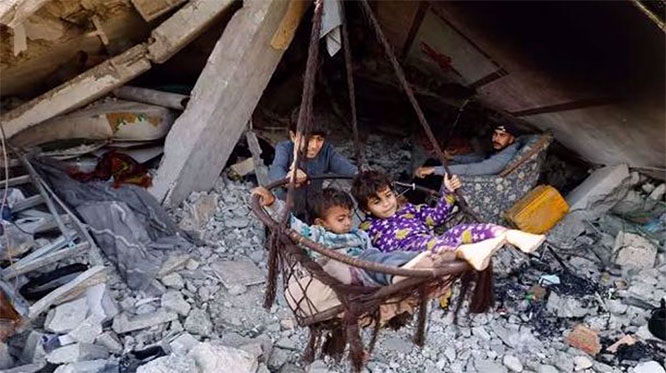
UNICEF teams say they repeatedly continue to witness heart-wrenching scenes of fearful Palestinian children sleeping outdoors with amputated limbs, while others live as orphans in flooded, makeshift shelters.

“I saw this myself in August. There is no safe place for them. The world cannot normalize their suffering,” Pires said, lamenting that the UN could “do a lot more if the aid that is really needed was entering faster.”

The UNICEF spokesperson warned that with the advent of winter, the risks for hundreds of thousands of displaced children will increase.

He warned, “The stakes are incredibly high” for children as winter acts as a threat multiplier, where children have no heating, no insulation, and few blankets. He said respiratory infections rise.

“Too many children have already paid the highest price,” Pires said. “Too many are still paying it, even under a ceasefire. The world promised them it would stop and that we would protect them.”

“Now we must act like it,” the UNICEF spokesperson added.

Since the Israeli regime launched its genocidal war against Palestinians in Gaza in October 2023, it has killed nearly 70,000 people in the territory, most of them women and children, and injured over 170,000 more, while reducing most of the structures in the enclave to rubble.

Comments

Add new comment

  • Coastaldigest.com reserves the right to delete or block any comments.
  • Coastaldigset.com is not responsible for its readers’ comments.
  • Comments that are abusive, incendiary or irrelevant are strictly prohibited.
  • Please use a genuine email ID and provide your name to avoid reject.