



Tone of Ukraine crisis shifts as mighty Russia signals openness to talk more

News Network
February 15, 2022

Moscow, Feb 15: The tone of the crisis over Ukraine shifted Monday as Russia’s top diplomat endorsed more talks to resolve its stand-off with the West, and Ukrainian officials hinted at offering concessions to avert war, even as Russian warships massed off Ukraine’s Black Sea coast and Russian ground troops appeared poised to strike.

In stage-managed, televised meetings, the Kremlin sent its strongest signals yet that it would seek further negotiations with the West rather than launch immediate military action, with state television showing a feed of Foreign Minister Sergey Lavrov telling President Vladimir Putin there was still a diplomatic path ahead. Minutes later, it showed Defence Minister Sergei Shoigu telling Putin that what he characterised as “large-scale drills” around Ukraine were coming to an end.

“I believe that our possibilities are far from exhausted,” Lavrov said, referring to Russia’s negotiations with the West. “I would propose continuing and intensifying them.”

Putin responded ambiguously: “Good.”

It was a sign that the Kremlin was still holding out the possibility that it could use its troop buildup to achieve key objectives without military action. The prospect for such a scenario was bolstered in Kyiv, the Ukrainian capital, where President Volodymyr Zelenskyy left open the possibility of dropping his country’s ambition to join the NATO alliance — a move that would help fulfil one of Putin’s key demands.

At a news conference, Zelenskyy emphasized that NATO membership was “for our security,” with the goal of joining the alliance written into the country’s constitution. But he acknowledged the difficult place the country found itself in, nearly completely encircled by Russian forces and with partners like the United States insisting they will not send troops into Ukraine to repel a Russian invasion.

“How much should Ukraine go on that path?” Zelenskyy said of NATO membership. “Who will support us?” The prospect of Ukraine joining NATO, he posited, could be “like a dream.”

Zelenskyy spoke alongside Chancellor Olaf Scholz of Germany, the latest Western leader trying shuttle diplomacy to avert war. The flurry of diplomacy came as fears of war have caused oil prices to spike, pushing well past $90 a barrel.

“If Russia violates the territorial integrity of Ukraine again, we know what to do,” Scholz said. “In the event of military escalation, we are ready for very far-reaching and effective sanctions in coordination with our allies.”

Scholz will fly to Moscow on Tuesday for crisis talks with Putin, following up on last week’s Kremlin visit by President Emmanuel Macron of France. Foreign Minister Zbigniew Rau of Poland — a country that is one of Russia’s most vocal critics in Europe — was also scheduled to visit Moscow on Tuesday to meet with his Russian counterpart, Lavrov. And Foreign Minister Luigi Di Maio of Italy prepared to depart for his own Eastern European tour, which will bring him to Kyiv on Tuesday and Moscow on Wednesday.

Because of the continuing crisis, the United States is temporarily closing its embassy in Kyiv and moving its operations to Lviv, a city much farther from Russian territory, the State Department said.

In his televised meeting with Putin, Lavrov highlighted the West’s diplomatic frenzy as a sign that the Kremlin’s strategy of pairing negotiations with military pressure was working. Putin laid out that strategy in an address to Russian diplomats in November: It was good that “tensions” were high with the West, the president told them, and it was “important for them to remain in this state for as long as possible.”

And he directed his diplomats to demand “security guarantees” from the West, such as a legally binding pledge that Ukraine will never join the NATO alliance.
“Our initiative,” Lavrov told Putin, “shook up our Western colleagues and became the reason they have no longer been able to ignore many of our previous appeals.”

Lavrov also said that Russia had prepared a 10-page response in its written back-and-forth with NATO and the United States over the Kremlin’s security demands.

Ambiguity about what comes next has been central to Putin’s strategy in the crisis set off by his troop buildup. Western officials warn that an invasion remains a real possibility in the coming days.

In Monday’s televised meetings, Putin did not state his own position, even after his defence minister told him that Russian military exercises were winding down. He did not specify which exercises were ending, but Russia has used the pretext of exercises to move troops and warships from across the country to within striking distance of Ukraine.

“Some of the drills are already ending and some will end soon,” Shoigu said.

“We’ll speak in more detail now,” Putin told him, before the Kremlin’s video feed ended.

The ambiguity over Russia’s intentions is forcing Ukraine and its Western partners to make hard decisions about what concessions to make to prevent an invasion — and causing discord over how seriously to take the threat.

The secretary of Ukraine’s security council, Oleksiy Danilov, reiterated the government’s position Monday that an invasion is less likely than how the United States has portrayed it. Such comments are intended to prevent panic among Ukrainians but also might be aimed at easing negotiations with Russia, analysts have said.

“We recognize the risks that exist on the territory of our country,” Danilov said. “But the situation is under complete control. Moreover, we, as of today, do not see that a full-scale invasion by the Russian Federation could happen on the 16th or 17th of this month.”

United States officials last week suggested Russian military action could begin within days. “We don’t see it,” Danilov said.

On Monday, the State Department recommended that US citizens leave Belarus and Transnistria, a Russian-backed breakaway region in Moldova. Both Belarus and Transnistria neighbour Ukraine.
The outlines of a possible diplomatic resolution, though still highly ambiguous and with uncertain prospects, arose in media interviews by a senior diplomat and at Zelenskyy’s joint news conference with Scholz.

In a televised address to the nation Monday evening, Zelenskyy struck a tone that was less dismissive of the threat of Russian military action than his previous comments. Zelenskyy said he had declared Wednesday — the date US officials had suggested as a possible date for the start of a Russian incursion — as a day of “national unity.”

Zelenskyy said that previous predictions by Western governments of a possible start of war had proved wrong and said there was no reason to worry Wednesday.

Comments

Add new comment

  • Coastaldigest.com reserves the right to delete or block any comments.
  • Coastaldigset.com is not responsible for its readers’ comments.
  • Comments that are abusive, incendiary or irrelevant are strictly prohibited.
  • Please use a genuine email ID and provide your name to avoid reject.
News Network
January 23,2026

Karnataka Governor Thaawarchand Gehlot read only three lines from the 122-paragraph address prepared by the Congress-led state government while addressing the joint session of the Legislature on Thursday, effectively bypassing large sections critical of the BJP-led Union government.

The omitted portions of the customary Governor’s address outlined what the state government described as a “suppressive situation in economic and policy matters” under India’s federal framework. The speech also sharply criticised the Centre’s move to replace the Mahatma Gandhi National Rural Employment Guarantee Act (MGNREGA) with the Viksit Bharat–Guarantee for Rozgar and Ajeevika Mission (Gramin) Act, commonly referred to as the VB-GRAM (G) Act.

Governor Gehlot had earlier conveyed his objection to several paragraphs that were explicitly critical of the Union government. On Thursday, he confined himself to the opening lines — “I extend a warm welcome to all of you to the joint session of the State legislature. I am extremely pleased to address this august House” — before jumping directly to the concluding sentence of the final paragraph.

He ended the address by reading the last line of paragraph 122: “Overall, my government is firmly committed to doubling the pace of the State’s economic, social and physical development. Jai Hind — Jai Karnataka.”

According to the prepared speech, the Karnataka government demanded the scrapping of the VB-GRAM (G) Act, describing it as “contractor-centric” and detrimental to rural livelihoods, and called for the full restoration of MGNREGA. The state government argued that the new law undermines decentralisation, weakens labour protections, and centralises decision-making in violation of constitutional norms.

Key points from the unread sections of the speech:

•    Karnataka facing a “suppressive” economic and policy environment within the federal system

•    Repeal of MGNREGA described as a blow to rural livelihoods

•    VB-GRAM (G) Act accused of protecting corporate and contractor interests

•    New law alleged to weaken decentralised governance

•    Decision-making said to be imposed by the Centre without consulting states

•    Rights of Adivasis, women, backward classes and agrarian communities curtailed

•    Labourers allegedly placed under contractor control

•    States facing mounting fiscal stress due to central policies

•    VB-GRAM (G) Act accused of enabling large-scale corruption

Comments

Add new comment

  • Coastaldigest.com reserves the right to delete or block any comments.
  • Coastaldigset.com is not responsible for its readers’ comments.
  • Comments that are abusive, incendiary or irrelevant are strictly prohibited.
  • Please use a genuine email ID and provide your name to avoid reject.
News Network
January 23,2026

Mangaluru: The Karnataka Government Polytechnic (KPT), Mangaluru, has achieved autonomous status from the All India Council for Technical Education (AICTE), becoming the first government polytechnic in the country to receive such recognition in its 78-year history. The status was granted by AICTE, New Delhi, and subsequently approved by the Karnataka Board of Technical Education in October last year.

Officials said the autonomy was conferred a few months ago. Until recently, AICTE extended autonomous status only to engineering colleges, excluding diploma institutions. However, with a renewed national focus on skill development, several government polytechnics across India have now been granted autonomy.

KPT, the second-largest polytechnic in Karnataka, was established in 1946 with four branches and has since expanded to offer eight diploma programmes, including computer science and polymer technology. The institution is spread across a 19-acre campus.

Ravindra M Keni, the first dean of the institution, told The Times of India that AICTE had proposed autonomous status for polytechnic institutions that are over 25 years old. “Many colleges applied. In the first round, 100 institutions were shortlisted, which was further narrowed down to 15 in the second round. We have already completed one semester after becoming an autonomous institution,” he said. He added that nearly 500 students are admitted annually across eight three-year diploma courses.

Explaining the factors that helped KPT secure autonomy, Keni said the institution has consistently recorded 100 per cent admissions and placements for its graduates. He also noted its strong performance in sports, with the college emerging champions for 12 consecutive years, along with active student participation in NCC and NSS activities.

Autonomous status allows KPT to design industry-oriented curricula, conduct examinations, prepare question papers, and manage academic documentation independently. The institution can also directly collaborate with industries and receive priority funding from AICTE or the Ministry of Education. While academic autonomy has been granted, financial control will continue to rest with the state government.

“There will be separate committees for examinations, question paper setting, boards of studies, and boards of examiners. The institution will now have the freedom to conduct admissions without government notifications and issue its own marks cards,” Keni said, adding that new academic initiatives would be planned after a year of functioning under the autonomous framework.

Comments

Add new comment

  • Coastaldigest.com reserves the right to delete or block any comments.
  • Coastaldigset.com is not responsible for its readers’ comments.
  • Comments that are abusive, incendiary or irrelevant are strictly prohibited.
  • Please use a genuine email ID and provide your name to avoid reject.
News Network
January 20,2026

iran.jpg

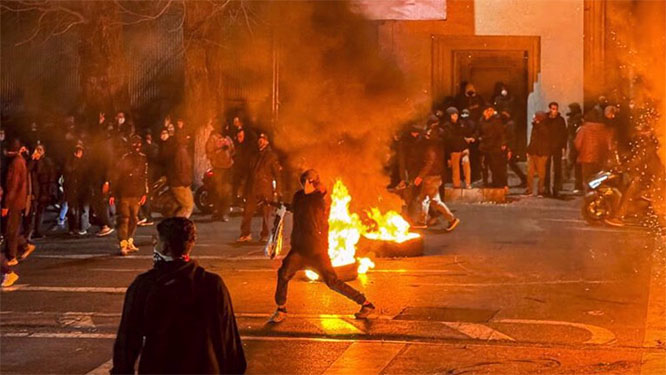
Iranian security and intelligence forces have captured more than 470 individuals in three provinces, identified as key figures behind the recent wave of violent unrest and terrorist activities linked to foreign-backed networks.

The Intelligence Ministry's provincial office in Khorasan Razavi announced on Monday the arrest of 192 armed terrorists, identified as the main agents behind recent riots in the region. 

According to an official statement, the detainees were involved in the killing of several security personnel and civilians, setting fire to mosques, public service facilities, and buses, as well as attacks on military and law enforcement centers.

The seized items from the group include several bulletproof vests, Kalashnikov rifles, hunting weapons, Winchester rifles, and various cold weapons such as daggers, swords, brass knuckles, tactical knives, crossbows, and chains.

Evidence indicates that some of the individuals were tied to hostile movements and terrorist organizations, with links overseas. Others were identified as members of violent criminal gangs, actively taking part in the unrest alongside their associates.

Simultaneously, in the western province of Lorestan, the IRGC announced the arrest of 134 individuals as the main leaders and influential field agents of a US-Israeli terrorist network.

The IRGC statement stated that these individuals formed terrorist cells during the recent unrest, committing "Daesh-like" acts.

They wounded security forces with firearms and cold weapons, and burned and destroyed public and private properties, including mosques, shops, banks, and private and public vehicles.

In the northwestern province of Zanjan, the police reported detaining 150 people identified as principal leaders and agents behind recent riots.

Authorities noted that these individuals were responsible for destroying public and private property and intentionally setting fire to vehicles in the province's squares.

Their crimes include shedding the blood of innocent people, destroying public and private property, attempting to enter military sites, disrupting public order, and spreading terror among citizens.

A variety of cold weapons were reportedly seized from the detainees.

What began late last month as peaceful protests over economic hardship across Iran turned violent after public statements by US and Israeli regime figures encouraged vandalism and disorder.

During the unrest, foreign-backed mercenaries rampaged through cities, killing security forces and civilians and damaging public property.

Comments

Add new comment

  • Coastaldigest.com reserves the right to delete or block any comments.
  • Coastaldigset.com is not responsible for its readers’ comments.
  • Comments that are abusive, incendiary or irrelevant are strictly prohibited.
  • Please use a genuine email ID and provide your name to avoid reject.