



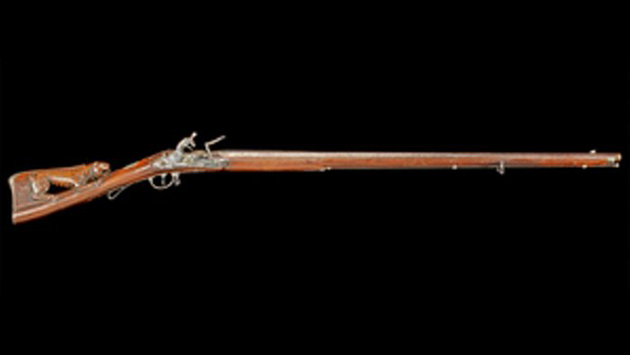
London, May 29: A rare 18th century decorated gun made in India for Mysore ruler Tipu Sultan, and valued at around GBP 2 million, has been barred from export to allow time for a UK-based institution to acquire it for the public study of a "fraught period" in the India-UK history.
UK Arts and Heritage Minister Lord Stephen Parkinson took the decision last week to impose the export ban on the “Flintlock Sporting Gun” following advice from the Reviewing Committee on the Export of Works of Art and Objects of Cultural Interest (RCEWA).
The 14-bore gun, dated between 1793 and 1794, was designed for shooting game and is signed by its maker Asad Khan Muhammed.
This British colonial-era firearm is said to have been “presented to General the Earl Cornwallis”, who previously fought Tipu Sultan between 1790 and 1792.
“This visually striking firearm is a significant antiquity in its own right, as well as an illustration of the important, interconnected history between Britain and India,” said Lord Parkinson.
“I hope that it can be shared with the widest possible public and used to deepen our understanding of a fraught period which shaped both our nations,” he said.
Famously known as the Tiger of Mysore, Tipu Sultan was a defiant opponent of the British East India Company and its allies during the Anglo-Mysore Wars.
He was killed on May 4, 1799, while defending his stronghold of Seringapatam and several exquisite items from that siege have come up on the auction circuit over the years – most recently his Bedchamber Sword which sold for a record-breaking GBP 14 million at Bonhams auction house in London.
Following the killing of Tipu Sultan, his distinctive personal weapons were taken from the palace and given to leading British military figures of the time.
The RCEWA found the gun to be of aesthetic importance as well as significant to the study of Tipu Sultan and his court, Lord Cornwallis and British history, and the conclusion of the third Anglo-Mysorean war.
“This is the finest and most elaborately decorated of the personal firearms made for Tipu Sultan, ruler of Mysore, a large state in South India. Dated 1793-4, this fourteen-bore gun was designed for shooting game and is signed by Asad Khan Muhammad.
It is extremely beautiful as well as technically advanced,” said Committee Member Christopher Rowell.
“The mechanism allows two shots to be fired from the single barrel without reloading, revealing the probable influence of itinerant French gunmakers. Tipu’s court was sophisticated and its workshops produced a variety of fine metalwork including weaponry and ordnance, which was stylish as well as deadly,” he said.
Rowell elaborates how he was fascinated by Western technical innovations, including rocketry, but his leanings towards France antagonised Britain, which waged four wars against Mysore.
In 1799, he was killed as the British army overran the capital of Seringapatam.
“This superbly executed sporting gun was presented to General Earl Cornwallis, victor of the previous war against Tipu in 1790-2, which had forced the Sultan to cede half his territory. Tipu was known as the ‘Tiger of Mysore’ and his personal emblems are ubiquitous, from the tiger with brass-inlaid eyes carved into the hardwood stock to the stylised tiger stripes inlaid in silver along the blued steel barrel. One of the silver mounts depicts a tiger attacking European soldiers, an image redolent of ‘Tipu’s Tiger’ in the V&A [Victoria & Albert Museum],” noted Rowell.
“Given its aesthetic significance, its impeccable provenance, its scope for further research and its relevance to both British and Indian history, I hope that this superb fowling piece made for the unfortunate ruler of Mysore, Tipu Sultan, will be acquired by a British Institution where it can be appreciated by all,” he added.
The chiselled gun inlaid with gold and silver has a length of 138 cm and is made of hardwood stock, is carved, has silver mounts and a steel barrel.
The decision on the export licence application for the gun will be deferred for a period ending on September 25 following which any offers will be considered by the unnamed owners of the gun.
The RCEWA is an independent body serviced by the Arts Council England, which advises the UK’s Secretary of State for Culture, Media and Sport on whether a cultural object, intended for export, is of national importance under specified criteria.

Comments
Add new comment