Ukraine tensions escalate as West accuses Russia of lying about troop withdrawal

Agencies
February 17, 2022

russia.jpg

Tensions over Ukraine abruptly ratcheted up Wednesday as Western officials accused Russia of lying about whether it had really begun pulling back troops from the Ukrainian border.

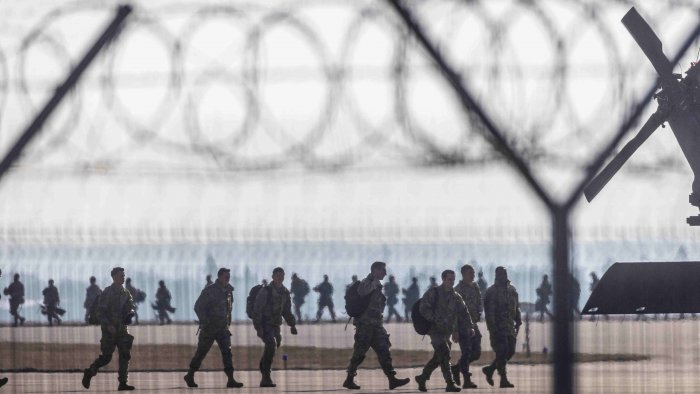
After days marked by flickers of hope that the conflict might be resolved peacefully, a senior US official, who refused to be quoted by name, told reporters that far from winding down its deployment, Moscow had added more than 7,000 combatants. Western allies expressed similar doubts about the Russian claims.

The US official directly accused Russia of lying, saying there was fresh evidence it was mobilizing for war.

British military officials said Wednesday they had spotted Russian armored vehicles, helicopters and a field hospital moving toward Ukraine’s border.

“Contrary to their claims, Russia continues to build up military capabilities near Ukraine,” Lt. Gen. Jim Hockenhull, the British chief of defense intelligence, said in a statement. “Russia has the military mass in place to conduct an invasion of Ukraine.

The Western warnings contrasted sharply with Russia’s attempts to show that it was de-escalating.

Only hours earlier, the Russian Defense Ministry had released a video of a military convoy departing Crimea over the 12-mile bridge to Russia that President Vladimir Putin ordered built after the peninsula’s 2014 annexation. And the Kremlin’s spokesperson praised the United States for being willing to negotiate and for offering constructive ideas.

With the sudden turn of events Wednesday night, the outlines of any diplomatic solution to the crisis once again looked very hard to discern.

In recent days, US officials had pointedly declined to accept Russian claims of a pullback.

On Wednesday, Secretary of State Antony Blinken, in an interview on MSNBC, said that the military units critical for an invasion force were continuing to move “toward the border, not away from the border.”

To some extent, the battle between the West and Moscow over Ukraine has been one of signaling. To keep international pressure on Russia high, the United States has repeatedly declared that an invasion was near, even imminent. Moscow, in turn, has repeatedly accused Washington of exaggerating the threat.

But beyond the verbal dueling, real troops have been repositioned.

In Brussels, defense ministers from the NATO countries discussed ways to reinforce military positions on their eastern perimeter, while the group’s secretary-general, Jens Stoltenberg, said he also saw nothing to support Russia’s claim of a drawdown. “What we see is that Russian troops are moving into position,” Stoltenberg said.

Mixed signals have been emanating virtually daily from Kyiv and Moscow, posing a challenge for diplomats, analysts and military planners. All sides are following delicate strategies, trying to appear resolute but not inflexible, so as to avoid blame in the event of war.

“There’s a lot of bluffing,” said Igor Novikov, a former foreign policy adviser to President Volodymyr Zelenskyy of Ukraine. “It’s a poker game at the moment. But a very dangerous poker game.”

After talking up the prospects for diplomacy in recent days, Putin went silent on the crisis, taking no questions after meeting with President Jair Bolsonaro of Brazil, although his government continued to telegraph openness to diplomacy and dismissed the idea of an invasion.

For Putin, Russian analysts said, the plan remained to use the threat of war to achieve far-reaching objectives that he would prefer to attain peacefully: a rollback of NATO’s presence in Eastern Europe and the recognition of a Russian sphere of interest in the region, including Ukraine.

Dmitri Trenin, director of the Carnegie Moscow Center, said he expected many Russian troops to remain positioned near the border, in part to maintain that state of tension. “He will keep the pressure on until he gets a satisfactory answer to his main question,” he said.

Putin appeared to dial down tensions this week in part because he had already made important early gains in a diplomatic effort that could still last for months. The United States, for instance, said it was prepared to revive talks on the placement of short and intermediate-range missiles in Europe. Some dialogue had already begun last year.

Putin has multiple ways to keep the pressure on, among them ominous new military moves, disinformation and cyberattacks. He can also wield political tactics like Tuesday’s vote in Russia’s Kremlin-controlled parliament that called on Putin to recognize the independence of Russian-backed separatists in eastern Ukraine, a move that he said he was not yet prepared to make.

“We are at the end of the beginning,” Trenin said, suggesting negotiations could continue for some time. “The game itself is still to come.”

One aspect has already emerged into public view: a discussion underway by European, Russian and Ukrainian leaders and officials over whether Ukraine might resolve the threat by abandoning its ambitions to join NATO.

After months of rejecting the Kremlin’s demands that NATO rule out Ukraine’s membership, US officials have also begun to signal that the question is one for Ukrainians themselves to decide. Even Zelenskyy has softened a bit recently, saying, “It seems to me that no one is hiding it anymore.”

Analysts say the trick will be to devise a plan that will be acceptable to the Kremlin without provoking a backlash in Ukraine that could destabilize the government.

“Everyone must step back a bit here and make it clear to themselves that we just can’t have a possible military conflict over a question that is not on the agenda,” German Chancellor Olaf Scholz said after meeting with Putin on Tuesday, speaking of Ukrainian NATO membership.

A Ukrainian deputy prime minister, Iryna Vereshchuk, suggested a referendum as a way to sell what would surely appear to be a concession to the Ukrainian public.

“The president assumes there is such a possibility, if there are no other options or tools,” Vereshchuk said in an interview on Ukrainian television. The prospects of Russia agreeing to a referendum are uncertain, as preparations could take months, during which it would be costly for Moscow to continue to maintain the threat of an imminent invasion.

But in a signal of possible US support, Wendy R. Sherman, a deputy secretary of state who in earlier rounds of talks had refused to accede to Russian demands that the United States rule out NATO membership for Ukraine, said in an interview published Wednesday that the United States would support any decision made by the Ukrainians.

“This decision remains with the Ukrainian people, what they want, where they see their future,” Sherman told Yevropaiska Pravda, a Ukrainian news outlet. “This is your choice.”

It seems certain that Putin will not be satisfied with simple assurances that Ukraine has no intention of joining NATO currently or a vague moratorium. “They are telling us it won’t happen tomorrow,” he said Tuesday. “Well, when will it happen? The day after tomorrow?”

Analysts have suggested setting a length for a moratorium, say 20-25 years, to assuage Putin’s misgivings.

Scholz pressed the idea of a lengthy delay, saying any Ukrainian entry into NATO was not likely during either of their terms in office. “I don’t know how long the president intends to stay in office,” he said, in a rare barb by a German leader directed at Putin. “I have a feeling for a little while yet, but certainly not forever.”

Senior Russian officials had some fun of their own, needling Washington for its prediction that an invasion could start Wednesday — perhaps in the wee hours of the morning, according to some news reports. Maria Zakharova, the Foreign Ministry’s often caustic spokesperson, said she would appreciate US and British news outlets publishing the schedules for Russia’s “invasions” in the coming year, because “I’d like to plan my vacation.”

Comments

Add new comment

  • Coastaldigest.com reserves the right to delete or block any comments.
  • Coastaldigset.com is not responsible for its readers’ comments.
  • Comments that are abusive, incendiary or irrelevant are strictly prohibited.
  • Please use a genuine email ID and provide your name to avoid reject.
News Network
January 31,2026

files.jpg

A fresh cache of files related to the investigation into the late convicted sex offender Jeffrey Epstein contains documents that reference President Donald Trump and other high-profile figures including Microsoft co-founder Bill Gates, Commerce Secretary Howard Lutnick and British billionaire Richard Branson.

Here are key details about mentions of the celebrities, none of whom have been accused of wrongdoing:

Donald Trump

The files included an FBI-compiled list of sexual assault allegations related to President Donald Trump -- many of them involving anonymous callers and unverified tips.

The allegations -- some secondhand -- were sent to the FBI's National Threat Operations Center which receives information by phone and electronically.

The document suggests that investigators followed up on a number of the tips. Some were deemed to lack credibility.

Trump has long denied any wrongdoing related to Epstein.

In a statement accompanying Friday's file dump, the Justice Department said: "Some of the documents contain untrue and sensationalist claims against President Trump that were submitted to the FBI right before the 2020 election. To be clear, the claims are unfounded and false."

Bill Gates

In a draft email among the documents, Epstein alleged Gates had engaged in extramarital affairs.

In the mail, Epstein wrote that his relationship with Gates had ranged from "helping Bill to get drugs, in order to deal with consequences of sex with russian girls, to facilitating his illicit trysts, with married women."

Richard Branson

Files show friendly relations between the two billionaires.

In an email sent to Epstein on Sept 11, 2013, Branson wrote "It was really nice seeing you yesterday. The boys in Watersports can't stop speaking about it! Any time you're in the area would love to see you. As long as you bring your harem!"

Elon Musk

The files contain numerous mail exchanges between Epstein and billionaire entrepreneur Elon Musk.

In November 2012, Epstein sent Musk an email asking "how many people will you be for the heli to island."

"Probably just Talulah and me. What day/night will be the wildest party on your island?" Musk replied.

Andrew Mountbatten-Windsor

The disgraced former prince invited Epstein to visit him at Buckingham Palace in September 2010 while the financier was making a trip to London.

An email exchange shows Epstein contacting Andrew to ask: "What time would you like me... we will also need... private time."

Andrew replied: "we could have dinner at Buckingham Palace and lots of privacy."

Howard Lutnick

Emails show that Epstein and businessman Lutnick -- currently Trump's commerce secretary -- made plans in December 2012 to lunch on Epstein's Caribbean island.

"We are heading towards you from St. Thomas" Lutnick's wife wrote to Epstein's secretary, asking where they should anchor.

Steve Tisch

Several mails suggested Epstein connected Steve Tisch, 76, producer of the movies "Forrest Gump" and "Risky Business" and the co-owner of the New York Giants football team, with multiple women.

In one exchange with Tisch, Epstein describes a woman as "russian, and rarely tells the full truth, but fun."

Zohran Mamdani's Mother, Filmmaker Mira Nair 

New York City Mayor Zohran Mamdani's mother, Mira Nair, attended an afterparty at convicted sex trafficker Ghislaine Maxwell's house for her 2009 film "Amelia", reveals a new set of Epstein files.

An email dated October 21, 2009, sent by publicist Peggy Siegal to Jeffrey Epstein, also surfaced in documents. The email, sent in the early hours, right after Siegal left the gathering, gives an insight into the afterparty. 

The party was also attended by former President Bill Clinton and Amazon CEO Jeff Bezos.

"Just left Ghislaine's townhouse...after party for film. Bill Clinton and Jeff Bezos were there...Jean Pigoni, director Mira Nair....etc," the email read.

The email described the reaction of guests to Nair's film as "tepid."

"Film received tepid reaction although women like it much more...Hillary Swank and Gen: at stupid party in Bloomingdales cheap sportwear department....very weird. Studio went for free party from store and windows for a month....Going to be in Wall Street 2 tomorrow ....more to come. xoxo Peg," the email read.

Comments

Add new comment

  • Coastaldigest.com reserves the right to delete or block any comments.
  • Coastaldigset.com is not responsible for its readers’ comments.
  • Comments that are abusive, incendiary or irrelevant are strictly prohibited.
  • Please use a genuine email ID and provide your name to avoid reject.
News Network
February 1,2026

Bengaluru, Feb 1: For travelers landing at Kempegowda International Airport (KIA), the sleek, wood-paneled curves of Terminal 2 promise a world-class welcome. But the famed “Garden City” charm quickly withers at the curb. As India’s aviation sector swells to record numbers—handling over 43 million passengers in Bengaluru alone this past year—the “last mile” has turned into a marathon of frustration.

The Bengaluru Logjam: Rules vs Reality

While the city awaits the 2027 completion of the Namma Metro Blue Line, the interim has been chaotic. Recent “decongestion” rules at Terminal 1 have pushed app-based cab pickups to distant parking zones, forcing weary passengers into a 20-minute walk with luggage.

“I landed after ten months away and felt like a stranger in my own city,” says Ruchitha Jain, a Koramangala resident. “My driver couldn’t find me, staff couldn’t guide me, and the so-called ‘Premium’ lane is just a fancy tax on convenience.”

•    The Cost of Distance: A 40-km cab ride can now easily cross ₹1,500, driven by demand pricing and airport surcharges.

•    The Bus Gap: While Vayu Vajra remains a lifeline, its ₹300–₹400 fare is often cited as the most expensive airport bus service in the country.

A National Pattern of Disconnect

The struggle is not unique to Karnataka. From Chennai’s coast to Hyderabad’s plateau, India’s airports tell a familiar story: brilliant runways, broken exits.

City:    Primary Issue   |    Recent Development

Bengaluru:    Cab pickup restrictions & distance  |    App-based taxis shifted to far parking zones; long walks and fare spikes reported

Chennai:    Multi-Level Parking (MLCP) hike  |    Passengers report 40-minute walks to reach cab pickup points

Hyderabad:    “Taxi mafia” & touting  |    Over 440 touting cases reported; security presence intensified

Mumbai:    Fare scams  |     Tourists charged ₹18,000 for just 400 metres, triggering police action

In Hyderabad, travelers continue to battle entrenched local groups that intimidate Uber and Ola drivers, pushing passengers toward overpriced private taxis. Chennai flyers, meanwhile, complain that reaching the designated pickup zones now takes longer than short-haul flights from cities like Coimbatore.

The ‘Budget Day’ Hope

As Finance Minister Nirmala Sitharaman presents the Union Budget 2026 today, the aviation sector is watching closely. With the government’s renewed emphasis on multimodal integration, there is cautious hope for funding toward seamless airport-metro-bus hubs.

The vision is clear: a future where planes, trains, and metros speak the same language. Until then, passengers at KIA—and airports across India—will continue to discover that the hardest part of flying isn’t the thousands of kilometres in the air, but the last few on the ground.

Comments

Add new comment

  • Coastaldigest.com reserves the right to delete or block any comments.
  • Coastaldigset.com is not responsible for its readers’ comments.
  • Comments that are abusive, incendiary or irrelevant are strictly prohibited.
  • Please use a genuine email ID and provide your name to avoid reject.
News Network
January 28,2026

ajit.jpg

Mumbai: The sudden death of Maharashtra Deputy Chief Minister Ajit Pawar in a plane crash in his hometown of Baramati has plunged the state into political uncertainty, raising a pressing question for both the Nationalist Congress Party (NCP) and its rival faction, the Nationalist Congress Party (Sharadchandra Pawar): what next?

For the two factions that emerged after the dramatic split of June–July 2023, the moment marks their gravest challenge yet. Many believe the answer now rests with party founder Sharad Pawar.

Sharad Pawar, who founded the NCP in 1999 after parting ways with the Congress over Sonia Gandhi’s foreign origin, has already indicated his intention to step away from electoral politics once his Rajya Sabha term ends in April 2026.

Speaking at a public event in Baramati ahead of his 85th birthday on December 12, 2025, Pawar said he would not contest any further elections. “I have contested 14 elections. The younger generation needs to be given an opportunity,” he said, adding that he would decide later whether to seek another Rajya Sabha term.

Often described as the Bhishma Pitamah of Indian politics, Pawar also spoke of his gradual withdrawal from active leadership. “For the first 30 years, I handled everything. For the next 25–30 years, Ajit Dada handled responsibilities. Now, arrangements must be made for new leadership,” he said.

Ajit Pawar’s death has dramatically altered that transition, especially as he was working towards reunifying the two NCP factions.

“After the developments of June–July 2023 and the 2024 Lok Sabha and Vidhan Sabha elections, there were deep changes within the family and the party. In the last six months, serious efforts were made to reunite. Even workers from both sides wanted unity. This is a massive blow,” a Pawar family insider told DH over phone from Baramati.

Electoral outcomes over the past year reflected the split. In the 2024 Lok Sabha elections, NCP (SP) recorded the best strike rate in Maharashtra, winning eight of the 10 seats it contested. The NCP, by contrast, won just one seat out of four.

However, the trend reversed in the subsequent Vidhan Sabha elections, where the NCP emerged stronger, securing 41 of the 288 seats, while NCP (SP) managed only 10.

Within NCP (SP), Sharad Pawar’s daughter Supriya Sule serves as Working President, followed by leaders such as Rohit Pawar, state president Shashikant Shinde and former state chief Jayant Patil.

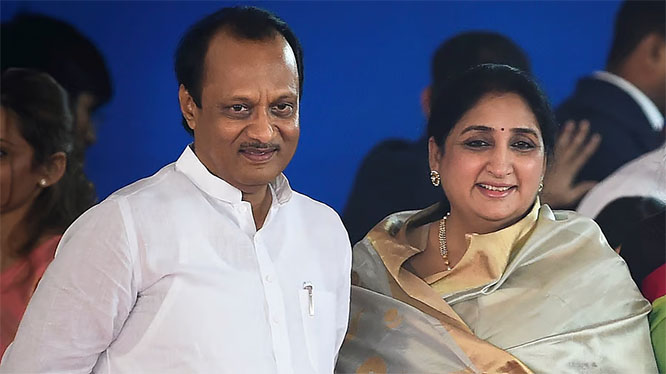
In the NCP, Praful Patel is the Working President and Raigad MP Sunil Tatkare heads the state unit. Ajit Pawar’s wife, Sunetra Pawar, is a Rajya Sabha MP, while their sons Parth and Jay are not actively involved in day-to-day politics. Parth Pawar briefly entered electoral politics in 2019 but lost the Lok Sabha election from Maval. Jay Pawar’s political debut was under consideration.

With Ajit Pawar gone, speculation has intensified that a member of the family may be asked to assume a larger role. For now, Sunetra Pawar is expected to play a key coordinating role in party affairs, alongside Patel and Tatkare.

The NCP continues to have several heavyweight leaders, including Chhagan Bhujbal, Hasan Mushrif, Dattatreya Bharne, Manikrao Kokate and Dhananjay Munde.

Ajit Pawar had already begun steps towards reconciliation between the two factions. While they contested the Pune and Pimpri-Chinchwad municipal elections separately, they later decided to fight the zilla parishad elections together under the ‘clock’ symbol—seen as the first formal step towards reunification.

Nagpur meet and party roadmap

Both NCP factions claim adherence to the ideology of ‘Shiv–Shahu–Phule–Ambedkar’. At the Rashtravadi Chintan Shivir held in Nagpur on September 19, 2025, the NCP reaffirmed its commitment to sarva dharma sambhav and discussed strengthening ties with the BJP “for the welfare and development of Maharashtra”.

In recent days, reports had suggested Ajit Pawar might return to the Maha Vikas Aghadi following the party’s poor performance in Pune municipal elections, but these claims were denied.

Big question for Maha Yuti

Ajit Pawar’s death also presents an immediate challenge for the Devendra Fadnavis-led Maha Yuti government. Pawar held crucial portfolios, including Finance, Planning and Excise. With the Budget Session approaching, appointing a new Finance Minister has become urgent.

Beyond numbers and portfolios, Maha Yuti has lost a swift decision-maker known for his administrative grip and political finesse—leaving a vacuum that will not be easy to fill.

Comments

Add new comment

  • Coastaldigest.com reserves the right to delete or block any comments.
  • Coastaldigset.com is not responsible for its readers’ comments.
  • Comments that are abusive, incendiary or irrelevant are strictly prohibited.
  • Please use a genuine email ID and provide your name to avoid reject.