



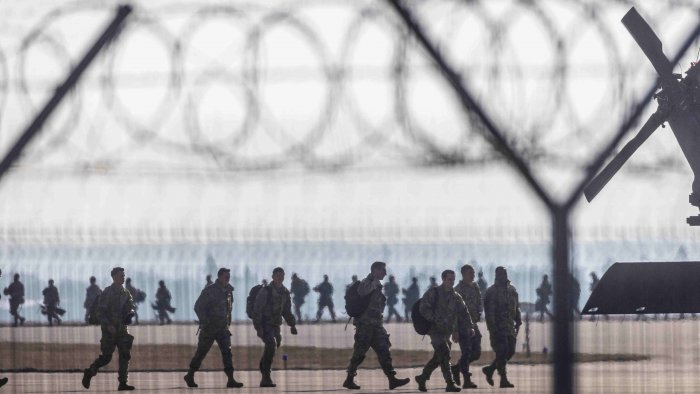
Ukraine tensions escalate as West accuses Russia of lying about troop withdrawal

Agencies
February 17, 2022

russia.jpg

Tensions over Ukraine abruptly ratcheted up Wednesday as Western officials accused Russia of lying about whether it had really begun pulling back troops from the Ukrainian border.

After days marked by flickers of hope that the conflict might be resolved peacefully, a senior US official, who refused to be quoted by name, told reporters that far from winding down its deployment, Moscow had added more than 7,000 combatants. Western allies expressed similar doubts about the Russian claims.

The US official directly accused Russia of lying, saying there was fresh evidence it was mobilizing for war.

British military officials said Wednesday they had spotted Russian armored vehicles, helicopters and a field hospital moving toward Ukraine’s border.

“Contrary to their claims, Russia continues to build up military capabilities near Ukraine,” Lt. Gen. Jim Hockenhull, the British chief of defense intelligence, said in a statement. “Russia has the military mass in place to conduct an invasion of Ukraine.

The Western warnings contrasted sharply with Russia’s attempts to show that it was de-escalating.

Only hours earlier, the Russian Defense Ministry had released a video of a military convoy departing Crimea over the 12-mile bridge to Russia that President Vladimir Putin ordered built after the peninsula’s 2014 annexation. And the Kremlin’s spokesperson praised the United States for being willing to negotiate and for offering constructive ideas.

With the sudden turn of events Wednesday night, the outlines of any diplomatic solution to the crisis once again looked very hard to discern.

In recent days, US officials had pointedly declined to accept Russian claims of a pullback.

On Wednesday, Secretary of State Antony Blinken, in an interview on MSNBC, said that the military units critical for an invasion force were continuing to move “toward the border, not away from the border.”

To some extent, the battle between the West and Moscow over Ukraine has been one of signaling. To keep international pressure on Russia high, the United States has repeatedly declared that an invasion was near, even imminent. Moscow, in turn, has repeatedly accused Washington of exaggerating the threat.

But beyond the verbal dueling, real troops have been repositioned.

In Brussels, defense ministers from the NATO countries discussed ways to reinforce military positions on their eastern perimeter, while the group’s secretary-general, Jens Stoltenberg, said he also saw nothing to support Russia’s claim of a drawdown. “What we see is that Russian troops are moving into position,” Stoltenberg said.

Mixed signals have been emanating virtually daily from Kyiv and Moscow, posing a challenge for diplomats, analysts and military planners. All sides are following delicate strategies, trying to appear resolute but not inflexible, so as to avoid blame in the event of war.

“There’s a lot of bluffing,” said Igor Novikov, a former foreign policy adviser to President Volodymyr Zelenskyy of Ukraine. “It’s a poker game at the moment. But a very dangerous poker game.”

After talking up the prospects for diplomacy in recent days, Putin went silent on the crisis, taking no questions after meeting with President Jair Bolsonaro of Brazil, although his government continued to telegraph openness to diplomacy and dismissed the idea of an invasion.

For Putin, Russian analysts said, the plan remained to use the threat of war to achieve far-reaching objectives that he would prefer to attain peacefully: a rollback of NATO’s presence in Eastern Europe and the recognition of a Russian sphere of interest in the region, including Ukraine.

Dmitri Trenin, director of the Carnegie Moscow Center, said he expected many Russian troops to remain positioned near the border, in part to maintain that state of tension. “He will keep the pressure on until he gets a satisfactory answer to his main question,” he said.

Putin appeared to dial down tensions this week in part because he had already made important early gains in a diplomatic effort that could still last for months. The United States, for instance, said it was prepared to revive talks on the placement of short and intermediate-range missiles in Europe. Some dialogue had already begun last year.

Putin has multiple ways to keep the pressure on, among them ominous new military moves, disinformation and cyberattacks. He can also wield political tactics like Tuesday’s vote in Russia’s Kremlin-controlled parliament that called on Putin to recognize the independence of Russian-backed separatists in eastern Ukraine, a move that he said he was not yet prepared to make.

“We are at the end of the beginning,” Trenin said, suggesting negotiations could continue for some time. “The game itself is still to come.”

One aspect has already emerged into public view: a discussion underway by European, Russian and Ukrainian leaders and officials over whether Ukraine might resolve the threat by abandoning its ambitions to join NATO.

After months of rejecting the Kremlin’s demands that NATO rule out Ukraine’s membership, US officials have also begun to signal that the question is one for Ukrainians themselves to decide. Even Zelenskyy has softened a bit recently, saying, “It seems to me that no one is hiding it anymore.”

Analysts say the trick will be to devise a plan that will be acceptable to the Kremlin without provoking a backlash in Ukraine that could destabilize the government.

“Everyone must step back a bit here and make it clear to themselves that we just can’t have a possible military conflict over a question that is not on the agenda,” German Chancellor Olaf Scholz said after meeting with Putin on Tuesday, speaking of Ukrainian NATO membership.

A Ukrainian deputy prime minister, Iryna Vereshchuk, suggested a referendum as a way to sell what would surely appear to be a concession to the Ukrainian public.

“The president assumes there is such a possibility, if there are no other options or tools,” Vereshchuk said in an interview on Ukrainian television. The prospects of Russia agreeing to a referendum are uncertain, as preparations could take months, during which it would be costly for Moscow to continue to maintain the threat of an imminent invasion.

But in a signal of possible US support, Wendy R. Sherman, a deputy secretary of state who in earlier rounds of talks had refused to accede to Russian demands that the United States rule out NATO membership for Ukraine, said in an interview published Wednesday that the United States would support any decision made by the Ukrainians.

“This decision remains with the Ukrainian people, what they want, where they see their future,” Sherman told Yevropaiska Pravda, a Ukrainian news outlet. “This is your choice.”

It seems certain that Putin will not be satisfied with simple assurances that Ukraine has no intention of joining NATO currently or a vague moratorium. “They are telling us it won’t happen tomorrow,” he said Tuesday. “Well, when will it happen? The day after tomorrow?”

Analysts have suggested setting a length for a moratorium, say 20-25 years, to assuage Putin’s misgivings.

Scholz pressed the idea of a lengthy delay, saying any Ukrainian entry into NATO was not likely during either of their terms in office. “I don’t know how long the president intends to stay in office,” he said, in a rare barb by a German leader directed at Putin. “I have a feeling for a little while yet, but certainly not forever.”

Senior Russian officials had some fun of their own, needling Washington for its prediction that an invasion could start Wednesday — perhaps in the wee hours of the morning, according to some news reports. Maria Zakharova, the Foreign Ministry’s often caustic spokesperson, said she would appreciate US and British news outlets publishing the schedules for Russia’s “invasions” in the coming year, because “I’d like to plan my vacation.”

Comments

Add new comment

  • Coastaldigest.com reserves the right to delete or block any comments.
  • Coastaldigset.com is not responsible for its readers’ comments.
  • Comments that are abusive, incendiary or irrelevant are strictly prohibited.
  • Please use a genuine email ID and provide your name to avoid reject.
News Network
February 1,2026

US President Donald Trump on Saturday claimed that the government of India led by Prime Minister Narendra Modi has made a deal to buy Venezuelan oil, as opposed to purchasing it from Iran.

"We've already made that deal, the concept of the deal," he told reporters on Air Force One.

Trump had imposed 25% tariffs on countries buying Venezuelan oil, including India, in March 2025. He had also hit India with tariffs for buying Russian oil, saying it was "funding" President Vladimir Putin's war against Ukraine.

Trump has said that the US has taken control of the oil-rich Venezuela after capturing former President Nicolas Maduro in January.

A fleet of 18 ships loaded with crude oil bound for refineries in Texas, Louisiana, and Mississippi in January, the most since December 2024, according to a report by the news agency Bloomberg.

Combined crude deliveries to the US will reach about 2,75,000 barrels a day, more than doubling volumes seen in December last year. Shipments to China, which averaged 4,00,000 barrels a day last year, fell to zero in January.

PM Modi, Venezuelan President Agree To Expand Ties

Prime Minister Narendra Modi and Venezuela's acting President Delcy Rodriguez spoke on Friday and agreed to take the bilateral relations to "new heights" in the years ahead.

It was the first phone call between the two leaders since the capture of Maduro and his wife by the US on January 3.

"Spoke with Acting President of Venezuela, Ms. Delcy Rodriguez. We agreed to further deepen and expand our bilateral partnership in all areas, with a shared vision of taking India-Venezuela relations to new heights in the years ahead," PM Modi said in a post on X.

A statement from Prime Minister Modi's office said the two leaders agreed to further expand and deepen the India-Venezuela partnership in all areas, including trade and investment, energy, digital technology, health, agriculture, and people-to-people ties.

They exchanged views on various regional and global issues of mutual interest and underscored the importance of their close cooperation for the Global South, the statement said.

Rodriguez also said that they discussed partnerships in the fields of agriculture, science and technology, mining, and tourism, as well as the pharmaceutical and automotive industries.

Comments

Add new comment

  • Coastaldigest.com reserves the right to delete or block any comments.
  • Coastaldigset.com is not responsible for its readers’ comments.
  • Comments that are abusive, incendiary or irrelevant are strictly prohibited.
  • Please use a genuine email ID and provide your name to avoid reject.
News Network
January 23,2026

oscar.jpg

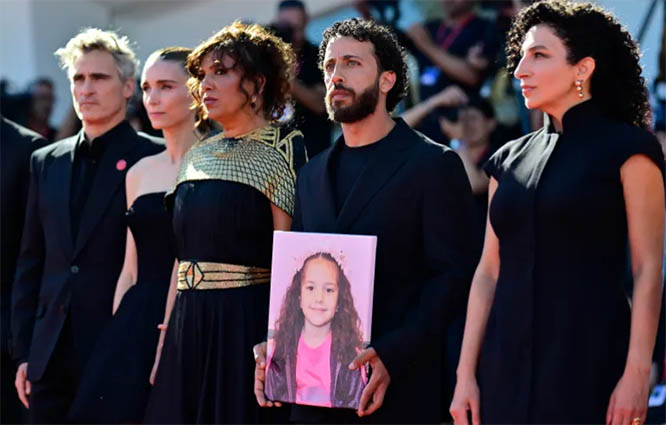
The Voice of Hind Rajab, inspired by the tragic final moments of a young Palestinian girl killed by Israeli fire in Gaza, has been nominated for an Academy Award in the Best International Feature Film category.

Directed by Tunisian filmmaker Kaouther Ben Hania, the film recounts the true story of five-year-old Hind Rajab, who lost her life in January 2024 while fleeing Israeli bombardment with her family.

The film features the real audio of Hind’s desperate call to the Palestinian Red Crescent Society, where she pleaded for help moments before the vehicle she was in was struck by 355 bullets.

The haunting narrative begins with a brief call made from the besieged Tel al-Hawa neighborhood of Gaza, where gunfire and armored vehicles drowned out every sound.

After witnessing the brutal killing of her family, she made a trembling call, her voice reduced to a whisper as she spoke of the massacre and her unbearable loneliness as the sole survivor.

Premiering at the Venice International Film Festival in September 2025, The Voice of Hind Rajab garnered widespread acclaim, receiving a record-setting 23-minute standing ovation and the Silver Lion Grand Jury Prize, the festival’s second-highest honor.

In her acceptance speech, Ben Hania dedicated the film to humanitarian workers and first responders in Gaza, emphasizing that Hind's voice symbolizes countless civilians affected by war.

She aims to give voice to victims often reduced to mere statistics, highlighting the broader suffering of civilians in war zones.

The film’s Oscar nomination underscores its powerful storytelling and ethical approach to depicting real-life tragedy, making it a crucial piece of contemporary cinema.

It serves not only as a narration of individual tragedy but also as an artistic and documentary response to the silence and censorship that often overshadow West Asian struggles and wars.

Using an innovative method she calls docufiction, Ben Hania bridges unvarnished reality and narrative structure, creating a work that is both artistically valuable and socially impactful.

Born in 1977 in Sidi Bouzid—later the epicenter of the Arab revolution—her background profoundly influenced her worldview and artistic approach.

She is a graduate of the Higher School of Audiovisual Arts of Tunis, Pantheon-Sorbonne University, and La Fémis in Paris, where her studies equipped her with the technical and theoretical tools needed to address complex subjects. 

Comments

Add new comment

  • Coastaldigest.com reserves the right to delete or block any comments.
  • Coastaldigset.com is not responsible for its readers’ comments.
  • Comments that are abusive, incendiary or irrelevant are strictly prohibited.
  • Please use a genuine email ID and provide your name to avoid reject.
News Network
January 31,2026

trumpkill.jpg

The US Department of Justice has released millions of new documents linked to the case of convicted child sex offender Jeffrey Epstein, before removing some pages that contained complaints mentioning President Donald Trump.

Deputy Attorney General Todd Blanche said on Friday that approximately 3.5 million files were published to comply with the Epstein Transparency Act, following criticism that the administration had missed a December 19 deadline set by Congress.

The documents include FBI communications and complaints submitted as tips, some of which list comments mentioning Trump and others who had social or professional ties to Epstein.

Trump has repeatedly denied any wrongdoing in relation to his past association with Epstein.

Pages removed from DOJ website

After their publication, pages containing complaints that mentioned Trump were removed from the DOJ website and now return a “page not found” message. Copies of the documents, however, have circulated widely on social media. CNN anchor Jake Tapper was among those who publicly noted that the pages had been taken down.

One complaint, filed by a friend of a victim, says Trump forced a girl aged 13–14 to perform “oral sex” approximately 35 years ago in New Jersey. The document states that an investigator was sent to Washington to conduct an interview.

Another complaint says Trump regularly paid an individual to perform sexual acts and adds that he was present when her newborn child was murdered by a relative. The paperwork notes that there was “no contact made” with the complainant.

A separate complaint, which provided no contact information, said “calendar girls” parties at Trump’s Mar-a-Lago involved children and sexual abuse. The document also names several public figures as present at such events.

In another account, a complainant said they witnessed a “sex trafficking ring” at Trump National Golf Club in Rancho Palos Verdes, California, in the mid-1990s. The person noted “threats” from Trump’s head of security if she spoke publicly about what she had seen.

Other figures mentioned in the files

The latest release also includes a draft email Epstein wrote to himself in 2013, referring to Microsoft co-founder Bill Gates. In the message, Epstein said Gates asked him to delete emails and referenced “personal matters.”

The DOJ has not provided a detailed explanation for why certain pages were removed after publication. The department said the document release was ongoing.

Comments

Add new comment

  • Coastaldigest.com reserves the right to delete or block any comments.
  • Coastaldigset.com is not responsible for its readers’ comments.
  • Comments that are abusive, incendiary or irrelevant are strictly prohibited.
  • Please use a genuine email ID and provide your name to avoid reject.