



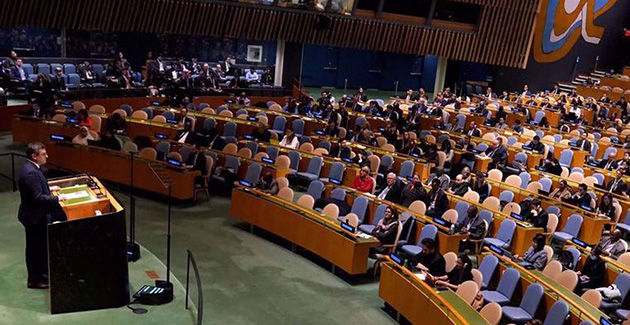
The United Nations General Assembly has asked Russia to withdraw its troops from Ukraine and prioritize on finding a diplomatic solution to the crisis in the former Soviet state as the US slapped fresh sanctions on Moscow.
A two-thirds majority of the UN body, who met for a special session of the UN General Assembly on Thursday, voted -- 141 for and 7 against while the rest, including heavyweights China and India, chose abstention -- in favor of a resolution that demanded Russian troops' withdrawal from Ukraine.
The resolution called for Russia to "immediately, completely and unconditionally" pull out its forces from Ukraine, and shift the Russian government’s focus on diplomatic means to establish a lasting peace between Moscow and Kiev.
The non-binding resolution, which was set forth by Germany, carries symbolic weight by signifying Russia's continued isolation on the world stage ahead of Friday's first anniversary of Russia’s February 24, 2022 start of a special military operation in pro-Russia speaking regions of eastern Ukraine with the aim of de-Nazifying the Donbas and other pro- Moscow areas in the former Soviet country.
Addressing the Assembly, Iran’s UN Ambassador Saeed Iravani said all parties involved in the Ukraine war should abandon military ambitions and prioritize a diplomatic solution to achieve sustainable peace.
Meanwhile, UN Secretary-General Antonio Guterres called the Russian campaign an “affront to our collective conscience.”
Guterres described the anniversary of Russia’s military ops as “a grim milestone for the people of Ukraine and for the international community.”
The US Ambassador to the UN, Linda Thomas-Greenfield, described the vote in favor of the anti-Russia resolution as a "historic" event and called on Russian troops to "withdraw immediately, completely and unconditionally from Ukraine's internationally recognized territory.” "Send your troops home."
The White House’s Press Secretary Karine Jean-Pierre, in related news, told reporters on Thursday that the US aimed to slap more sanctions against Russia over the war in Ukraine.
"The United States will implement sweeping sanctions against key sectors that generate revenue for Putin," she said.
She said at a virtual summit on Friday attended by leaders of the G7 countries -- Britain, Canada, France, Germany, Italy, Japan and the United States -- that will also be joined by Ukrainian President Volodymyr Zelensky, the group will jointly announce their anti-Moscow stance in favor of Kiev.
"Leaders will discuss how we continue supporting Ukraine," Jean-Pierre said.
However, she would not say whether the new US measures would be mirrored by the G7 partners.
Among the new targets of the fresh anti-Moscow sanctions will be banks and entities that help Moscow evade the waves of sanctions already imposed on Russia.
The United States will target Russian banks and the defense industry, as well as "actors in third-party countries that are attempting to backfill and evade our sanctions," Jean-Pierre said.
"We will also announce new economic energy and security assistance to help the Ukrainians continue to succeed, protect the people from Russian aggression and enable the Ukrainian government to provide basic services such as electricity and heat," she said.
Since the start of Russia’s military campaign in Ukraine, the US-led Western countries have supplied Kiev with funds, arms and munitions, as well as all-out political support.

Comments
Add new comment