



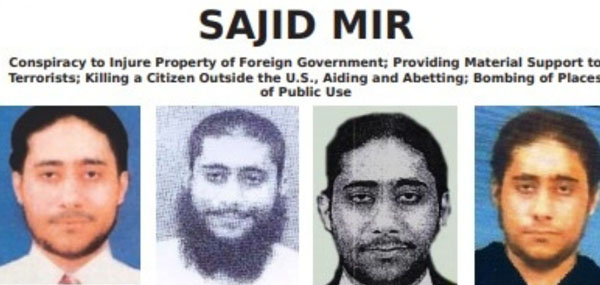
Years after claiming he is dead, Pakistan quietly jails Mumbai terror attack handler for 15 years

Agencies
June 25, 2022

sajidmir.jpg

Lahore, Jun 25: Sajid Majeed Mir, one of India’s most wanted terrorists on whom the US has placed a bounty of USD 5 million for his role in the 26/11 Mumbai terror attacks, has been jailed for over 15 years in a terror-financing case by an anti-terrorism court in Pakistan, which is struggling to exit the grey list of the FATF.

The Counter Terrorism Department (CTD) of the Punjab Police, which often issues convictions of the suspects in such cases to the media, did not notify Mir’s conviction.

His sentencing comes as Islamabad prepares for on site visit by the officials from the global terror financing watchdog Financial Action Task Force (FATF) to verify the implementation of Pakistan’s relevant anti-money laundering and terrorism-financing reforms.

“An anti-terrorism court in Lahore early this month had handed down 15 and a half years jail term to Sajid Majeed Mir, an activist of banned Lashkar-e-Taiba (LeT), in a terror-financing case,” a senior lawyer associated with terror financing cases of LeT and Jamaat-ud-Dawa (JuD) leaders told PTI on Friday.

Besides, since it was an in-camera proceeding at the jail, the media was not allowed.

The lawyer further said Mir has been in the Kot Lakhpat jail in Lahore since his arrest in April. He said the court also imposed a fine of over Rs 400,000 on the convict.

Pakistani authorities had in the past claimed he had died, but Western countries remained unconvinced and demanded proof of his death. This issue became a major sticking point in FATF’s assessment of Pakistan’s progress on the action plan late last year. This was where things finally started moving in Mir’s case leading to his ‘arrest’, the Dawn newspaper reported on Saturday.

His conviction and sentencing were, therefore, major achievements that Pakistani officials showcased in their progress report given to FATF on its action plan during the latest plenary, the paper commented.

It indeed helped in convincing FATF members that Pakistan had finished all the required tasks, it added.

Mir, 44, is on the FBI’s list of most-wanted terrorists. He has a USD five million reward on his head.

Mir is on India’s most-wanted list for his role in the 26/11 Mumbai attacks that left 166 people dead, including six Americans.

Before the last meeting of the Financial Action Task Force (FATF), Pakistan reportedly told the agency that it had arrested and prosecuted Sajid Mir in order to seek its removal from the global anti-laundering body’s ‘Grey list’.

Mir was called the “project manager” of the Mumbai attacks. Mir reportedly had visited India in 2005 using a fake passport with a fake name.

The FBI says that “Mir is wanted for his alleged involvement in the 2008 terrorist attacks in Mumbai, India. Beginning on November 26, 2008, and continuing through November 29, 2008, ten LeT attackers carried out a series of coordinated attacks against multiple targets in Mumbai, including hotels, cafes, and a train station, killing approximately 170 people.

“Six Americans were killed during the three-day attacks. Mir allegedly served as the chief planner of the attacks, directing preparations and reconnaissance, and was one of the Pakistan-based controllers during the attacks. Additionally, Mir allegedly conspired to commit a terrorist attack against a newspaper and its employees in Denmark between 2008 and 2009,” it said.

“Mir was indicted in the US District Court, Northern District of Illinois, Eastern Division, Chicago, Illinois, on April 21, 2011, and was charged with conspiracy to injure the property of a foreign government; providing material support to terrorists; killing a citizen outside of the US and aiding and abetting; and bombing of places of public use. An arrest warrant was issued on April 22, 2011,” it said.

Mumbai terror attacks’ alleged mastermind and JuD chief Hafiz Saeed has already been sentenced to 68 years imprisonment in terror financing cases by the Lahore anti-terrorism court.

The sentence is running concurrently, which means he will not have to spend many years in jail.

Mumbai attack operation commander Zakiur Rehman Lakhvi is also sentenced to several years in jail. Both Saeed and LeT militant Abdul Rehman Makki are also in Kot Lapkhapt jail in Lahore.

Saeed, a UN-designated terrorist on whom the US has placed a USD 10 million bounty, was arrested in July 2019 in the terror financing cases.

Saeed-led JuD is the front organisation for the LeT which is responsible for carrying out the 2008 Mumbai attack.

The US Department of the Treasury has designated Saeed as a Specially Designated Global Terrorist.

The global terror financing watchdog Financial Action Task Force (FATF) is instrumental in pushing Islamabad to take measures against terrorists roaming freely in Pakistan and using its territory to carry out attacks in India.

The FATF had placed Pakistan on the grey list in June 2018 and asked Islamabad to implement a plan of action to curb money laundering.

Last week, the Paris-based FATF said Pakistan will continue to be on the “Grey List” of countries under increased monitoring, a statement from the Paris-based global money-laundering and terror-financing watchdog said on Friday.

It said Pakistan may be removed from the list after an on-site visit to verify the implementation of its reforms on countering terror-financing mechanisms.

Comments

Add new comment

  • Coastaldigest.com reserves the right to delete or block any comments.
  • Coastaldigset.com is not responsible for its readers’ comments.
  • Comments that are abusive, incendiary or irrelevant are strictly prohibited.
  • Please use a genuine email ID and provide your name to avoid reject.
News Network
January 19,2026

trump.jpg

Donald Trump has linked his repeated threats to seize Greenland to his failure to win the Nobel Peace Prize, in a letter to Norwegian Prime Minister Jonas Gahr Støre.

The authenticity of the letter, in which Trump says he no longer feels obligated to “think purely of peace,” was confirmed by Støre to the Norwegian newspaper VG.

“Considering your country decided not to give me the Nobel Peace Prize for having stopped eight wars plus, I no longer feel an obligation to think purely of peace,” Trump wrote, adding he can now “think about what is good and proper for the United States.”

Støre said Trump’s letter was in response to a short message he had sent earlier, on behalf of himself and Finland’s President Alexander Stubb.

Trump has escalated rhetoric toward Greenland, a self-governing Danish territory, insisting the US will take control “one way or the other.” Over the weekend, he tweeted: “Now it is time, and it will be done!!!”

On Saturday, Trump threatened a 10% tariff on imports from Denmark, Norway, Sweden, France, Germany, the UK, the Netherlands, and Finland from 1 February until the US is allowed to purchase the island. EU diplomats met for emergency talks on possible retaliatory tariffs and sanctions.

In his letter, Trump argued Denmark “cannot protect” Greenland from Russia or China, questioning Danish ownership: “There are no written documents; it’s only that a boat landed there hundreds of years ago.” He added that NATO should support the US, claiming the world is “not secure unless we have complete and total control of Greenland.”

Trump’s stance has unsettled the EU and NATO, as he refused to rule out military action to take control of the mineral-rich island.

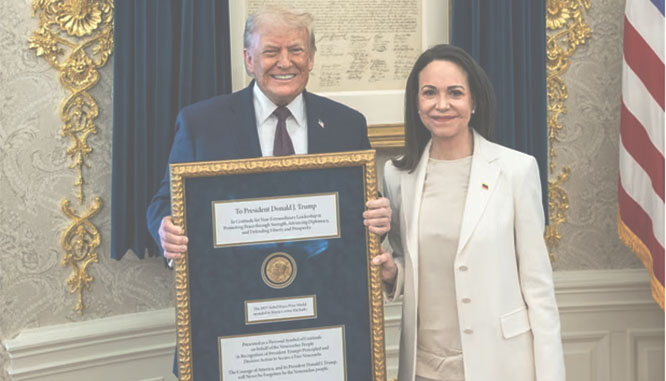
The Nobel Peace Prize is awarded by the independent Norwegian Nobel Committee, not the government. Trump had campaigned for last year’s prize, which went to Venezuelan opposition leader María Corina Machado, who dedicated her award to him.

Støre reiterated that the Nobel Prize decision rests solely with the committee.

Comments

Add new comment

  • Coastaldigest.com reserves the right to delete or block any comments.
  • Coastaldigset.com is not responsible for its readers’ comments.
  • Comments that are abusive, incendiary or irrelevant are strictly prohibited.
  • Please use a genuine email ID and provide your name to avoid reject.
News Network
January 23,2026

Karnataka Governor Thaawarchand Gehlot read only three lines from the 122-paragraph address prepared by the Congress-led state government while addressing the joint session of the Legislature on Thursday, effectively bypassing large sections critical of the BJP-led Union government.

The omitted portions of the customary Governor’s address outlined what the state government described as a “suppressive situation in economic and policy matters” under India’s federal framework. The speech also sharply criticised the Centre’s move to replace the Mahatma Gandhi National Rural Employment Guarantee Act (MGNREGA) with the Viksit Bharat–Guarantee for Rozgar and Ajeevika Mission (Gramin) Act, commonly referred to as the VB-GRAM (G) Act.

Governor Gehlot had earlier conveyed his objection to several paragraphs that were explicitly critical of the Union government. On Thursday, he confined himself to the opening lines — “I extend a warm welcome to all of you to the joint session of the State legislature. I am extremely pleased to address this august House” — before jumping directly to the concluding sentence of the final paragraph.

He ended the address by reading the last line of paragraph 122: “Overall, my government is firmly committed to doubling the pace of the State’s economic, social and physical development. Jai Hind — Jai Karnataka.”

According to the prepared speech, the Karnataka government demanded the scrapping of the VB-GRAM (G) Act, describing it as “contractor-centric” and detrimental to rural livelihoods, and called for the full restoration of MGNREGA. The state government argued that the new law undermines decentralisation, weakens labour protections, and centralises decision-making in violation of constitutional norms.

Key points from the unread sections of the speech:

•    Karnataka facing a “suppressive” economic and policy environment within the federal system

•    Repeal of MGNREGA described as a blow to rural livelihoods

•    VB-GRAM (G) Act accused of protecting corporate and contractor interests

•    New law alleged to weaken decentralised governance

•    Decision-making said to be imposed by the Centre without consulting states

•    Rights of Adivasis, women, backward classes and agrarian communities curtailed

•    Labourers allegedly placed under contractor control

•    States facing mounting fiscal stress due to central policies

•    VB-GRAM (G) Act accused of enabling large-scale corruption

Comments

Add new comment

  • Coastaldigest.com reserves the right to delete or block any comments.
  • Coastaldigset.com is not responsible for its readers’ comments.
  • Comments that are abusive, incendiary or irrelevant are strictly prohibited.
  • Please use a genuine email ID and provide your name to avoid reject.
News Network
January 20,2026

Mangaluru: In a major step towards strengthening rural innovation, the Office of the Principal Scientific Adviser (PSA) to the Government of India is supporting the establishment of RuTAGe Smart Village Centres (RSVCs) across the country through collaborations with academic institutions, civil society organisations and philanthropic partners.

As part of this national initiative, Nitte (Deemed to be University) will set up the first RSVCs in the region at Nitte GP in Udupi district and at the Nitte Health Centre, Sevanjali Trust, Farangipete, in Dakshina Kannada district. The centres will be inaugurated on January 21. In South India, the programme is being implemented by the Section Infin-8 Foundation (SI-8).

Speaking to reporters on Monday, SI-8 founder-director Vishwas US said experts from Nitte University and SI-8 would work closely with farmers, students, youth and local entrepreneurs to adapt and deploy technologies tailored to local needs.

Project head Prof Iddya Karunasagar, representing Nitte DU, said the RSVCs at Nitte and Farangipete would serve as demonstration hubs for a wide range of agriculture, energy, skill-development and assistive technologies. These include solar dryers for fruits, vegetables and crops; soil-testing solutions; power weeders and women-friendly farm tools; wind-powered devices for rural artisans; grain storage systems; grass-cutting and tree-climbing equipment; and liquid fertiliser production using cowshed waste.

SI-8 CEO Aravind C Kumar said the centres would also provide access to digital and knowledge-based platforms such as ISRO applications, government scheme portals, market linkage tools and gamified learning resources, along with assistive technologies for persons with visual impairments.

Highlighting the broader impact of the initiative, Principal Scientific Adviser Prof Ajay Kumar Sood said it demonstrated how applied research could bridge the rural–urban divide and help create self-reliant, technology-enabled villages.

The initiative has been made possible through philanthropic support from Dr NC Murthy of ACM Business Solutions, LLC, USA. Dr Sapna Poti, Director (Strategic Alliances) at the Office of the Principal Scientific Adviser, said the long-term objective is to build self-sufficient, technology-driven communities capable of generating sustainable livelihoods on their own.

Comments

Add new comment

  • Coastaldigest.com reserves the right to delete or block any comments.
  • Coastaldigset.com is not responsible for its readers’ comments.
  • Comments that are abusive, incendiary or irrelevant are strictly prohibited.
  • Please use a genuine email ID and provide your name to avoid reject.