‘1st time in Independent India': US on 'affecting status' of Muslims with CAA, NRC

News Network
December 27, 2019

Washington, Dec 27: The amended Citizenship law along with a National Register of Citizens (NRC) being planned by the Narendra Modi government "may affect the status" of Muslim minority in India, a report by the Congressional Research Service (CRS) has said.
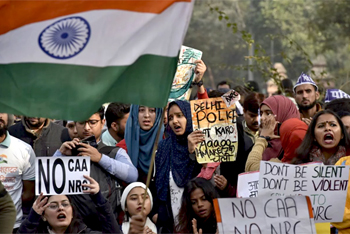
The December 18 report also said that for the first time in independent India's history, a religious criterion has been added to the country's naturalization process.

The CRS is an independent research wing of the US Congress which prepares reports periodically on issues of domestic and global importance for the lawmakers to take informed decision. These are not considered as official reports of the US Congress.

"In tandem with a National Register of Citizens (NRC) planned by the federal government, the CAA (Citizenship Amendment Act) may affect the status of India's large Muslim minority of roughly 200 million," said the CRS in its first ever report on the amended Citizenship law.

According to the Citizenship (Amendment) Act, non-Muslim refugees who came to India till December 31, 2014, to escape religious persecution in Pakistan, Bangladesh and Afghanistan will be given Indian citizenship.

Since both houses of Parliament approved amendments to the citizenship law earlier this month, protests - sometimes violent - have taken place across the country during which many protesters have died, especially in Uttar Pradesh and Karnataka.

"India's Citizenship Act of 1955 prohibited illegal immigrants from becoming citizens. Among numerous amendments to the act since 1955, none contained a religious aspect," the CRS said in its two-page report.

The changes sparked significant controversy, including large-scale and sometimes violent protests. Opponents of the CAA warn that Prime Minister Narendra Modi and his Bharatiya Janata Party (BJP) are pursuing a Hindu majoritarian, anti-Muslim agenda that threatens India's status as an officially secular republic and violates international human rights norms, it said.

The CRS claims that the amendment's key provisions allowing immigrants of six religions from three countries a path to citizenship while excluding Muslims may violate certain Articles of the Indian Constitution, in particular Articles 14 and 15.

The Citizenship (Amendment) Act was immediately challenged in the Supreme Court by scores of petitioners, but the court has refused to issue a stay on implementation and is deferring hearing petitions until January 22, it notes, adding that the government argues that the three specified countries have a state religion -- Islam -- resulting in persecution of religious minorities.

"Proponents say that Muslims do not face persecution in Pakistan, Bangladesh, or Afghanistan, and that the CAA is constitutional because it addresses migrants rather than Indian citizens," it said.

"Yet it is not clear why migrants from other neighbouring countries with state (or favoured) religions, such as Sri Lanka (where Buddhism is the official religion and Tamil Hindus face persecution) and Burma (where Buddhism enjoys primacy and Rohingya Muslims are persecuted), are excluded from a path to citizenship. In addition, oppressed Muslim minority communities such as Pakistan's Ahmadis and Shias enjoy no protection under the CAA," the CRS said.

"The New Delhi government maintains that the NRC update is a fair and non-discriminatory process driven by the Supreme Court that does not impose a religious test or render any persons 'stateless'," it said adding that the United Nations, the US Commission for International Religious Freedom, and independent human rights groups have expressed concerns about NRC.


Comments

Add new comment

  • Coastaldigest.com reserves the right to delete or block any comments.
  • Coastaldigset.com is not responsible for its readers’ comments.
  • Comments that are abusive, incendiary or irrelevant are strictly prohibited.
  • Please use a genuine email ID and provide your name to avoid reject.
News Network
January 23,2026

Mangaluru: The Karnataka Government Polytechnic (KPT), Mangaluru, has achieved autonomous status from the All India Council for Technical Education (AICTE), becoming the first government polytechnic in the country to receive such recognition in its 78-year history. The status was granted by AICTE, New Delhi, and subsequently approved by the Karnataka Board of Technical Education in October last year.

Officials said the autonomy was conferred a few months ago. Until recently, AICTE extended autonomous status only to engineering colleges, excluding diploma institutions. However, with a renewed national focus on skill development, several government polytechnics across India have now been granted autonomy.

KPT, the second-largest polytechnic in Karnataka, was established in 1946 with four branches and has since expanded to offer eight diploma programmes, including computer science and polymer technology. The institution is spread across a 19-acre campus.

Ravindra M Keni, the first dean of the institution, told The Times of India that AICTE had proposed autonomous status for polytechnic institutions that are over 25 years old. “Many colleges applied. In the first round, 100 institutions were shortlisted, which was further narrowed down to 15 in the second round. We have already completed one semester after becoming an autonomous institution,” he said. He added that nearly 500 students are admitted annually across eight three-year diploma courses.

Explaining the factors that helped KPT secure autonomy, Keni said the institution has consistently recorded 100 per cent admissions and placements for its graduates. He also noted its strong performance in sports, with the college emerging champions for 12 consecutive years, along with active student participation in NCC and NSS activities.

Autonomous status allows KPT to design industry-oriented curricula, conduct examinations, prepare question papers, and manage academic documentation independently. The institution can also directly collaborate with industries and receive priority funding from AICTE or the Ministry of Education. While academic autonomy has been granted, financial control will continue to rest with the state government.

“There will be separate committees for examinations, question paper setting, boards of studies, and boards of examiners. The institution will now have the freedom to conduct admissions without government notifications and issue its own marks cards,” Keni said, adding that new academic initiatives would be planned after a year of functioning under the autonomous framework.

Comments

Add new comment

  • Coastaldigest.com reserves the right to delete or block any comments.
  • Coastaldigset.com is not responsible for its readers’ comments.
  • Comments that are abusive, incendiary or irrelevant are strictly prohibited.
  • Please use a genuine email ID and provide your name to avoid reject.
News Network
January 20,2026

iran.jpg

Iranian security and intelligence forces have captured more than 470 individuals in three provinces, identified as key figures behind the recent wave of violent unrest and terrorist activities linked to foreign-backed networks.

The Intelligence Ministry's provincial office in Khorasan Razavi announced on Monday the arrest of 192 armed terrorists, identified as the main agents behind recent riots in the region. 

According to an official statement, the detainees were involved in the killing of several security personnel and civilians, setting fire to mosques, public service facilities, and buses, as well as attacks on military and law enforcement centers.

The seized items from the group include several bulletproof vests, Kalashnikov rifles, hunting weapons, Winchester rifles, and various cold weapons such as daggers, swords, brass knuckles, tactical knives, crossbows, and chains.

Evidence indicates that some of the individuals were tied to hostile movements and terrorist organizations, with links overseas. Others were identified as members of violent criminal gangs, actively taking part in the unrest alongside their associates.

Simultaneously, in the western province of Lorestan, the IRGC announced the arrest of 134 individuals as the main leaders and influential field agents of a US-Israeli terrorist network.

The IRGC statement stated that these individuals formed terrorist cells during the recent unrest, committing "Daesh-like" acts.

They wounded security forces with firearms and cold weapons, and burned and destroyed public and private properties, including mosques, shops, banks, and private and public vehicles.

In the northwestern province of Zanjan, the police reported detaining 150 people identified as principal leaders and agents behind recent riots.

Authorities noted that these individuals were responsible for destroying public and private property and intentionally setting fire to vehicles in the province's squares.

Their crimes include shedding the blood of innocent people, destroying public and private property, attempting to enter military sites, disrupting public order, and spreading terror among citizens.

A variety of cold weapons were reportedly seized from the detainees.

What began late last month as peaceful protests over economic hardship across Iran turned violent after public statements by US and Israeli regime figures encouraged vandalism and disorder.

During the unrest, foreign-backed mercenaries rampaged through cities, killing security forces and civilians and damaging public property.

Comments

Add new comment

  • Coastaldigest.com reserves the right to delete or block any comments.
  • Coastaldigset.com is not responsible for its readers’ comments.
  • Comments that are abusive, incendiary or irrelevant are strictly prohibited.
  • Please use a genuine email ID and provide your name to avoid reject.
News Network
February 3,2026

wind.jpg

Dakshina Kannada MP Capt Brijesh Chowta has urged the Centre to give high priority to offshore wind energy generation along the Mangaluru coast, citing its strategic importance to India’s green energy and port-led development goals.

Raising the issue in the Lok Sabha under Rule 377, Chowta said studies by the National Institute of Oceanography have identified the Mangaluru coastline as part of India’s promising offshore wind ‘Zone-2’, covering nearly 6,490 sq km. He noted that the region’s relatively low exposure to cyclones and earthquakes makes it suitable for long-term offshore wind projects and called for its development as a dedicated offshore wind energy zone.

Highlighting the role of New Mangalore Port, Chowta said its modern infrastructure, multiple berths and heavy cargo-handling capacity position it well as a logistics hub for transporting and assembling large wind energy equipment.

He also pointed to the presence of major industrial units such as MRPL, OMPL, UPCL and the Mangaluru SEZ, which could serve as direct buyers of green power through power purchase agreements, improving project viability and speeding up execution.

With Karnataka’s peak power demand crossing 18,000 MW in early 2025, Chowta stressed the need to diversify renewable energy sources. He added that offshore wind projects in the Arabian Sea are strategically safer compared to the cyclone-prone Bay of Bengal.

Calling the project vital to India’s target of 500 GW of renewable energy by 2030, Chowta urged the Ministry of New and Renewable Energy to initiate resource assessments, pilot projects and stakeholder consultations at the earliest.

Comments

Add new comment

  • Coastaldigest.com reserves the right to delete or block any comments.
  • Coastaldigset.com is not responsible for its readers’ comments.
  • Comments that are abusive, incendiary or irrelevant are strictly prohibited.
  • Please use a genuine email ID and provide your name to avoid reject.