



300 girl students taken ill due to chemical leakage in Delhi

May 6, 2017

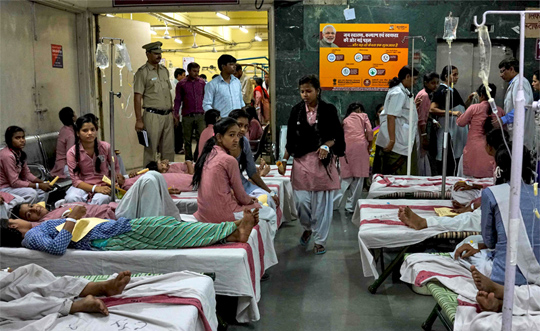
New Delhi, May 6: Over 300 students were hospitalised on Saturday after toxic fumes spread due to chemical leakage at a container depot near two schools in southeast Delhi's Tughlakabad area.
chemical

The students of Rani Jhansi School and Government Girls Senior Secondary School, run by the city administration, were rushed to nearby hospitals as they complained of irritation in eyes and breathlessness.

The Delhi government has ordered a magisterial probe into the incident. Police have registered an FIR in the matter under various sections of IPC and the Environment (Protection) Act.

Union minister JP Nadda has instructed all Centre-run hospitals to be ready to help the victims. A team of doctors from AIIMS has been put on stand-by to cater to any emergency.

A senior doctor at Batra hospital, where 55 children in the age group of 10-14 years were admitted, said their condition was stable.

According to the police, a call was received at 7:35am about some chemical leakage at customs area of Tughlaqabad depot, which is located near the schools.

The chemical in the container was imported from China and was to be taken to Sonepat in Haryana, it said.

Following the incident, teams of police and National Disaster Response Force (NDRF) as well as CATS ambulance reached the spot.

"Some chemical leakage at customs area of Tughlaqabad depot has caused eye irritation to the girl students in Rani Jhansi school," DCP(Southeast) Romil Baaniya said.

According to police, 310 students have received treatment in hospitals.

As many as 107 students were admitted in Majithia Hospital and 62 in Batra Hospital.

Some children had mild breathing difficulty, eye irritation and mild headache, the doctor at Batra Hospital said. Two children who had come with complaints of breathing difficulty were admitted in the paediatric ICU.

"The condition of all the children, including those admitted in the ICU, is stable. They are currently under observation and they are likely to be discharged in three to four hours," said the doctor.

Deputy chief minister Manish Sisodia said he has ordered the area district magistrate and SDM to launch a probe into the incident.

"There was an exam in the school which we have cancelled following the incident," he said.

Sisodia, who also holds education portfolio, said that he spoke to doctors who told him that all the students were doing fine and were under observation.

Lt governor Anil Baijal and opposition leader in Delhi assembly Vijender Gupta visited the victims at ESI Hospital and enquired about their condition.

Hitting out at the Delhi government, Gupta sought a high-level probe into the incident.

Gupta said it is "negligence" on the part of school authorities. At the time of opening the school there were signs of gas leakage. Why didn't the school authorities stop the students from entering the school?, he tweeted.

The chairperson of the Delhi Commission for Women (DCW), Swati Maliwal, met the children admitted in the Batra hospital and demanded shifting of the container depot.

"V sad. It is a man made disaster as no need for Container Depot to be in centre of Delhi. Shud b imm shifted, accountability fixed for gas leak," she tweeted.

Apollo hospital authorities said that the condition of 42 children and an adult admitted there was stable.

"Therapeutic interventions as per clinical requirements were administered to them. Currently, all patients are in a stable condition," the hospital said in a statement.

Comments

Add new comment

  • Coastaldigest.com reserves the right to delete or block any comments.
  • Coastaldigset.com is not responsible for its readers’ comments.
  • Comments that are abusive, incendiary or irrelevant are strictly prohibited.
  • Please use a genuine email ID and provide your name to avoid reject.
News Network
December 13,2025

New Delhi: School-going children are picking up drug and smoking habits and engaging in consumption of alcohol, with the average age of introduction to such harmful substances found to be around 13 years, suggesting a need for earlier interventions as early as primary school, a multi-city survey by AIIMS-Delhi said.

The findings also showed substance use increased in higher grades, with grade XI/XII students two times more likely to report use of substances when compared with grade VIII students. This emphasised the importance of continued prevention and intervention through middle and high school.

The study led by Dr Anju Dhawan of AIIMS's National Drug Dependence Treatment Centre, published in the National Medical Journal of India this month, looks at adolescent substance use across diverse regions.

The survey included 5,920 students from classes 8, 9, 11 and 12 in urban government, private and rural schools across 10 cities -- Bengaluru, Chandigarh, Delhi, Dibrugarh, Hyderabad, Imphal, Jammu, Lucknow, Mumbai, and Ranchi. The data were collected between May 2018 and June 2019.

The average age of initiation for any substance was 12.9 (2.8) years. It was lowest for inhalants (11.3 years) followed by heroin (12.3 years) and opioid pharmaceuticals (without prescription; 12.5 years).

Overall, 15.1 per cent of participants reported lifetime use, 10.3 per cent reported past year use, and 7.2 per cent reported use in the past month of any substance, the study found.

The most common substances used in the past year, after tobacco (4 per cent) and alcohol (3.8 per cent), were opioids (2.8 per cent), followed by cannabis (2 per cent) and inhalants (1.9 per cent). Use of non-prescribed pharmaceutical opioids was most common among opioid users (90.2 per cent).

On being asked, 'Do you think this substance is easily available for a person of your age' separately for each substance category, nearly half the students (46.3 per cent) endorsed that tobacco products and more than one-third of the students (36.5 per cent) agreed that a person of their age can easily procure alcohol products.

Similarly, for Bhang (21.9 per cent), ganja/charas (16.1 per cent), inhalants (15.2 per cent), sedatives (13.7 per cent), opium and heroin (10 per cent each), the students endorsed that these can be easily procured.

About 95 per cent of the children, irrespective of their grade, agreed with the statement that 'drug use is harmful'.

The rates of substance use (any) among boys were significantly higher than those of girls for substance use (ever), use in the past year and use in the past 30 days. Compared to grade VIII students, grade IX students were more likely, and grade XI/XII students were twice as likely to have used any substance (ever).

The likelihood of past-year use of any substance was also higher for grade IX students and for grade XI/XII students as compared to grade VIII students.

About 40 per cent of students mentioned that they had a family member who used tobacco or alcohol each. The use of cannabis (any product) and opioid (any product) by a family member was reported by 8.2 per cent and 3.9 per cent of students, respectively, while the use of other substances, such as inhalants/sedatives by family was 2-3 per cent, the study found.

A relatively smaller percentage of students reported use of tobacco or alcohol among peers as compared to among family members, while a higher percentage reported inhalants, sedatives, cannabis or opioid use among peers.

Children using substances (past year) compared to non-users reported significantly higher any substance use by their family members and peers.

There were 25.7 per cent students who replied 'yes' to the question 'conflicts/fights often occur in your family'. Most students also replied affirmatively to 'family members are aware of how their time is being spent' and 'damily members are aware of with whom they spend their time'.

Comments

Add new comment

  • Coastaldigest.com reserves the right to delete or block any comments.
  • Coastaldigset.com is not responsible for its readers’ comments.
  • Comments that are abusive, incendiary or irrelevant are strictly prohibited.
  • Please use a genuine email ID and provide your name to avoid reject.