



83% voter turnout in Goa, 70 % polling in Punjab

February 4, 2017

Chandigarh/Panaji, Feb 4: A high voter turnout of over 83 per cent was today recorded in the Assembly polls in Goa, where the ruling BJP is engaged in a fierce fight with the Opposition Congress, AAP and an alliance of MGP, Shiv Sena and GSM for the 40-member House.
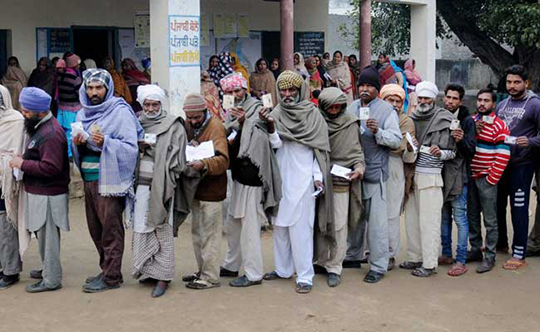
voters-punjab

According to EC sources, the poll percentage could go up as there are long queues of voters at many booths across the state even after 5 PM. Heavy polling was witnessed in the mining belt of Sankhalim, Bicholim and Curchorem.

The election passed off peacefully with no untoward incident reported from anywhere in the coastal state expect some cases of EVM glitches and cancellation of voting in one booth.

A 78-year-old man died outside a polling booth in Panaji city. Leslie Saldanha, who was waiting to cast his vote, collapsed and died, officials said. ECI's data from various polling booth showed that over 83 per cent of 11.10 lakh voters turned up to exercise franchise.

An impressive 83 per cent voting was recorded in the state in 2012 assembly polls, which saw the BJP wresting power from the Congress.

Defence Minister Manohar Parrikar, widely seen as the chief ministerial face of the BJP, Union Minister Shripad Naik and Chief Minister Laxmikant Parsekar were among the early voters who cast their ballots.

People in large numbers turned up at the polling stations right from the morning amid pleasant weather. A total of 250 contestants are in the fray, which include many independents.

The election is being closely fought by major political forces –- BJP, Congress, AAP and the MGP-led alliance. The polls will decide future of Goa's five former Chief Ministers –- Churchill Alemao, Pratapsinh Rane, Ravi Naik, Digambar Kamat and Luizinho Faleiro and the incumbent Parsekar.

BJP has put up 36 aspirants, Congress 37 and AAP is contesting on 39 seats and each of them backing independents in a few seats. BJP, which had a pre-poll alliance in 2012, is going it alone this time after the MGP snapped the partnership and forged a front with Goa Suraksha Manch floated by RSS rebel Subhas Velingkar and Shiv Sena. Counting of votes will be taken up on March 11.

Technical glitches, skirmishes at some places in Punjab

Punjab today recorded an estimated 70 per cent polling during which technical glitches and stray incidents of violence were reported in the state which is seeing a high-stake contest among Congress, new entrant AAP and ruling SAD-BJP combine.

"Nearly 70 per cent polling has taken place," an election office spokesman said here giving the preliminary figures of poll percentage. "Barring stray incidents of violence the polling in single-phase remained peaceful," Additional Director General of Police (ADGP- elections) V K Bhawra said.

Two persons were injured in a clash which took place between AAP and Congress workers at Sultanpur village in Sangrur district, police said.

In Tarn Taran district, a Congress worker identified as Jagjit Singh was injured when an Akali supporter allegedly opened fire at him outside a polling booth in Lalu Ghuman village, they said.

A large number of voter-verified paper audit trail (VVPAT) machines, installed for the first time in the ongoing Punjab Assembly polls, developed snags during the polling process in the state.

A technical snag was reported in VVPAT machines in Majitha and Sangrur, an election office spokesman said, adding that the matter had been referred to the ECI.

Due to a snag in the machines, polling had to be called off a number of times, Punjab Chief Electoral Officer (CEO) V K Singh said, adding that these machines were replaced by others.

Over 79 per cent electors had cast their votes in the 2012 assembly polls. The final figure of today's voting is still awaited as all those who were inside the polling booths will be allowed to vote, an election official spokesman said here.

Shortly before the polling was to end, Chief Minister Parkash Singh Badal "thanked Punjabis for peaceful polling and reposing faith in SAD-BJP alliance." A statement issued by Badal's spokesman quoted him as saying, "Moved by people's love despite negative agenda."

However, this time around 70 per cent out of the total 1.98 crore electors exercised their franchise to seal the fate of 1,145 candidates including Chief Minister Parkash Singh Badal, his son and Deputy, Sukhbir Singh Badal, Cabinet Minister Bikram Singh Majithia and Punjab Congress President and the party's chief ministerial candidate, Capt Amarinder Singh.

The total number of electors in the state is 1,98,79,069, including 93,75,546 females. There are 415 transgender voters. The total number of candidates in the fray include 81 women and a transgender.

Six persons were injured during a clash between Congress and SAD supporters at Ropowali village in Fatehgarh Churian constituency, police said.

In Majitha, a heated exchange of words took place between Akali candidate Bikram Singh Majithia and Congress candidate Sukhjinder Raj Singh Lalli after the former raised objection over allegedly bringing vehicles inside the polling station.

"Don't break the rules," Majithia, who is seeking re-election for third time from Majitha constituency, told his opponent, asking the driver to take the vehicles out of the polling booth.

A verbal duel took place between some media personnel and security staff deployed at one of the polling booths in Majitha constituency after the scribes alleged that they were not allowed to enter the polling booth by the security personnel despite authorisation, police said. A minor clash took place between Congress and BJP workers at Preet Nagar of Jalandhar Central constituency.

Another minor clash between SAD and AAP workers took place at Kotkapura in Faridkot district while there was report of a clash at Kalanaur in Batala between AAP and Congress workers, in which police had to use mild force to diffuse the situation.

Minor clashes also took place between Congress and BJP workers at Samrala village in Bhoa Assembly segment in Pathankot district. In Phillaur's Atta village, a verbal duel took place between Congress and Akali Dal workers. In Nangal village in Phillaur, a verbal duel took place between AAP and BSP workers.

Meanwhile, Moga district police booked Independent candidate Manjit Singh Mann, contesting from Moga constituency, under the provisions of the Representation of the People Act and and also under relevant section of the IPC, for campaigning after the deadline for the same had ended, Moga's Returning Officer said.

A 35-year-old man identified as Prakash, a resident of Bhim Nagar in Jalandhar, died due to suspected cardiac arrest, when he came out of the polling booth at a school in Bashirpura, Jalandhar, police said.


Comments

Add new comment

  • Coastaldigest.com reserves the right to delete or block any comments.
  • Coastaldigset.com is not responsible for its readers’ comments.
  • Comments that are abusive, incendiary or irrelevant are strictly prohibited.
  • Please use a genuine email ID and provide your name to avoid reject.
News Network
December 6,2025

pilot.jpg

New Delhi: IndiGo, India’s largest airline, faced major operational turbulence this week after failing to prepare for new pilot-fatigue regulations issued by the Directorate General of Civil Aviation (DGCA). The stricter rules—designed to improve flight safety—took effect in phases through 2024, with the latest implementation on November 1. IndiGo has acknowledged that inadequate roster planning led to widespread cancellations and delays.

Below are the key DGCA rules that affected IndiGo’s operations:

1. Longer Mandatory Weekly Rest

Weekly rest for pilots has been increased from 36 hours to 48 hours.

The government says the extended break is essential to curb cumulative fatigue. This rule remains in force despite the current crisis.

2. Cap on Night Landings

Pilots can now perform only two night landings per week—a steep reduction from the earlier limit of six.

Night hours, defined as midnight to early morning, are considered the least alert period for pilots.

Given the disruptions, this rule has been temporarily relaxed for IndiGo until February 10.

3. Reduced Maximum Night Flight Duty

Flight duty that stretches into the night is now capped at 10 hours.

This measure has also been kept on hold for IndiGo until February 10 to stabilize operations.

4. Weekly Rest Cannot Be Replaced With Personal Leave

Airlines can no longer count a pilot’s personal leave as part of the mandatory 48-hour rest.

Pilots say this closes a loophole that previously reduced actual rest time.

Currently, all airlines are exempt from this rule to normalise travel.

5. Mandatory Fatigue Monitoring

Airlines must submit quarterly fatigue reports along with corrective actions to DGCA.

This system aims to create a transparent fatigue-tracking framework across the industry.

The DGCA has stressed that these rules were crafted to strengthen flight safety and align India with global fatigue-management standards. The temporary relaxations are expected to remain until February 2025, giving IndiGo time to stabilise its schedules and restore normal air travel.

Comments

Add new comment

  • Coastaldigest.com reserves the right to delete or block any comments.
  • Coastaldigset.com is not responsible for its readers’ comments.
  • Comments that are abusive, incendiary or irrelevant are strictly prohibited.
  • Please use a genuine email ID and provide your name to avoid reject.
News Network
December 13,2025

New Delhi: School-going children are picking up drug and smoking habits and engaging in consumption of alcohol, with the average age of introduction to such harmful substances found to be around 13 years, suggesting a need for earlier interventions as early as primary school, a multi-city survey by AIIMS-Delhi said.

The findings also showed substance use increased in higher grades, with grade XI/XII students two times more likely to report use of substances when compared with grade VIII students. This emphasised the importance of continued prevention and intervention through middle and high school.

The study led by Dr Anju Dhawan of AIIMS's National Drug Dependence Treatment Centre, published in the National Medical Journal of India this month, looks at adolescent substance use across diverse regions.

The survey included 5,920 students from classes 8, 9, 11 and 12 in urban government, private and rural schools across 10 cities -- Bengaluru, Chandigarh, Delhi, Dibrugarh, Hyderabad, Imphal, Jammu, Lucknow, Mumbai, and Ranchi. The data were collected between May 2018 and June 2019.

The average age of initiation for any substance was 12.9 (2.8) years. It was lowest for inhalants (11.3 years) followed by heroin (12.3 years) and opioid pharmaceuticals (without prescription; 12.5 years).

Overall, 15.1 per cent of participants reported lifetime use, 10.3 per cent reported past year use, and 7.2 per cent reported use in the past month of any substance, the study found.

The most common substances used in the past year, after tobacco (4 per cent) and alcohol (3.8 per cent), were opioids (2.8 per cent), followed by cannabis (2 per cent) and inhalants (1.9 per cent). Use of non-prescribed pharmaceutical opioids was most common among opioid users (90.2 per cent).

On being asked, 'Do you think this substance is easily available for a person of your age' separately for each substance category, nearly half the students (46.3 per cent) endorsed that tobacco products and more than one-third of the students (36.5 per cent) agreed that a person of their age can easily procure alcohol products.

Similarly, for Bhang (21.9 per cent), ganja/charas (16.1 per cent), inhalants (15.2 per cent), sedatives (13.7 per cent), opium and heroin (10 per cent each), the students endorsed that these can be easily procured.

About 95 per cent of the children, irrespective of their grade, agreed with the statement that 'drug use is harmful'.

The rates of substance use (any) among boys were significantly higher than those of girls for substance use (ever), use in the past year and use in the past 30 days. Compared to grade VIII students, grade IX students were more likely, and grade XI/XII students were twice as likely to have used any substance (ever).

The likelihood of past-year use of any substance was also higher for grade IX students and for grade XI/XII students as compared to grade VIII students.

About 40 per cent of students mentioned that they had a family member who used tobacco or alcohol each. The use of cannabis (any product) and opioid (any product) by a family member was reported by 8.2 per cent and 3.9 per cent of students, respectively, while the use of other substances, such as inhalants/sedatives by family was 2-3 per cent, the study found.

A relatively smaller percentage of students reported use of tobacco or alcohol among peers as compared to among family members, while a higher percentage reported inhalants, sedatives, cannabis or opioid use among peers.

Children using substances (past year) compared to non-users reported significantly higher any substance use by their family members and peers.

There were 25.7 per cent students who replied 'yes' to the question 'conflicts/fights often occur in your family'. Most students also replied affirmatively to 'family members are aware of how their time is being spent' and 'damily members are aware of with whom they spend their time'.

Comments

Add new comment

  • Coastaldigest.com reserves the right to delete or block any comments.
  • Coastaldigset.com is not responsible for its readers’ comments.
  • Comments that are abusive, incendiary or irrelevant are strictly prohibited.
  • Please use a genuine email ID and provide your name to avoid reject.