



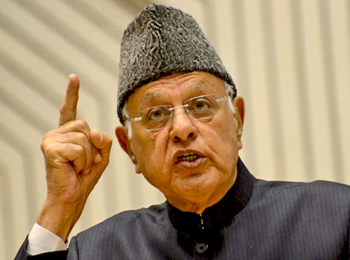
Abrogation of Art 370 will lead to massive unrest: Farooq

November 16, 2014

Farooq
London, Nov 16: Health woes have kept Farooq Abdullah far away from home but the three-term Chief Minister of Jammu and Kashmir says that his bigger worry today is BJP's "sinister" plan to abrogate the state's special status which will lead to "massive unrest".

For the first time in nearly four decades, the 77-year-old President of the ruling National Conference, who is in the UK for the last three months for treatment of failing kidneys, is unable to lead his party's campaign in an Assembly election.

"I am a batsman under treatment but raring to go back to the field," he said in an interview to PTI here, explaining that he was unlikely to be in a position to go back home before February next, well after the Nov-Dec polls.

"But believe me my bigger worry is the known agenda of the BJP to abrogate Article 370 of the Constitution which gives our state a special status for which commitments were given by Mahatma Gandhi and by the Government of India.

"They (BJP) will do anything to achieve their objectives. They will polarise this sensitive state as they have done in the rest of the country. They will strike deals with anyone," Abdullah said.

Warning of serious implications of abrogation of Art 370, he said, "there would be massive unrest in younger minds and we will never achieve peace."

About Prime Minister Narendra Modi, the veteran politician said, "I do not know whether he can go against the dictates of RSS on Art 370. It will be a great day for the entire nation when he understands the heartbeats of the people of Jammu and Kashmir."

Criticising BJP's attempts to rope in separatist leader Sajjad Lone who recently met Modi, Abdullah said, "people who have been strong supporters of an independent Kashmir are being wooed by the BJP. Were they not the people who created hell in the state?"

Abdullah regards the current election as "very significant" because it will decide the future of the state as to whether Jammu and Kashmir will continue to enjoy autonomy within the Constitution of India or Art 370 will be dismantled.

"My appeal to the people is to forget all differences, all pains and tribulations of the past and stand together against forces determined to dismantle Kashmiriyat," he said.

The former chief minister appealed to the separatist Hurriyat Conference not to boycott the election as "that will not help the situation but will only help those out to abrogate our special status".

He said that Jammu, Kashmir and Ladakh are one state and "they have to stand together for the future progress of the state".

He urged "my Hindu brethren not to forget the slogan of NC -- Hindu, Muslim, Sikh itehad (unity)" and added, "it is vital that the secular fabric of the state is not disturbed".

Abdullah urged his party workers to stand behind his son and current Chief Minister Omar in this crucial election.

Asked how he rated Omar's performance, the veteran leader said, "he has done well with all the difficulties that come in a coalition government. He has tried to serve the people sincerely and with dedication. He is honest and upright."

He referred to the recent devastating floods describing them as an unprecedented natural disaster.

"My heart goes out to the people who have suffered. The state government is doing whatever it can to rehabilitate them. I know there has been some criticism of the state administration but I also know that Omar plunged fully into relief and rehabilitation efforts," Abdullah said.

Abdullah said the NC's experience with its coalition partner Congress had been both good and bad. "The biggest stumbling block has been Saifuddin Soz, the state Congress President, who always created hurdles."

Asked if there was a possibility of NC and Congress again coming together after the election, he replied, "time alone will tell."

Abdullah was severe in his criticism of Mufti Mohammed Sayeed's PDP which he called "BJP's trojan horse".

"PDP is the creation of RSS and BJP to fight the National Conference. Behind the doors they are very much part of BJP. It is Team B of BJP," he claimed.

As for his own party, the NC leader ruled out any truck with the BJP. "We were part of NDA under Atal Bihari Vajpayee. He was a different person and those were different times."

Talking of the larger Kashmir issue, Abdullah said that New Delhi will have to find a solution through dialogue with Pakistan.

"Efforts must be made to settle the long-pending dispute in the best interests of the people of Jammu and Kashmir, India and Pakistan. There will have to be give and take on both sides. There cannot be one winner," he said.

Abdullah also said that borders cannot change and both Vajpayee and his successor Manmohan Singh had initiated the process of finding a solution with Pakistan President Pervez Musharraf based on no change of borders.

He urged the Modi government to look at the option of restoring the state's autonomy about which the state Assembly had passed resolutions during his tenure as the Chief Minister.

"Let them discuss it in Parliament. If any section weakens the Centre-State bond it can be done away with after that discussion."

Meanwhile, he favoured opening of the border between the two parts of Kashmir for all. "Let them (people of PoK) see how much progress we have made."

Asked if he had any regrets during his long political career, Abdullah responded with, "lots of regrets" before going on to list his failure to bring Kashmiri Pandits displaced by militancy back to their home. "Unless that happens Kashmir will never be the same."

He concluded the interview by saying that although he was not well, he hoped to be back with the people "to fight for a better future".


Comments

Add new comment

  • Coastaldigest.com reserves the right to delete or block any comments.
  • Coastaldigset.com is not responsible for its readers’ comments.
  • Comments that are abusive, incendiary or irrelevant are strictly prohibited.
  • Please use a genuine email ID and provide your name to avoid reject.
News Network
December 6,2025

pilot.jpg

New Delhi: IndiGo, India’s largest airline, faced major operational turbulence this week after failing to prepare for new pilot-fatigue regulations issued by the Directorate General of Civil Aviation (DGCA). The stricter rules—designed to improve flight safety—took effect in phases through 2024, with the latest implementation on November 1. IndiGo has acknowledged that inadequate roster planning led to widespread cancellations and delays.

Below are the key DGCA rules that affected IndiGo’s operations:

1. Longer Mandatory Weekly Rest

Weekly rest for pilots has been increased from 36 hours to 48 hours.

The government says the extended break is essential to curb cumulative fatigue. This rule remains in force despite the current crisis.

2. Cap on Night Landings

Pilots can now perform only two night landings per week—a steep reduction from the earlier limit of six.

Night hours, defined as midnight to early morning, are considered the least alert period for pilots.

Given the disruptions, this rule has been temporarily relaxed for IndiGo until February 10.

3. Reduced Maximum Night Flight Duty

Flight duty that stretches into the night is now capped at 10 hours.

This measure has also been kept on hold for IndiGo until February 10 to stabilize operations.

4. Weekly Rest Cannot Be Replaced With Personal Leave

Airlines can no longer count a pilot’s personal leave as part of the mandatory 48-hour rest.

Pilots say this closes a loophole that previously reduced actual rest time.

Currently, all airlines are exempt from this rule to normalise travel.

5. Mandatory Fatigue Monitoring

Airlines must submit quarterly fatigue reports along with corrective actions to DGCA.

This system aims to create a transparent fatigue-tracking framework across the industry.

The DGCA has stressed that these rules were crafted to strengthen flight safety and align India with global fatigue-management standards. The temporary relaxations are expected to remain until February 2025, giving IndiGo time to stabilise its schedules and restore normal air travel.

Comments

Add new comment

  • Coastaldigest.com reserves the right to delete or block any comments.
  • Coastaldigset.com is not responsible for its readers’ comments.
  • Comments that are abusive, incendiary or irrelevant are strictly prohibited.
  • Please use a genuine email ID and provide your name to avoid reject.
News Network
December 16,2025

bengal.jpg

The deletion of over 58 lakh names from West Bengal’s draft electoral rolls following a Special Intensive Revision (SIR) has sparked widespread concern and is likely to deepen political tensions in the poll-bound state.

According to the Election Commission, the revision exercise has identified 24 lakh voters as deceased, 19 lakh as relocated, 12 lakh as missing, and 1.3 lakh as duplicate entries. The draft list, published after the completion of the first phase of SIR, aims to remove errors and duplication from the electoral rolls.

However, the scale of deletions has raised fears that a large number of eligible voters may have been wrongly excluded. The Election Commission has said that individuals whose names are missing can file objections and seek corrections. The final voter list is scheduled to be published in February next year, after which the Assembly election announcement is expected. Notably, the last Special Intensive Revision in Bengal was conducted in 2002.

The development has intensified the political row over the SIR process. Chief Minister Mamata Banerjee and her Trinamool Congress have strongly opposed the exercise, accusing the Centre and the Election Commission of attempting to disenfranchise lakhs of voters ahead of the elections.

Addressing a rally in Krishnanagar earlier this month, Banerjee urged people to protest if their names were removed from the voter list, alleging intimidation during elections and warning of serious consequences if voting rights were taken away.

The BJP, meanwhile, has defended the revision and accused the Trinamool Congress of politicising the issue to protect what it claims is an illegal voter base. Leader of the Opposition Suvendu Adhikari alleged that the ruling party fears losing power due to the removal of deceased, fake, and illegal voters.

The controversy comes amid earlier allegations by the Trinamool Congress that excessive work pressure during the SIR led to the deaths by suicide of some Booth Level Officers (BLOs), for which the party blamed the Election Commission. With the draft list now out, another round of political confrontation appears imminent.

As objections begin to be filed, the focus will be on whether the correction mechanism is accessible, transparent, and timely—critical factors in ensuring that no eligible voter is denied their democratic right ahead of a crucial election.

Comments

Add new comment

  • Coastaldigest.com reserves the right to delete or block any comments.
  • Coastaldigset.com is not responsible for its readers’ comments.
  • Comments that are abusive, incendiary or irrelevant are strictly prohibited.
  • Please use a genuine email ID and provide your name to avoid reject.
