



Akhilesh releases SP manifesto; Mulayam, Shivpal give a miss

January 22, 2017

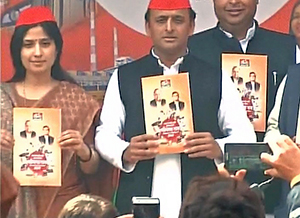
Lucknow, Jan 22: Ruling Samajwadi Party today released its manifesto for Uttar Pradesh Assembly elections promising a bunch of schemes for all round development of the state at a function which SP patron Mulayam Singh Yadav and his brother Shivpal gave a miss.
Akhilesh 12

With an eye on development, Akhilesh riding on the crest of "kaam bolta hai" (work speaks) slogan, announced schemes which prioritise development of the state.

The manifesto announced distribution of laptops, Kanya Vidya Dhan, Samajwadi Pension, laying of Purvanchal Expressway, and establishing Janeshwar Mishra model villages besides improving helplines for police and women.

He said the model villages in the name of Janeshwar Mishra would be a tribute to the Samajwadi leader on his death anniversary today.

The Chief Minister, in his new role as the Samajwadi Party national president, directed all candidates to prepare a road map for development of their respective Assembly constituencies.

A highlight of the manifesto was Samajwadi Kisan Kosh for farmers to purchase seeds and fertilisers, perhaps to match the Pradhan Mantri Kisan Bima Yojana.

As Mulayam and Shivpal, the warring uncle of Akhilesh, were conspicuous by their absence, senior SP leader Azam Khan rushed to the SP patriarch's bungalow to bring him to the event. But even then Mulayam did not grace the occasion where senior party leaders and Dimple Yadav, MP and wife of the chief minister were present.

In an impassioned appeal to the electorate to vote SP back to power, Akhilesh said, "We got support on 2012 manifesto, we also fulfilled promises made in it."

"The manifesto is a 'sankalp' (promise) to form future government. It's clear that we all want to form Samajwadi Party government. If you work for 5 years, you will get government of five years," he said.

The chief minister asked party workers to go to the masses and make them aware of the schemes implemented by his government during the past five years.

"A lot of work has been done in a big way. We have to work more in future. I tried for the past five years not to leave path of socialism and also ensure balanced development to improve rural economics," he said.

Akhilesh also ridiculed his political opponents, saying, "Some parties are there who have nothing to do."

He slammed BJP for its Lok Sabha poll promises and asked what happed to its 'Sab ka saath, sab ka vikas' slogan.

"People are desperately looking for those who had promised acche din," he said.
In a veiled attack on Prime Minsiter Narendra Modi, he said BJP has nothing to speak on development. "They sometimes give you 'jhadu' (broom) or ask you to perform yoga," he said.

He also took on BSP, claiming that the 'Patthar Wali Sarkar' has done nothing for UP except erecting stone statues of elephants, its poll symbol.

"If BSP comes to power, its government will install bigger elephant statues," he alleged.
The 32-page SP manifesto promises 24 hour power supply to villages and effective dial 100 so that police reaches within 10-15 minutes.

"In days to come, the government will move one step forward and ensure better connect with people. Samajwadi smartphone scheme is one effort," Akhilesh said, adding that already 1.40 crore registrations have been made for the same.

He said Samajawdi Party pension will benefit one crore people and Rs 1000 pension would be given to each one of them.

With an eye on the rural areas, he announced welfare schemes for labourers and added that poor women will be given pressure cookers.

The manifesto promised setting up of hostels for working women, mid-day meal for farm workers, free medical treatment to the poor and an end to 'inspector raj'.

It promised expansion of metro rail in Kanpur, Agra and Meerut. It also promised air ambulance at Lucknow, ambulance for animals, free treatment to those with Rs 1.5 lakh annual income and one litre ghee a month to improve the health of malnourished children.

Akhilesh exuded confidence that his party will sweep 300 of the 403 seats, up from 224 it had won in 2017.

Referring to his dream project, Lucknow-Agra expressway, he said it has reduced the travel time considerably.

"Those who have travelled know it the best," he said.

"If given chance, it (expressway) will reach Ghazipur and Ballia," he said.

The SP manifesto also promised setting up of 'mandi' (market) and skill develoment centres in rural areas to give a boost to the state's economy.

He said while SP was anxious for the state's development, BSP was preoccupied with bigger statues of elephants to surpass the huge statue of Janeshwar Mishra here or Shivaji statue in Maharashtra.

In an apparent reference to the ups and downs in the state politics, he turned philosophical and said, "Hame jaise jaise din dekhe the dekh liye, bahut kam samay mein...acche bure kharab sab dekh liye...

"Please tell me what is acche din...what is your definition of acchey din...many times attempts were made to vitiate the atmosphere in the state...trust me again and let us form government. Balanced development will be carried forward...," he said.

Earlier, addressing workers, party leader Ahmad Hasan termed BSP surpemo as "anti-Muslim", claiming that in her regime "there were no muslim DMs in any of 75 districts. Even an eligible Muslim officer was not made Chief Secretary."

"She had sought vote for Modi in Gujarat and you all should be aware of it," he said.
"In past five years, SP government has fulfilled all promises it made in its 2012 manifesto.

Akhilesh had faced challenges, both political and governance. But, we salute him for his initiatives. Everyone in the state trusts him," he said.

Hasan alleged that Mayawati had made a "record in corruption" and National Rural Health Mission scam alone was to the tune of over Rs 5,000 crore.

Party vice president Kironmay Nanda said this Assembly elections is crucial and SP will form government for the second time.

"There is no alternative to SP. In 2012, the state was backward and election was fought on the face of 'netaji' (Mulayam). We implemented all the schemes promised by us. UP will become Uttam Pradesh in our next regime," Nanda said.

New slogans like "Jiska UP, Uska Desh; Bachcha Bachcha Akhilesh" (Country belongs to that party which rules UP, it is Akhilesh all over).

Akhilesh's wife Dimple attended the manifesto release function for the first time and posed with him donning the bright red SP cap.


Comments

Add new comment

  • Coastaldigest.com reserves the right to delete or block any comments.
  • Coastaldigset.com is not responsible for its readers’ comments.
  • Comments that are abusive, incendiary or irrelevant are strictly prohibited.
  • Please use a genuine email ID and provide your name to avoid reject.
News Network
December 16,2025

jordan.jpg

Prime Minister Narendra Modi on Monday held talks with Jordan’s King Abdullah II in Amman, during which the two leaders discussed ways to further strengthen bilateral relations, with the Prime Minister outlining an eight-point vision covering key areas of cooperation.

Describing the meeting as “productive”, PM Modi said he shared a roadmap focused on trade and economy, fertilisers and agriculture, information technology, healthcare, infrastructure, critical and strategic minerals, civil nuclear cooperation, and people-to-people ties.

In a post on social media platform X, the Prime Minister praised King Abdullah II’s personal commitment to advancing India–Jordan relations, particularly as both countries mark the 75th anniversary of the establishment of diplomatic ties this year.

“Held productive discussions with His Majesty King Abdullah II in Amman. His personal commitment towards vibrant India-Jordan relations is noteworthy. This year, we are celebrating the 75th anniversary of our bilateral diplomatic relations,” PM Modi said.

The meeting took place at the Al Husseiniya Palace, where the two leaders also exchanged views on regional and global issues of mutual interest. According to the Ministry of External Affairs (MEA), both sides agreed to further deepen cooperation in areas including trade and investment, defence and security, counter-terrorism and de-radicalisation, fertilisers and agriculture, infrastructure, renewable energy, tourism, and heritage.

The MEA said both leaders reaffirmed their united stand against terrorism.

PM Modi arrived in Amman earlier on Monday and was received by Jordanian Prime Minister Jafar Hassan, who accorded him a formal welcome. Following the talks, King Abdullah II hosted a banquet dinner in honour of the Prime Minister, reflecting the warmth of bilateral ties.

Jordan is the first leg of PM Modi’s three-nation tour. From Amman, the Prime Minister will travel to Ethiopia at the invitation of Prime Minister Abiy Ahmed Ali, marking his first official visit to the African nation. The tour will conclude with a visit to Oman.

Comments

Add new comment

  • Coastaldigest.com reserves the right to delete or block any comments.
  • Coastaldigset.com is not responsible for its readers’ comments.
  • Comments that are abusive, incendiary or irrelevant are strictly prohibited.
  • Please use a genuine email ID and provide your name to avoid reject.
News Network
December 13,2025

New Delhi: School-going children are picking up drug and smoking habits and engaging in consumption of alcohol, with the average age of introduction to such harmful substances found to be around 13 years, suggesting a need for earlier interventions as early as primary school, a multi-city survey by AIIMS-Delhi said.

The findings also showed substance use increased in higher grades, with grade XI/XII students two times more likely to report use of substances when compared with grade VIII students. This emphasised the importance of continued prevention and intervention through middle and high school.

The study led by Dr Anju Dhawan of AIIMS's National Drug Dependence Treatment Centre, published in the National Medical Journal of India this month, looks at adolescent substance use across diverse regions.

The survey included 5,920 students from classes 8, 9, 11 and 12 in urban government, private and rural schools across 10 cities -- Bengaluru, Chandigarh, Delhi, Dibrugarh, Hyderabad, Imphal, Jammu, Lucknow, Mumbai, and Ranchi. The data were collected between May 2018 and June 2019.

The average age of initiation for any substance was 12.9 (2.8) years. It was lowest for inhalants (11.3 years) followed by heroin (12.3 years) and opioid pharmaceuticals (without prescription; 12.5 years).

Overall, 15.1 per cent of participants reported lifetime use, 10.3 per cent reported past year use, and 7.2 per cent reported use in the past month of any substance, the study found.

The most common substances used in the past year, after tobacco (4 per cent) and alcohol (3.8 per cent), were opioids (2.8 per cent), followed by cannabis (2 per cent) and inhalants (1.9 per cent). Use of non-prescribed pharmaceutical opioids was most common among opioid users (90.2 per cent).

On being asked, 'Do you think this substance is easily available for a person of your age' separately for each substance category, nearly half the students (46.3 per cent) endorsed that tobacco products and more than one-third of the students (36.5 per cent) agreed that a person of their age can easily procure alcohol products.

Similarly, for Bhang (21.9 per cent), ganja/charas (16.1 per cent), inhalants (15.2 per cent), sedatives (13.7 per cent), opium and heroin (10 per cent each), the students endorsed that these can be easily procured.

About 95 per cent of the children, irrespective of their grade, agreed with the statement that 'drug use is harmful'.

The rates of substance use (any) among boys were significantly higher than those of girls for substance use (ever), use in the past year and use in the past 30 days. Compared to grade VIII students, grade IX students were more likely, and grade XI/XII students were twice as likely to have used any substance (ever).

The likelihood of past-year use of any substance was also higher for grade IX students and for grade XI/XII students as compared to grade VIII students.

About 40 per cent of students mentioned that they had a family member who used tobacco or alcohol each. The use of cannabis (any product) and opioid (any product) by a family member was reported by 8.2 per cent and 3.9 per cent of students, respectively, while the use of other substances, such as inhalants/sedatives by family was 2-3 per cent, the study found.

A relatively smaller percentage of students reported use of tobacco or alcohol among peers as compared to among family members, while a higher percentage reported inhalants, sedatives, cannabis or opioid use among peers.

Children using substances (past year) compared to non-users reported significantly higher any substance use by their family members and peers.

There were 25.7 per cent students who replied 'yes' to the question 'conflicts/fights often occur in your family'. Most students also replied affirmatively to 'family members are aware of how their time is being spent' and 'damily members are aware of with whom they spend their time'.

Comments

Add new comment

  • Coastaldigest.com reserves the right to delete or block any comments.
  • Coastaldigset.com is not responsible for its readers’ comments.
  • Comments that are abusive, incendiary or irrelevant are strictly prohibited.
  • Please use a genuine email ID and provide your name to avoid reject.
News Network
December 6,2025

pilot.jpg

New Delhi: IndiGo, India’s largest airline, faced major operational turbulence this week after failing to prepare for new pilot-fatigue regulations issued by the Directorate General of Civil Aviation (DGCA). The stricter rules—designed to improve flight safety—took effect in phases through 2024, with the latest implementation on November 1. IndiGo has acknowledged that inadequate roster planning led to widespread cancellations and delays.

Below are the key DGCA rules that affected IndiGo’s operations:

1. Longer Mandatory Weekly Rest

Weekly rest for pilots has been increased from 36 hours to 48 hours.

The government says the extended break is essential to curb cumulative fatigue. This rule remains in force despite the current crisis.

2. Cap on Night Landings

Pilots can now perform only two night landings per week—a steep reduction from the earlier limit of six.

Night hours, defined as midnight to early morning, are considered the least alert period for pilots.

Given the disruptions, this rule has been temporarily relaxed for IndiGo until February 10.

3. Reduced Maximum Night Flight Duty

Flight duty that stretches into the night is now capped at 10 hours.

This measure has also been kept on hold for IndiGo until February 10 to stabilize operations.

4. Weekly Rest Cannot Be Replaced With Personal Leave

Airlines can no longer count a pilot’s personal leave as part of the mandatory 48-hour rest.

Pilots say this closes a loophole that previously reduced actual rest time.

Currently, all airlines are exempt from this rule to normalise travel.

5. Mandatory Fatigue Monitoring

Airlines must submit quarterly fatigue reports along with corrective actions to DGCA.

This system aims to create a transparent fatigue-tracking framework across the industry.

The DGCA has stressed that these rules were crafted to strengthen flight safety and align India with global fatigue-management standards. The temporary relaxations are expected to remain until February 2025, giving IndiGo time to stabilise its schedules and restore normal air travel.

Comments

Add new comment

  • Coastaldigest.com reserves the right to delete or block any comments.
  • Coastaldigset.com is not responsible for its readers’ comments.
  • Comments that are abusive, incendiary or irrelevant are strictly prohibited.
  • Please use a genuine email ID and provide your name to avoid reject.
