



Arab spring hasn't failed, it has just begun: Tawakkul Karman

Agencies
July 9, 2019

Mainau Island, Jul 9: Days before Tawakkul Karman, then 32, was to become the face of Arab Spring -- a series of pro-democracy movements that swept much of the Middle East and North Africa in 2011, shaking some of the region's longest-standing governments -- she would often think of the safety of her children.

The mother of three who worked as a journalist in Yemen -- and went on to become one of the youngest recipients of the Nobel Prize for Peace -- had been organising protests since 2007 against the "authoritarian regime" of Ali Abdullah Saleh, but in 2011, as the movement gained traction, threats to her and her family poured in.

"They arrested me, threatened me and my family and tried to kill me. When they couldn't break me, they threatened to harm my kids. But I wasn't afraid as I thought about all the kids in Yemen and what future would they have. I thought that if I give up for the sake of my three kids, it would mean betraying all the others," Karman said while addressing a gathering of Nobel prize-winning scientists and young scientists from around the world during the 69th Lindau Nobel Nobel Laureates meeting.

The threats only made her stronger and her resolve to "fight for freedom" for all of Yemen earned her the epithet 'Mother of the Yemeni Revolution'.

When she urged protesters to march to the Presidential Palace in May 2011 in a peaceful and nonviolent protest, Saleh's military killed 13 protesters.

Karman was arrested but escaped the jaws of death after an outpouring of support through letters and protests prompted her release. The incident catapulted her onto international limelight and there was no stopping her after that.

"The Yemen that I was dreaming for while growing up is the same Yemen my father told me about - a happy one. It was people's dream too which is why they flooded the streets in protest. It is a dream I still have," said Karman, who co-founded Women Journalists without Chains in 2005 to promote human rights, particularly freedom of opinion and expression, and democratic rights.

Karman believes that Yemen will transform its image of a suffering country as the Arab Spring was still alive.

"Do you think people calling for change went to the streets for fun? It was the last option for people who had been suffering for decades under the dictatorship of Saleh.

"Their voice had been suppressed. And the call for freedom spread to other countries like Egypt, Tunisia and Libya and now Algeria and Sudan," she said.

"Those in the west who say that Arab Spring will die or fail, my question to them is: Do you think the democracies that you enjoy in your countries, be it Sweden, Germany or other European countries, and were achieved by being mere spectators? The Arab Spring hasn't failed. This is just the beginning. We are still in the battle of freedom,” Karman said.

She added, "we have removed a dictator and now we are facing a counter-revolution led by those countries whose interests have been harmed by this change. The counter-revolution is led by three countries which themselves are dictators, Saudi, Emirates and Iran.“

"But people in Sudan and Algeria have told them to shut up. They went to the streets to send out a clear message that people will not stop until they achieve freedom and democracy. We are telling the governments in the West, we will win our battle now with your help or later without you."

Karman said that the Nobel Prize win has been a boost to the protestors.

"Winning Nobel Prize was a big moment for me as a woman, for me as a leader, but also for our revolution since people were on the streets singing that 'we have won the Nobel prize'," said Karman.

Comments

Add new comment

  • Coastaldigest.com reserves the right to delete or block any comments.
  • Coastaldigset.com is not responsible for its readers’ comments.
  • Comments that are abusive, incendiary or irrelevant are strictly prohibited.
  • Please use a genuine email ID and provide your name to avoid reject.
News Network
February 1,2026

Bengaluru: Karnataka Deputy Chief Minister D K Shivakumar on Sunday criticised the Union Budget presented by Finance Minister Nirmala Sitharaman, claiming it offered no tangible benefit to the state.

Though he said he was yet to study the budget in detail, Shivakumar asserted that Karnataka had gained little from it. “There is no benefit for our state from the central budget. I was observing it. They have now named a programme after Mahatma Gandhi, after repealing the MGNREGA Act that was named after him,” he said.

Speaking to reporters here, the Deputy Chief Minister demanded the restoration of MGNREGA, and made it clear that the newly enacted rural employment scheme — VB-G RAM G — which proposes a 60:40 fund-sharing formula between the Centre and the states, would not be implemented in Karnataka.

“I don’t see any major share for our state in this budget,” he added.

Shivakumar, who also holds charge of Bengaluru development, said there were high expectations for the city from the Union Budget. “The Prime Minister calls Bengaluru a ‘global city’, but what has the Centre done for it?” he asked.

He also drew attention to the problems faced by sugar factories, particularly those in the cooperative sector, alleging a lack of timely decisions and support from the central government.

Noting that the Centre has the authority to fix the minimum support price (MSP) for agricultural produce, Shivakumar said the Union government must take concrete steps to protect farmers’ interests.

Comments

Add new comment

  • Coastaldigest.com reserves the right to delete or block any comments.
  • Coastaldigset.com is not responsible for its readers’ comments.
  • Comments that are abusive, incendiary or irrelevant are strictly prohibited.
  • Please use a genuine email ID and provide your name to avoid reject.
News Network
January 20,2026

DGP.jpg

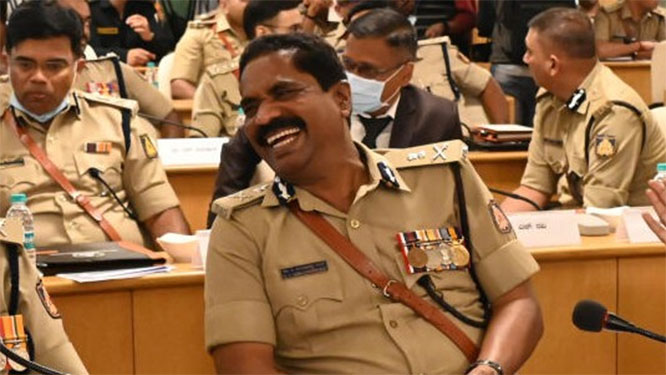
Karnataka DGP (Civil Rights Enforcement) K Ramachandra Rao was suspended with immediate effect, as per a state government order issued on Monday, 19 January. The order cited conduct unbecoming of a government servant and causing embarrassment to the state administration.

The Karnataka government suspended Rao after a purported video showed him in a compromising position with a woman inside his official chamber. The video went viral on social media. Rao rejected the videos outright, terming them "fabricated and false".

Who is K Ramachandra Rao?

Rao is a DGP-rank officer who was heading the Directorate of Civil Rights Enforcement until his suspension. He was promoted to DGP in September 2023 and assumed office in October 2023, the Sunday Guardian reported.

He also served as the Chairman and Managing Director of the Karnataka State Police Housing and Infrastructure Development Corporation Limited.

His stint as the Inspector General of Police (IGP) for the Southern Range was also marred by controversy. In 2014, during a cash seizure near Mysuru’s Yelwal, officials claimed the seized amount was ₹20 lakh, while the accused (Kerala-based merchants) claimed it was around ₹2.27 crore.

Rao, who was present during the seizure, denied all allegations. However, he was transferred soon after.

Allegations of collusion with a businessman surfaced, and a senior police officer was quoted by The Sunday Guardian as saying, “In Rao’s case, the CID has clearly mentioned that there was a great degree of lapse on the part of Rao and a deputy superintendent of police after it was brought to their notice that a few policemen, including a gunman attached to the IGP, were involved in the robbery.”

Rao had denied all wrongdoing in that incident. Despite past controversies, he rose to the state’s top police position, the Sunday Guardian reported.

Ranya Rao’s stepfather

Rao is the stepfather of Kannada actress Harshavardhini Ranya alias Ranya Rao, accused of orchestrating the illegal import of gold worth over ₹12.56 crore from Dubai to India along with two others — businessman Tarun Raju, and jewellery dealer Sahil Jain.

‘Obscene video’ controversy

A viral video showed Rao behaving inappropriately with a woman inside his office while in uniform.

The Karnataka government said in its Monday order that “vide videos and news reports widely broadcast on public news channels and media platforms, it is observed that Dr K Ramachandra Rao has acted in an obscene manner which is unbecoming of a Government Servant and also causing embarrassment to the Government.”

The order said the matter was examined by the state government, which found that the officer's conduct amounted to a violation of Rule 3 of the All India Services (Conduct) Rules, 1968.

The government said it is prima facie satisfied that "it is necessary to place Rao under suspension with immediate effect, pending inquiry".

During the suspension period, Rao will be entitled to subsistence allowance as per Rule 4 of the All India Services (Discipline and Appeal) Rules, 1969.

The order also places restrictions on his movement, stating that during the period of suspension, the officer must not leave headquarters under any circumstances without the written permission of the state government.

Comments

Add new comment

  • Coastaldigest.com reserves the right to delete or block any comments.
  • Coastaldigset.com is not responsible for its readers’ comments.
  • Comments that are abusive, incendiary or irrelevant are strictly prohibited.
  • Please use a genuine email ID and provide your name to avoid reject.
News Network
January 20,2026

Mangaluru: In a major step towards strengthening rural innovation, the Office of the Principal Scientific Adviser (PSA) to the Government of India is supporting the establishment of RuTAGe Smart Village Centres (RSVCs) across the country through collaborations with academic institutions, civil society organisations and philanthropic partners.

As part of this national initiative, Nitte (Deemed to be University) will set up the first RSVCs in the region at Nitte GP in Udupi district and at the Nitte Health Centre, Sevanjali Trust, Farangipete, in Dakshina Kannada district. The centres will be inaugurated on January 21. In South India, the programme is being implemented by the Section Infin-8 Foundation (SI-8).

Speaking to reporters on Monday, SI-8 founder-director Vishwas US said experts from Nitte University and SI-8 would work closely with farmers, students, youth and local entrepreneurs to adapt and deploy technologies tailored to local needs.

Project head Prof Iddya Karunasagar, representing Nitte DU, said the RSVCs at Nitte and Farangipete would serve as demonstration hubs for a wide range of agriculture, energy, skill-development and assistive technologies. These include solar dryers for fruits, vegetables and crops; soil-testing solutions; power weeders and women-friendly farm tools; wind-powered devices for rural artisans; grain storage systems; grass-cutting and tree-climbing equipment; and liquid fertiliser production using cowshed waste.

SI-8 CEO Aravind C Kumar said the centres would also provide access to digital and knowledge-based platforms such as ISRO applications, government scheme portals, market linkage tools and gamified learning resources, along with assistive technologies for persons with visual impairments.

Highlighting the broader impact of the initiative, Principal Scientific Adviser Prof Ajay Kumar Sood said it demonstrated how applied research could bridge the rural–urban divide and help create self-reliant, technology-enabled villages.

The initiative has been made possible through philanthropic support from Dr NC Murthy of ACM Business Solutions, LLC, USA. Dr Sapna Poti, Director (Strategic Alliances) at the Office of the Principal Scientific Adviser, said the long-term objective is to build self-sufficient, technology-driven communities capable of generating sustainable livelihoods on their own.

Comments

Add new comment

  • Coastaldigest.com reserves the right to delete or block any comments.
  • Coastaldigset.com is not responsible for its readers’ comments.
  • Comments that are abusive, incendiary or irrelevant are strictly prohibited.
  • Please use a genuine email ID and provide your name to avoid reject.