



Assam-Nagaland border row: Judicial probe ordered into killings, Rijiju to meet CMs

August 21, 2014

assam violence

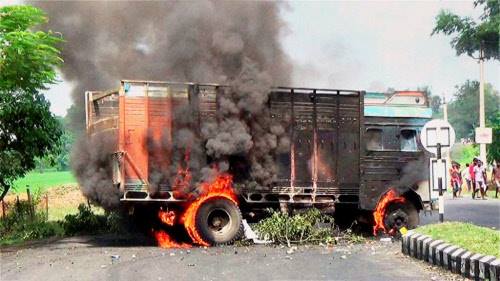
Guwahati, Aug 21: Minister of State for Home Kiren Rijiju is likely to meet chief ministers of Assam and Nagaland on Thursday as the border row between the two states intensified and two people were killed in police firing after curfew was clamped in Golaghat on Wednesday.

After Assam Chief Minister Tarun Gogoi blamed the central government for not taking the situation seriously, Rijiju refuted his charges, and said, "I will meet chief ministers of Assam and Nagaland, chief secretaries and senior police officials."

Quashing Gogoi's claims, he added, "Gogoi cannot blame us. It is a very irresponsible statement from the chief minister."

"The centre has already said border dispute can only be solved after negotiations between two states. The government at the centre can only assist during the talk."

Chief Minister Tarun Gogoi has ordered a judicial probe into the firing, while regional political party AGP has called for a 12-hour dawn-to-dusk shutdown Thursday.

The violence in Assam's Golaghat district erupted about a week ago. Violence erupted after armed groups from Nagaland allegedly attacked villagers in Assam, leading to several deaths and also rendered thousand homeless.

Hundreds of men and women took to the streets in Rongajan and Arengapathar areas in the district to denounce "police atrocities" Tuesday which left one person dead and 20 injured.

The trouble erupted over a border conflict between the two states.

On Wednesday, police first used batons to disperse the crowd but failed to restore order.

The crowd became unruly and attacked many vehicles on the roads in Rongajan. They also targeted public property, a police official said.

This forced police to fire at the mob, he said.

Of the 14 injured, nine were taken to the Jorhat Medical College Hospital, said Assam Home Commissioner G.D. Tripathy.

Chief Minister Tarun Gogoi Wednesday blamed the central government for the trouble along the Assam-Nagaland border and said the Narendra Modi government had not taken the issue seriously.

"It was unfortunate that one person died. We have ordered an inquiry and a senior police official has been suspended," Gogoi said.

"The neutral force (CRPF) deployed in the border is responsible for law and order," he went on.

"I take my responsibility as chief minister but the Centre, particularly the home minister, is also responsible. They have not been taking the matter as seriously as they should have," Gogoi said.

Gogoi said he had taken up the matter with his Nagaland counterpart T.R. Zeliang. He asked police to use non-lethal weapons like rubber bullets and water cannons while dealing with mass protests.

Police had Tuesday used batons and fired rubber bullets to disperse an equally emotive mob.

One demonstrator was run over by a speeding truck as he tried to escape the police baton-charge in Rongajan. This inflamed passions further.

Gogoi said he has decided to institute a judicial probe by a retired judge of the Gauhati High Court into the police firing in Golaghat district Wednesday.

"We would leave no stone unturned to find out the truth behind the firing incident," the chief minister said in a statement.

Gogoi also appealed to individuals, organisations, political leaders and the media to exercise restraint and to join in the government's efforts to restore normalcy in the violence affected areas.

"I appeal to everyone to cooperate with the government in bringing back peace to the affected areas. It is only through dialogue and understanding that we can resolve our problems amicably," he said.

Assam's regional political party Asom Gana Parishad (AGP) has called for a 12-hour dawn to dusk shutdown Tursday protesting the state government's failure to protect the people living in the Assam-Nagaland border, against "police atrocities" and the central government's silence over the crisis.

The shutdown will begin from 5 am, AGP president Atul Bora told reporters.

All emergency services including medical, media, issues related to relief camps, examinees, water and food and civil supplies, were exempted, he said.

The AGP will also stage protest demonstrations across the state Friday and a "Border Chalo" programme Aug 25 demanding security for the people there.

"The problem on the Assam-Nagaland border has been continuing for a long time but Chief Minister Tarun Gogoi has not done anything to solve the crisis. The government today (Wednesday) asked police and security forces to attack innocent civilians in the most brutal manner," Bora said.

The party also sent letters to Prime Minister Narendra Modi and Home Minister Rajnath Singh, seeking their immediate intervention in the matter.

Comments

Add new comment

  • Coastaldigest.com reserves the right to delete or block any comments.
  • Coastaldigset.com is not responsible for its readers’ comments.
  • Comments that are abusive, incendiary or irrelevant are strictly prohibited.
  • Please use a genuine email ID and provide your name to avoid reject.
News Network
December 13,2025

New Delhi: School-going children are picking up drug and smoking habits and engaging in consumption of alcohol, with the average age of introduction to such harmful substances found to be around 13 years, suggesting a need for earlier interventions as early as primary school, a multi-city survey by AIIMS-Delhi said.

The findings also showed substance use increased in higher grades, with grade XI/XII students two times more likely to report use of substances when compared with grade VIII students. This emphasised the importance of continued prevention and intervention through middle and high school.

The study led by Dr Anju Dhawan of AIIMS's National Drug Dependence Treatment Centre, published in the National Medical Journal of India this month, looks at adolescent substance use across diverse regions.

The survey included 5,920 students from classes 8, 9, 11 and 12 in urban government, private and rural schools across 10 cities -- Bengaluru, Chandigarh, Delhi, Dibrugarh, Hyderabad, Imphal, Jammu, Lucknow, Mumbai, and Ranchi. The data were collected between May 2018 and June 2019.

The average age of initiation for any substance was 12.9 (2.8) years. It was lowest for inhalants (11.3 years) followed by heroin (12.3 years) and opioid pharmaceuticals (without prescription; 12.5 years).

Overall, 15.1 per cent of participants reported lifetime use, 10.3 per cent reported past year use, and 7.2 per cent reported use in the past month of any substance, the study found.

The most common substances used in the past year, after tobacco (4 per cent) and alcohol (3.8 per cent), were opioids (2.8 per cent), followed by cannabis (2 per cent) and inhalants (1.9 per cent). Use of non-prescribed pharmaceutical opioids was most common among opioid users (90.2 per cent).

On being asked, 'Do you think this substance is easily available for a person of your age' separately for each substance category, nearly half the students (46.3 per cent) endorsed that tobacco products and more than one-third of the students (36.5 per cent) agreed that a person of their age can easily procure alcohol products.

Similarly, for Bhang (21.9 per cent), ganja/charas (16.1 per cent), inhalants (15.2 per cent), sedatives (13.7 per cent), opium and heroin (10 per cent each), the students endorsed that these can be easily procured.

About 95 per cent of the children, irrespective of their grade, agreed with the statement that 'drug use is harmful'.

The rates of substance use (any) among boys were significantly higher than those of girls for substance use (ever), use in the past year and use in the past 30 days. Compared to grade VIII students, grade IX students were more likely, and grade XI/XII students were twice as likely to have used any substance (ever).

The likelihood of past-year use of any substance was also higher for grade IX students and for grade XI/XII students as compared to grade VIII students.

About 40 per cent of students mentioned that they had a family member who used tobacco or alcohol each. The use of cannabis (any product) and opioid (any product) by a family member was reported by 8.2 per cent and 3.9 per cent of students, respectively, while the use of other substances, such as inhalants/sedatives by family was 2-3 per cent, the study found.

A relatively smaller percentage of students reported use of tobacco or alcohol among peers as compared to among family members, while a higher percentage reported inhalants, sedatives, cannabis or opioid use among peers.

Children using substances (past year) compared to non-users reported significantly higher any substance use by their family members and peers.

There were 25.7 per cent students who replied 'yes' to the question 'conflicts/fights often occur in your family'. Most students also replied affirmatively to 'family members are aware of how their time is being spent' and 'damily members are aware of with whom they spend their time'.

Comments

Add new comment

  • Coastaldigest.com reserves the right to delete or block any comments.
  • Coastaldigset.com is not responsible for its readers’ comments.
  • Comments that are abusive, incendiary or irrelevant are strictly prohibited.
  • Please use a genuine email ID and provide your name to avoid reject.