



Assembly elections: Voting begins in West Bengal and Assam

April 4, 2016

Kolkata/ Guwahati: Apr 4: The first of the six-phase Assembly election in West Bengal began at 7 AM today in 18 constituencies in the Left-wing extremism-affected areas.
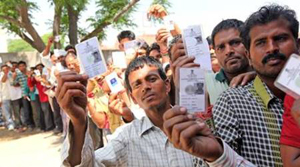
election
A tight multi-layered security ring was thrown in the three districts of West Midnapore, Purulia and Bankura to tackle any threat by Maoists.

Phase 1(a) of the election will decide the fate of 133 candidates, including 11 women, fighting from the 18 constituencies.

Out of them, 13 seats have been roughly classified as LWE-affected areas by the Election Commission where voting will end early at 4 pm due to security considerations.

In the remaining five constituencies of Purulia, Manbazar, Kashipur, Para and Raghunathpur voting will go on for two extra hours till 6 pm.

Total number of voters in the constituencies are a little over 40 lakh (40,09,171) out of which 20,47,202 are males.

The third gender category list shows only a handful of 16 voters.

There are total 4,945 polling stations out of which 1,962 have been classified as critical ones by the Election Commission.

Voter Verifiable Audit Trails (VVAT) are being done in 562 polling stations.

Unlike in 2011 Assembly polls where the Trinamool Congress was its partner, the Congress this time has forged an alliance with the Left parties.

All the three - Trinamool, Left-Congress alliance and BJP - have fielded candidates from all 18 seats.

Gobordhan Bagdi is the only one fighting on two seats of Para and Raghunathpur on a JMM ticket.

In all Left-wing extremism affected polling stations, the EC has decided to deploy a minimum of one section of force, which has around ten security personnel.

There will be a minimum of three security layers including sector forces and a quick response team.

Central forces will be present in every polling booth and depending on the requirement the deployment of forces can increase.

For aerial surveillance, two choppers will conduct regular sorties and inform forces on the ground if they notice any undesirable activity.

First phase of Assam Assembly polls begins amid tight security

The first of the two-phase Assam Assembly election began at 7 AM today amid strict security, with 65 of the state's total 126 constituencies going to the poll in which the main contenders are the ruling Congress and the BJP-AGP-BPF alliance.

An electorate of 95,11,732, including 45,95,712 women, are able to exercise their franchise in 12,190 polling booths to decide the fate of 539 candidates.

As many as 1,241 polling stations have been identified as 'critical' polling stations, 1,992 as 'hypersensitive' and 3,739 as 'sensitive'.

In all 535 companies of security forces have been deployed in the 65 constituencies. Out of them 433 companies are central forces and 102 are from the state police, Assam Chief Electoral Officer Vijayendra said yesterday.

Security has been tightened across the state with the Indo-Bangla border along Barak Valley's Karimganj district being sealed.

The 65 constituencies are spread across Upper Assam, the hill districts, the northern banks and the Barak Valley.

More than 48,000 polling personnel have been deployed in the first phase.

The first phase will witness mostly direct contest between the ruling Congress and the BJP-AGP-BPF alliance, though the AIUDF has put up candidates in 27 constituencies.

The Congress is contesting all 65 constituencies, the BJP 54 and its alliance partners AGP in 11 and BPF in three.

The AIUDF, another important contender has put up candidates in 27 while the CPI and CPI-M in 10 each, the CPI(ML)(L) in six along with 60 others of unrecognised parties and 13 Independents.

Prominent Congress candidates in the fray include Chief Minister Tarun Gogoi from Titabor, Speaker of the outgoing Assembly Pranab Gogoi from Sibsagar and former Union minister and prominent tea tribe leader Paban Singh Ghatowar.

The BJP's star candidates in the first phase include Union minister and party's chief ministerial candidate Sarbananda Sonowal from Majuli and Jorhat Lok Sabha MP Kamakhya Prasad Tasa from Titabor.

AGP's working president Atul Bora is also an important face in the fray.

While the Congress looks forward to retaining power for the fourth successive term, the BJP called for a 'parivartan' (change) to usher in development.

Comments

Add new comment

  • Coastaldigest.com reserves the right to delete or block any comments.
  • Coastaldigset.com is not responsible for its readers’ comments.
  • Comments that are abusive, incendiary or irrelevant are strictly prohibited.
  • Please use a genuine email ID and provide your name to avoid reject.
News Network
December 13,2025

New Delhi: School-going children are picking up drug and smoking habits and engaging in consumption of alcohol, with the average age of introduction to such harmful substances found to be around 13 years, suggesting a need for earlier interventions as early as primary school, a multi-city survey by AIIMS-Delhi said.

The findings also showed substance use increased in higher grades, with grade XI/XII students two times more likely to report use of substances when compared with grade VIII students. This emphasised the importance of continued prevention and intervention through middle and high school.

The study led by Dr Anju Dhawan of AIIMS's National Drug Dependence Treatment Centre, published in the National Medical Journal of India this month, looks at adolescent substance use across diverse regions.

The survey included 5,920 students from classes 8, 9, 11 and 12 in urban government, private and rural schools across 10 cities -- Bengaluru, Chandigarh, Delhi, Dibrugarh, Hyderabad, Imphal, Jammu, Lucknow, Mumbai, and Ranchi. The data were collected between May 2018 and June 2019.

The average age of initiation for any substance was 12.9 (2.8) years. It was lowest for inhalants (11.3 years) followed by heroin (12.3 years) and opioid pharmaceuticals (without prescription; 12.5 years).

Overall, 15.1 per cent of participants reported lifetime use, 10.3 per cent reported past year use, and 7.2 per cent reported use in the past month of any substance, the study found.

The most common substances used in the past year, after tobacco (4 per cent) and alcohol (3.8 per cent), were opioids (2.8 per cent), followed by cannabis (2 per cent) and inhalants (1.9 per cent). Use of non-prescribed pharmaceutical opioids was most common among opioid users (90.2 per cent).

On being asked, 'Do you think this substance is easily available for a person of your age' separately for each substance category, nearly half the students (46.3 per cent) endorsed that tobacco products and more than one-third of the students (36.5 per cent) agreed that a person of their age can easily procure alcohol products.

Similarly, for Bhang (21.9 per cent), ganja/charas (16.1 per cent), inhalants (15.2 per cent), sedatives (13.7 per cent), opium and heroin (10 per cent each), the students endorsed that these can be easily procured.

About 95 per cent of the children, irrespective of their grade, agreed with the statement that 'drug use is harmful'.

The rates of substance use (any) among boys were significantly higher than those of girls for substance use (ever), use in the past year and use in the past 30 days. Compared to grade VIII students, grade IX students were more likely, and grade XI/XII students were twice as likely to have used any substance (ever).

The likelihood of past-year use of any substance was also higher for grade IX students and for grade XI/XII students as compared to grade VIII students.

About 40 per cent of students mentioned that they had a family member who used tobacco or alcohol each. The use of cannabis (any product) and opioid (any product) by a family member was reported by 8.2 per cent and 3.9 per cent of students, respectively, while the use of other substances, such as inhalants/sedatives by family was 2-3 per cent, the study found.

A relatively smaller percentage of students reported use of tobacco or alcohol among peers as compared to among family members, while a higher percentage reported inhalants, sedatives, cannabis or opioid use among peers.

Children using substances (past year) compared to non-users reported significantly higher any substance use by their family members and peers.

There were 25.7 per cent students who replied 'yes' to the question 'conflicts/fights often occur in your family'. Most students also replied affirmatively to 'family members are aware of how their time is being spent' and 'damily members are aware of with whom they spend their time'.

Comments

Add new comment

  • Coastaldigest.com reserves the right to delete or block any comments.
  • Coastaldigset.com is not responsible for its readers’ comments.
  • Comments that are abusive, incendiary or irrelevant are strictly prohibited.
  • Please use a genuine email ID and provide your name to avoid reject.