



Baba Ramdev stretches out an empire

April 14, 2016

Apr 14: The company, which is striking fear into its current and potential competitors, expects to report revenue of $750 million in the fiscal year that ended in March, more than double the previous year’s $300 million.
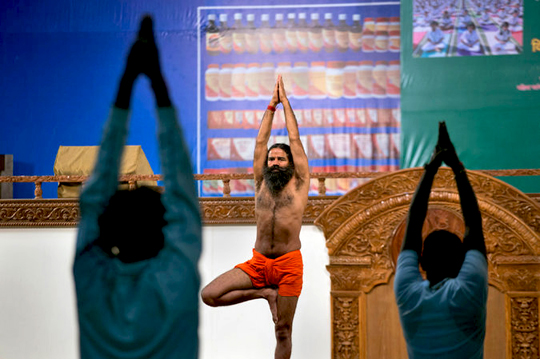
ramdev

The Sitting on an orange sofa set over a Persian carpet, in a gated office park of freshly painted tan buildings and manicured lawns, Baba Ramdev is surrounded by the trappings of any major corporate leader almost anywhere in the world.

But Ramdev is also an Indian swami, having renounced all worldly pleasures and possessions, and he sits cross-legged on the couch, his face fringed by an untamed beard, his body draped in the saffron cloth of a Hindu holy man.

Famous for bringing yoga to the Indian masses, Ramdev, 50, is also the leader of what has become known as the “Baba Cool Movement” — a group of spiritual men, known as “babas.”

They are marketing health-based consumer items based on the ancient Indian medicinal system of herbal treatments, known as Ayurveda. His rapidly expanding business empire of packaged food, cosmetics and home-care products is eating into the sales of both multinational and Indian corporations.

The babas’ message about the value of traditional Indian ingredients is particularly resonant in the current environment in India, where a prime minister and his political party have built a narrative around the value of ancient Hindu practices, from yoga to reverence for cows.

Ramdev is the most prominent of a growing group of brand-building babas, whose ranks include Sri Sri Ravi Shankar, the founder of the Art of Living, an Indian spiritual practice, who promotes a line of creams, soaps and shampoos also called Ayurveda.

“There is truly a tectonic shift” in the consumer products business in India, said Harish Bijoor, a brand strategy specialist and former head of marketing at a subsidiary of the big conglomerate Tata Group.

Ramdev and his friend and business partner, Acharya Balakrishna, 44, run Patanjali Ayurved Limited from a corporate headquarters in Haridwar, ancient city on the banks of River Ganga in Uttarakhand. In an interview, Ramdev said he was the creative force and public face of Patanjali, even though, as a swami, he does not have an official title or hold any shares of the privately held company.

Rising at 3:30 am each day to drink the juice of the amla fruit, berry rich in vitamin C and considered the top immunity booster in Ayurveda medicine, he unleashes a torrent of new product ideas — an herbal energy bar, an herbal hair dye, a sugar-free immune booster — that he records in large Hindi script in a spiral bound notebook. Then he plunges into three hours of yoga, followed by a 12-hour day that is split between Patanjali business and the public meetings of a spiritual and political leader.

Balakrishna, as the managing director, runs day-to-day operations. “Without him, nothing would be possible,” Ramdev said of his partner, who paced in the office as the interview with the loquacious swami spilled over its one-hour allotment.

The two men met in the 1990s when they studied at the same gurukul, a residential school that was the norm for Indian Hindus before the British arrived. Both the sons of farmers, they went on together to study in the Himalayas, Ramdev focusing on yoga and Balakrishna on Ayurveda.

In 1994, they founded the first of three charitable trusts, to run a hospital and a university dealing in Ayurvedic medicine, and an ashram. There, they held yoga camps and free health checkups at which they dispensed Ayurveda treatments, which are largely herbal. Before long, they had set up a manufacturing plant for Ayurveda products.

Around the same time, Ramdev began his televised yoga classes. Lean and muscular, Ramdev proved to be a telegenic tour de force, bringing yoga to India’s poor and the growing middle class. He gradually ventured beyond yoga to become a public critic of government corruption, leading a mass protest in New Delhi in 2011 and later endorsing Prime Minister Narendra Modi during the election in 2014.

Modi and his BJP swept to power soon after, unleashing a strong Hindu nationalist sentiment that Ramdev says has created “an ideal ecosystem” to support his business. Modi pushed the United Nations to create International Yoga Day, and he inaugurated it last year, with Ramdev by his side, in a nationally televised ceremony involving 35,000 people.

Ramdev, given to raucous laughter and bouts of giggles that make him seem disarmingly humble, can just as suddenly overflow with bravado, as he did when asked about the source of Patanjali’s popularity and power. “People buy our products because they believe I will only sell them good things,” he said. Beyond Ramdev’s appeal, Patanjali products are attractive because they are high quality and prices are about 20% lower than the competition, analysts said.

It is not clear how Patanjali is able to charge such low prices, given that its profit margin of 13% is within the industry range of 13 to 16%. Ramdev ventured that, with his fame, his advertising costs are much lower than those of his competitors, who spend as much as 15% of their revenue promoting their products.

The faces of Ramdev and Balakrishna adorn almost every building, billboard and truck connected to the company, which is expanding so fast it is striking fear into its current and potential competitors. The company expects to report revenue of $750 million in the fiscal year that ended in March, more than double the previous year’s $300 million, the two men said.

Meteoric rise

Credit-Suisse Securities, in a report early this year, said Patanjali’s “meteoric rise” had hurt Colgate-Palmolive (India) Ltd, which is majority owned by the US-based Colgate-Palmolive. Sales of Colgate’s toothpastes slowed from growing at about 10% annually just 1% in the quarter ending in December, in the face of competition from Patanjali, Rohit Kadam, the analyst who wrote the report, said in an interview.

The report said sales of health supplements at Dabur India Ltd, one of the country’s largest consumer goods companies, had been growing at close to 20% annually but began falling at the end of last year, hurt by competition from Patanjali. In the face of that threat, Patanjali’s competitors “are working on overdrive to create similar types of product options,” Bijoor, the brand strategist, said.

Colgate has introduced toothpastes containing the extract of neem and charcoal, both still used by villagers to clean their teeth. Spokesmen for Colgate and Dabur did not respond to requests for comment. Experts say that for the foreseeable future, the only danger signs for Patanjali is the enthusiasm of its founder, Ramdev.

If he takes it “a bit too far, he’ll lose new customers,” said Sunil Alagh, a business consultant and formerly chief executive of Britannia Industries Ltd, famous for packaged cookies. In the past, Ramdev had dived into controversial conservative causes without hesitation. Last year, for example, he claimed that he could cure homosexuality by treating a person with yoga.

Ramdev was also outspoken in his condemnation of a student at a New Delhi university who faced sedition charges after the authorities accused him of participating in a pro-Pakistan campus rally. “The traitors,” Ramdev said, “must be arrested.”

Controversy aside, Bijoor has predicted that the “Baba Cool Movement” would eventually outsell both multinationals and top Indian companies alike. “It’s about a good connect,” he said. “It’s about becoming the umbilical cord connecting the past to the present.”


Comments

Add new comment

  • Coastaldigest.com reserves the right to delete or block any comments.
  • Coastaldigset.com is not responsible for its readers’ comments.
  • Comments that are abusive, incendiary or irrelevant are strictly prohibited.
  • Please use a genuine email ID and provide your name to avoid reject.
News Network
December 16,2025

bengal.jpg

The deletion of over 58 lakh names from West Bengal’s draft electoral rolls following a Special Intensive Revision (SIR) has sparked widespread concern and is likely to deepen political tensions in the poll-bound state.

According to the Election Commission, the revision exercise has identified 24 lakh voters as deceased, 19 lakh as relocated, 12 lakh as missing, and 1.3 lakh as duplicate entries. The draft list, published after the completion of the first phase of SIR, aims to remove errors and duplication from the electoral rolls.

However, the scale of deletions has raised fears that a large number of eligible voters may have been wrongly excluded. The Election Commission has said that individuals whose names are missing can file objections and seek corrections. The final voter list is scheduled to be published in February next year, after which the Assembly election announcement is expected. Notably, the last Special Intensive Revision in Bengal was conducted in 2002.

The development has intensified the political row over the SIR process. Chief Minister Mamata Banerjee and her Trinamool Congress have strongly opposed the exercise, accusing the Centre and the Election Commission of attempting to disenfranchise lakhs of voters ahead of the elections.

Addressing a rally in Krishnanagar earlier this month, Banerjee urged people to protest if their names were removed from the voter list, alleging intimidation during elections and warning of serious consequences if voting rights were taken away.

The BJP, meanwhile, has defended the revision and accused the Trinamool Congress of politicising the issue to protect what it claims is an illegal voter base. Leader of the Opposition Suvendu Adhikari alleged that the ruling party fears losing power due to the removal of deceased, fake, and illegal voters.

The controversy comes amid earlier allegations by the Trinamool Congress that excessive work pressure during the SIR led to the deaths by suicide of some Booth Level Officers (BLOs), for which the party blamed the Election Commission. With the draft list now out, another round of political confrontation appears imminent.

As objections begin to be filed, the focus will be on whether the correction mechanism is accessible, transparent, and timely—critical factors in ensuring that no eligible voter is denied their democratic right ahead of a crucial election.

Comments

Add new comment

  • Coastaldigest.com reserves the right to delete or block any comments.
  • Coastaldigset.com is not responsible for its readers’ comments.
  • Comments that are abusive, incendiary or irrelevant are strictly prohibited.
  • Please use a genuine email ID and provide your name to avoid reject.
News Network
December 13,2025

New Delhi: School-going children are picking up drug and smoking habits and engaging in consumption of alcohol, with the average age of introduction to such harmful substances found to be around 13 years, suggesting a need for earlier interventions as early as primary school, a multi-city survey by AIIMS-Delhi said.

The findings also showed substance use increased in higher grades, with grade XI/XII students two times more likely to report use of substances when compared with grade VIII students. This emphasised the importance of continued prevention and intervention through middle and high school.

The study led by Dr Anju Dhawan of AIIMS's National Drug Dependence Treatment Centre, published in the National Medical Journal of India this month, looks at adolescent substance use across diverse regions.

The survey included 5,920 students from classes 8, 9, 11 and 12 in urban government, private and rural schools across 10 cities -- Bengaluru, Chandigarh, Delhi, Dibrugarh, Hyderabad, Imphal, Jammu, Lucknow, Mumbai, and Ranchi. The data were collected between May 2018 and June 2019.

The average age of initiation for any substance was 12.9 (2.8) years. It was lowest for inhalants (11.3 years) followed by heroin (12.3 years) and opioid pharmaceuticals (without prescription; 12.5 years).

Overall, 15.1 per cent of participants reported lifetime use, 10.3 per cent reported past year use, and 7.2 per cent reported use in the past month of any substance, the study found.

The most common substances used in the past year, after tobacco (4 per cent) and alcohol (3.8 per cent), were opioids (2.8 per cent), followed by cannabis (2 per cent) and inhalants (1.9 per cent). Use of non-prescribed pharmaceutical opioids was most common among opioid users (90.2 per cent).

On being asked, 'Do you think this substance is easily available for a person of your age' separately for each substance category, nearly half the students (46.3 per cent) endorsed that tobacco products and more than one-third of the students (36.5 per cent) agreed that a person of their age can easily procure alcohol products.

Similarly, for Bhang (21.9 per cent), ganja/charas (16.1 per cent), inhalants (15.2 per cent), sedatives (13.7 per cent), opium and heroin (10 per cent each), the students endorsed that these can be easily procured.

About 95 per cent of the children, irrespective of their grade, agreed with the statement that 'drug use is harmful'.

The rates of substance use (any) among boys were significantly higher than those of girls for substance use (ever), use in the past year and use in the past 30 days. Compared to grade VIII students, grade IX students were more likely, and grade XI/XII students were twice as likely to have used any substance (ever).

The likelihood of past-year use of any substance was also higher for grade IX students and for grade XI/XII students as compared to grade VIII students.

About 40 per cent of students mentioned that they had a family member who used tobacco or alcohol each. The use of cannabis (any product) and opioid (any product) by a family member was reported by 8.2 per cent and 3.9 per cent of students, respectively, while the use of other substances, such as inhalants/sedatives by family was 2-3 per cent, the study found.

A relatively smaller percentage of students reported use of tobacco or alcohol among peers as compared to among family members, while a higher percentage reported inhalants, sedatives, cannabis or opioid use among peers.

Children using substances (past year) compared to non-users reported significantly higher any substance use by their family members and peers.

There were 25.7 per cent students who replied 'yes' to the question 'conflicts/fights often occur in your family'. Most students also replied affirmatively to 'family members are aware of how their time is being spent' and 'damily members are aware of with whom they spend their time'.

Comments

Add new comment

  • Coastaldigest.com reserves the right to delete or block any comments.
  • Coastaldigset.com is not responsible for its readers’ comments.
  • Comments that are abusive, incendiary or irrelevant are strictly prohibited.
  • Please use a genuine email ID and provide your name to avoid reject.
News Network
December 16,2025

jordan.jpg

Prime Minister Narendra Modi on Monday held talks with Jordan’s King Abdullah II in Amman, during which the two leaders discussed ways to further strengthen bilateral relations, with the Prime Minister outlining an eight-point vision covering key areas of cooperation.

Describing the meeting as “productive”, PM Modi said he shared a roadmap focused on trade and economy, fertilisers and agriculture, information technology, healthcare, infrastructure, critical and strategic minerals, civil nuclear cooperation, and people-to-people ties.

In a post on social media platform X, the Prime Minister praised King Abdullah II’s personal commitment to advancing India–Jordan relations, particularly as both countries mark the 75th anniversary of the establishment of diplomatic ties this year.

“Held productive discussions with His Majesty King Abdullah II in Amman. His personal commitment towards vibrant India-Jordan relations is noteworthy. This year, we are celebrating the 75th anniversary of our bilateral diplomatic relations,” PM Modi said.

The meeting took place at the Al Husseiniya Palace, where the two leaders also exchanged views on regional and global issues of mutual interest. According to the Ministry of External Affairs (MEA), both sides agreed to further deepen cooperation in areas including trade and investment, defence and security, counter-terrorism and de-radicalisation, fertilisers and agriculture, infrastructure, renewable energy, tourism, and heritage.

The MEA said both leaders reaffirmed their united stand against terrorism.

PM Modi arrived in Amman earlier on Monday and was received by Jordanian Prime Minister Jafar Hassan, who accorded him a formal welcome. Following the talks, King Abdullah II hosted a banquet dinner in honour of the Prime Minister, reflecting the warmth of bilateral ties.

Jordan is the first leg of PM Modi’s three-nation tour. From Amman, the Prime Minister will travel to Ethiopia at the invitation of Prime Minister Abiy Ahmed Ali, marking his first official visit to the African nation. The tour will conclude with a visit to Oman.

Comments

Add new comment

  • Coastaldigest.com reserves the right to delete or block any comments.
  • Coastaldigset.com is not responsible for its readers’ comments.
  • Comments that are abusive, incendiary or irrelevant are strictly prohibited.
  • Please use a genuine email ID and provide your name to avoid reject.
