



Babri case adjourned as judge is absent

March 22, 2017

New Delhi, Mar 22: Justice Rohinton Nariman, who made remarks about reviving the criminal conspiracy charge against BJP veteran L.K. Advani and other top leaders, including Union Minister Uma Bharti, during the previous hearing of the Babri Masjid demolition case, was not a part of the Supreme Court Bench on Wednesday.
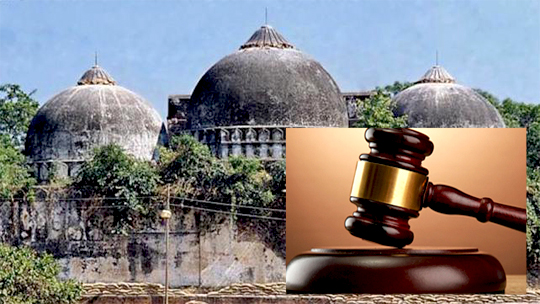
adjourned

On March 6, Justice Nariman, who was sitting as a judge along with Justice P.C. Ghose, remarked that “there was something peculiar going on in this case” and opened the floor for initiating a debate on reopening the criminal conspiracy charge against BJP leaders. The court was hearing a CBI appeal against the dropping of the conspiracy charge against them.

On Wednesday, the Bench was sitting in a combination of Justices Ghose and the newly-appointed Justice Dipak Gupta.

Justice Rohinton Nariman was heading a Bench in court 13 with Justice P.C. Pant.

When the Babri matter came up for hearing, Justice Ghose said the case may be adjourned as it was part-heard.

“My brother [J. Nariman] is not present. The case is part-heard,” Justice Ghose said.

Senior advocate K.K. Venugopal, appearing for Mr. Advani, asked the case to come up after four weeks.

“That would be in May...” Justice Ghose disapproved. The judge is retiring on May 27.

Justice Ghose then agreed to hear the matter on March 23 with Justice Nariman by his side on the Bench.

The sudden turn of events on March 6 came on an appeal filed by the CBI in 2011, during the UPA era, in the Supreme Court against the dropping of the conspiracy charge against Mr. Advani and other leaders like Ms. Bharti, Murli Manohar Joshi, Vinay Katiyar, Sadvi Ritambara, Giriraj Kishore and Vishnu Hari Dalmia.

“We prima facie do not approve of the way these people have been discharged... And no additional charge sheet filed so far? See, people cannot be discharged like this on technical grounds,” Justice Nariman observed orally then.

“We will allow you [CBI] to file supplementary charge sheet by including the conspiracy charge. We will ask the trial court to conduct a joint trial in a Lucknow court,” he said.

The CBI, represented by Additional Solicitor General Neeraj Kishan Kaul, had seemed to agree with the court's observations and submitted that a joint trial should be conducted.

However, Mr. Venugopal strongly objected to the turn of events and argued that the conspiracy charge against Mr. Advani and other leaders were already dropped, and its revival would mean the reexamination of the 186 witnesses who had deposed in the case. Mr. Venugopal pointed out that the CBI had appealed the Supreme Court after an inordinate delay.

But the Bench remained adamant.

The Babri Masjid demolition case stemmed from two crime files: Crime No: 197/1992 and Crime No: 198/1992. Both were filed shortly after the disputed structure of Babri Masjid was demolished on December 6, 1992.

Crime no. 197/1992 was registered in the Ayodhya Police Station against “lakhs of unknown kar sevaks”. This FIR dealt with the actual demolition of the masjid. It lined up a bunch of serious offences, including robbery or dacoity with attempt to commit murder,causing hurt by an act endangering life or safety of others, deterring public servants from doing duty and promoting enmity between different religious groups. The most severe of these offences could get the offender up to 10 years in jail.

The second one, Crime no. 198/1992, was registered against 12 persons, including Ashok Singhal, Mr. Giriraj Kishore, Mr. Advani, Mr. Joshi, Mr. Dalmiya, Mr. Katiyar, Ms. Bharati and Sadhvi Ritambara, who were on the dais at the ''Ram Katha Kunj'' when the masjid was being demolished.

They were accused of promoting enmity, making imputations and assertions prejudicial to national integration and statements conducing to public mischief. Maximum punishment, if found guilty for these offences, was up to five years'’ imprisonment. The cases are being tried in courts in Lucknow and Rae Bareilly, respectively.

The CBI took over Crime 197 in Lucknow, while 198 remained with the State CID in Rae Bareilly. Eventually 198 also got transferred to the CBI and began being heard in the Lucknow court.

Now, with the CBI investigating both crimes as one, a joint charge sheet was filed on October 5, 1993 accusing Mr. Advani and the other leaders of conspiracy.

The CBI charge sheet alleged that a secret meeting took place at the residence of Mr. Katiyar on the eve of the demolition, during which the final decision to bring down the disputes structure was taken. The Special Judicial Magistrate and the Additional Sessions Court also found the conpsiracy prima facie tenable.

However, in February 2001, the Lucknow Bench of the Allahabad High Court found a technical error in the manner Crime 198 was transferred to the CBI without consulting the High Court. Though it did not touch upon the conspiracy charge against the leaders, the High Court asked the Uttar Pradesh government to correct the flaw. Subsequent governments failed to act and Crime 198 finally got detached and returned to Rae Bareilly.

On May 4, 2001, Special Judge, Lucknow, Shrikant Shukla dropped the conspiracy charge against Advani and 20 others on the ground that Crime 197 — the Special Court was only trying this crime — was only regarding the actual demolition and not the hatching of any conspiracy. On May 20, 2010, the High Court upheld Judge Shukla's order while dismissing the CBI's revision petition.

Arguing before the Supreme Court in its appeal on February 19, 2011, the CBI submitted that Judge Shukla made an “artificial distinction” in the demolition case in order to drop the names of Mr. Advani and the 20 others for the reason that they did not participate in the “actual demolition”. The CBI called for a joint trial of both Crime nos. 197 and 198 like how they did previously.

“Acts of instigation, facilitation, the actual demolition of the masjid, the continuous assault on media persons, thus, form a single connected transaction and can well be a concerted conspiracy under Section 120-B of the IPC. In respect of continuous criminal act attracting various offences, the transaction has to be viewed in as a whole and evidence cannot be led at two different courts,” the CBI said in its 2011 appeal.

In his defence, Mr. Advani had argued that the entire endeavour of the CBI to file a composite charge sheet and foist conspiracy charges against him and the other leaders during the UPA government's time was a politically motivated one. Mr. Advani had claimed that the Special Court, in 2001, rightly come to the firm conclusion that it had no jurisdiction to hear the charge of conspiracy. Mr. Advani defended that the CBI's appeals were sheer abuse of law.

Comments

Add new comment

  • Coastaldigest.com reserves the right to delete or block any comments.
  • Coastaldigset.com is not responsible for its readers’ comments.
  • Comments that are abusive, incendiary or irrelevant are strictly prohibited.
  • Please use a genuine email ID and provide your name to avoid reject.
News Network
December 20,2025

train.jpg

At least seven elephants were killed and one calf injured after a herd collided with the Sairang-New Delhi Rajdhani Express in Assam's Hojai on Saturday morning, leading to disruption of rail services. 

The Sairang-New Delhi Rajdhani Express struck a herd of elephants, resulting in the derailment of the locomotive and five coaches. No passenger casualties or injuries were reported, officials said.

The New Delhi-bound train met with the accident around 2.17 am, PTI reported. The Sairang-New Delhi Rajdhani Express connects Mizoram's Sairang (near Aizawl) to Anand Vihar Terminal (Delhi). 

Railway has issued helpline numbers at the Guwahati Railway Station:-

•    0361-2731621
•    0361-2731622
•    0361-2731623

The accident site is located about 126 km from Guwahati. Following the incident, accident relief trains and railway officials rushed to the spot to initiate rescue operations.

Train Services Disrupted

Sources said that due to the derailment and elephant body parts scattered on the tracks, train services to Upper Assam and other parts of the Northeast were affected.

Passengers from the affected coaches were temporarily accommodated in vacant berths available in other coaches of the train. Once the train reaches Guwahati, additional coaches will be attached to accommodate all passengers, after which the train will resume its onward journey.

The incident occurred at a location that is not a designated elephant corridor. The loco pilot, upon spotting the herd on the tracks, applied emergency brakes. Despite this, the elephants dashed into the train, leading to the collision and derailment.

Last month, an elephant was killed after being hit by a train in Dhupguri in West Bengal's Jalpaiguri district. The incident took place on November 30. 

The adult elephant was killed on the spot, and a calf was discovered lying injured beside the tracks. 

Over 70 Elephants Killed In Train Collisions Over Last 5 Years

At least 79 elephants have died in train collisions across the country in the last five years, the Environment Ministry had informed Parliament in August.

In a written reply in the Lok Sabha, Minister of State for Environment Kirti Vardhan Singh had said the figure is based on reports from state governments and Union Territory administrations for the period 2020-21 to 2024-25.

He said that the ministry does not maintain consolidated data on the deaths of other wild animals on railway tracks, including in designated elephant corridors.

Singh confirmed that three elephants, including a mother and her calf, were killed on July 18 this year after being hit by a speeding express train on the Kharagpur-Tatanagar section in West Bengal's Paschim Midnapore district. The incident took place near Banstala between Jhargram and Banstala stations.

The minister said several measures have been taken jointly by the Environment Ministry and the Railways to prevent such accidents.

These include imposing speed restrictions in elephant habitats, pilot projects such as seismic sensor-based detection of elephants near tracks and construction of underpasses, ramps and fencing at vulnerable points.

The Wildlife Institute of India, in consultation with the ministry and other stakeholders, has also issued guidelines titled 'Eco-friendly Measures to Mitigate Impacts of Linear Infrastructure' to help agencies design railways and other projects in ways that reduce human-animal conflicts.

Singh added that capacity-building workshops were conducted for railway officials at the Wildlife Institute of India in 2023 and 2024 to raise awareness on elephant conservation and protection.

A detailed report titled 'Suggested Measures to Mitigate Elephant & Other Wildlife Train Collisions on Vulnerable Railway Stretches in India' had also been prepared after surveys across 127 railway stretches covering 3,452 km.

Of these, 77 stretches spanning 1,965 km in 14 states were prioritised for mitigation, with site-specific interventions suggested. 

Comments

Add new comment

  • Coastaldigest.com reserves the right to delete or block any comments.
  • Coastaldigset.com is not responsible for its readers’ comments.
  • Comments that are abusive, incendiary or irrelevant are strictly prohibited.
  • Please use a genuine email ID and provide your name to avoid reject.
News Network
December 16,2025

bengal.jpg

The deletion of over 58 lakh names from West Bengal’s draft electoral rolls following a Special Intensive Revision (SIR) has sparked widespread concern and is likely to deepen political tensions in the poll-bound state.

According to the Election Commission, the revision exercise has identified 24 lakh voters as deceased, 19 lakh as relocated, 12 lakh as missing, and 1.3 lakh as duplicate entries. The draft list, published after the completion of the first phase of SIR, aims to remove errors and duplication from the electoral rolls.

However, the scale of deletions has raised fears that a large number of eligible voters may have been wrongly excluded. The Election Commission has said that individuals whose names are missing can file objections and seek corrections. The final voter list is scheduled to be published in February next year, after which the Assembly election announcement is expected. Notably, the last Special Intensive Revision in Bengal was conducted in 2002.

The development has intensified the political row over the SIR process. Chief Minister Mamata Banerjee and her Trinamool Congress have strongly opposed the exercise, accusing the Centre and the Election Commission of attempting to disenfranchise lakhs of voters ahead of the elections.

Addressing a rally in Krishnanagar earlier this month, Banerjee urged people to protest if their names were removed from the voter list, alleging intimidation during elections and warning of serious consequences if voting rights were taken away.

The BJP, meanwhile, has defended the revision and accused the Trinamool Congress of politicising the issue to protect what it claims is an illegal voter base. Leader of the Opposition Suvendu Adhikari alleged that the ruling party fears losing power due to the removal of deceased, fake, and illegal voters.

The controversy comes amid earlier allegations by the Trinamool Congress that excessive work pressure during the SIR led to the deaths by suicide of some Booth Level Officers (BLOs), for which the party blamed the Election Commission. With the draft list now out, another round of political confrontation appears imminent.

As objections begin to be filed, the focus will be on whether the correction mechanism is accessible, transparent, and timely—critical factors in ensuring that no eligible voter is denied their democratic right ahead of a crucial election.

Comments

Add new comment

  • Coastaldigest.com reserves the right to delete or block any comments.
  • Coastaldigset.com is not responsible for its readers’ comments.
  • Comments that are abusive, incendiary or irrelevant are strictly prohibited.
  • Please use a genuine email ID and provide your name to avoid reject.
