



BJP well-placed to form next Manipur government

March 12, 2017

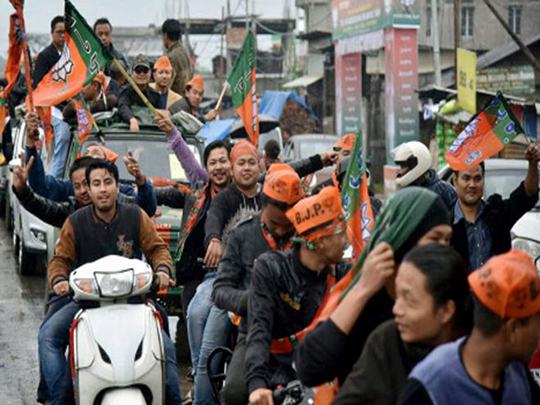
Imphal, Mar 12: The BJP is within a striking distance of forming a government in Manipur for the first time though it emerged as the second largest party after the Congress, provided it is able to enlist support of three NDA partners.
manipur

The election threw up a hung verdict with none of the two mainstream parties being able to cross the magic figure of 31 in the 60-member Assembly.

The Congress was the closest with 28 seats against BJP's 21, an impressive performance by all accounts.

The BJP is confident of forming the government by securing support of the Nationalist People's Party (NPP) and Naga People's Front (NPF), alliance partners of the North East Democratic Alliance and NDA at the Centre, which bagged four seats each.

The LJP, which is an NDA partner, TMC and Independents have bagged one seat each.
The NPF, NPP and LJP all fought the Assembly elections separately.

"We are confident of forming the next government in Manipur. The NPP has won four seats, LJP has won one seat. Even though we have fought separately we are hopeful that they will join us as they are our partners in the NDA government. we will talk to the TMC and Independent candidates also," BJP leader and one of the front-runners in the race to ascend to the chief minister's chair, N Biren, told reporters.

After its stunning victory in Assam in 2016, the BJP scripted a dramatic turnaround of fortunes in the Northeast, a traditional stronghold of the Congress, bagging 36.3 per cent votes, which is even higher than the Congress which polled 35.1 per cent votes.
The presence of the BJP was so nominal in the state that the party had hardly fielded any candidate in the last 2012 Assembly polls.

Things looked up after the BJP's ascension to power at the Centre in 2014.
"After party's victory at the Lok Sabha election in 2014, the party felt the need to increase its foot print in the Northeast as the region is very important in our party's vision of overall development and a Congress-free India," state BJP president K Bhabananda Singh had said prior to the elections.

After the party's victory in Assam, the BJP had engaged its election machinery full throttle as well as some of its finest strategists like Ram Madhav to repeat Assam in Manipur.

With anti-incumbency at its height after a 15-year Congress rule, led by Okram Ibobi Singh, the BJP milked both dissent within the Congress and the anti-incumbency factor till the last drop.

Ibobi Singh-led Congress's sweeping victory in Manipur in 2012 bagging 42 seats was attributed to a divided opposition. This time, the BJP built an anti-Congress platform by getting on board leaders who have popularity of their own but had fallen out with Ibobi Singh.

The BJP was able to pocket several top leaders of the Congress such as N Biren, Y Erabot and O Chauba, although it itself suffered a few casualties losing KH Jaikishan to the Congress.

The Congress's campaign strategy of accusing the saffron party of being hand in glove with the United Naga Council, which sponsored the crippling economic blockade to protest against the bifurcation of the districts in the-Naga dominated hills, did not cut much ice with the voters.

Neither did its allegation that if the BJP came to power it would compromise the territorial integrity of the state.

The BJP did well in the valley, where the Congress was hoping to reap the benefits of economic blockade.

The sharp decline in the vote share and number of seats of the Congress from 42 per cent in 2012 to 35 per cent in 2017, and to 28 seats from 42 seats last time has put the state leadership under the scanner.

The Congress strategy of bifurcating the hill and thus create a division between valley and hills which has 70 and 30 per cent of the seats respectively didn’t seem to have clicked this time.

The state Congress leadership, however, has blamed the "false promises of the BJP" and militant outfit NSCN (IM) for its poor performance.

"The NSCN (IM) in order to defeat the Congress had resorted to a massive rigging and booth-capturing in many seats in favour of the BJP and NPF candidates. The money power played a vital role in addition to a section of people's faith in the BJP's false promises about lifting the economic blockade," state Congress president T N Haokip told PTI.

Although the Congress is still three short of a majority, Haokip expressed confidence of forming the next government.

"We are confident. We will form the next government in Manipur. We are already in talks with like-minded secular and regional parties. But we will never go with separatist outfit like NPF," Haokip said.

Whether the smaller parties like NPP, NPF, LJP and TMC will join the Congress is a million-dollar question as all of them have won on an anti-Congress plank.

The NPP is yet to take a call as its general secretary Vivek Raj said, "We will decide after having an intra-party discussion."

The TMC leadership in Manipur is averse to going along with the BJP because of its implications in Bengal where it is a ruling party and has a 30 per cent Muslim electorate which is perceived to be anti-BJP.


Comments

Add new comment

  • Coastaldigest.com reserves the right to delete or block any comments.
  • Coastaldigset.com is not responsible for its readers’ comments.
  • Comments that are abusive, incendiary or irrelevant are strictly prohibited.
  • Please use a genuine email ID and provide your name to avoid reject.
News Network
December 13,2025

New Delhi: School-going children are picking up drug and smoking habits and engaging in consumption of alcohol, with the average age of introduction to such harmful substances found to be around 13 years, suggesting a need for earlier interventions as early as primary school, a multi-city survey by AIIMS-Delhi said.

The findings also showed substance use increased in higher grades, with grade XI/XII students two times more likely to report use of substances when compared with grade VIII students. This emphasised the importance of continued prevention and intervention through middle and high school.

The study led by Dr Anju Dhawan of AIIMS's National Drug Dependence Treatment Centre, published in the National Medical Journal of India this month, looks at adolescent substance use across diverse regions.

The survey included 5,920 students from classes 8, 9, 11 and 12 in urban government, private and rural schools across 10 cities -- Bengaluru, Chandigarh, Delhi, Dibrugarh, Hyderabad, Imphal, Jammu, Lucknow, Mumbai, and Ranchi. The data were collected between May 2018 and June 2019.

The average age of initiation for any substance was 12.9 (2.8) years. It was lowest for inhalants (11.3 years) followed by heroin (12.3 years) and opioid pharmaceuticals (without prescription; 12.5 years).

Overall, 15.1 per cent of participants reported lifetime use, 10.3 per cent reported past year use, and 7.2 per cent reported use in the past month of any substance, the study found.

The most common substances used in the past year, after tobacco (4 per cent) and alcohol (3.8 per cent), were opioids (2.8 per cent), followed by cannabis (2 per cent) and inhalants (1.9 per cent). Use of non-prescribed pharmaceutical opioids was most common among opioid users (90.2 per cent).

On being asked, 'Do you think this substance is easily available for a person of your age' separately for each substance category, nearly half the students (46.3 per cent) endorsed that tobacco products and more than one-third of the students (36.5 per cent) agreed that a person of their age can easily procure alcohol products.

Similarly, for Bhang (21.9 per cent), ganja/charas (16.1 per cent), inhalants (15.2 per cent), sedatives (13.7 per cent), opium and heroin (10 per cent each), the students endorsed that these can be easily procured.

About 95 per cent of the children, irrespective of their grade, agreed with the statement that 'drug use is harmful'.

The rates of substance use (any) among boys were significantly higher than those of girls for substance use (ever), use in the past year and use in the past 30 days. Compared to grade VIII students, grade IX students were more likely, and grade XI/XII students were twice as likely to have used any substance (ever).

The likelihood of past-year use of any substance was also higher for grade IX students and for grade XI/XII students as compared to grade VIII students.

About 40 per cent of students mentioned that they had a family member who used tobacco or alcohol each. The use of cannabis (any product) and opioid (any product) by a family member was reported by 8.2 per cent and 3.9 per cent of students, respectively, while the use of other substances, such as inhalants/sedatives by family was 2-3 per cent, the study found.

A relatively smaller percentage of students reported use of tobacco or alcohol among peers as compared to among family members, while a higher percentage reported inhalants, sedatives, cannabis or opioid use among peers.

Children using substances (past year) compared to non-users reported significantly higher any substance use by their family members and peers.

There were 25.7 per cent students who replied 'yes' to the question 'conflicts/fights often occur in your family'. Most students also replied affirmatively to 'family members are aware of how their time is being spent' and 'damily members are aware of with whom they spend their time'.

Comments

Add new comment

  • Coastaldigest.com reserves the right to delete or block any comments.
  • Coastaldigset.com is not responsible for its readers’ comments.
  • Comments that are abusive, incendiary or irrelevant are strictly prohibited.
  • Please use a genuine email ID and provide your name to avoid reject.
News Network
December 16,2025

jordan.jpg

Prime Minister Narendra Modi on Monday held talks with Jordan’s King Abdullah II in Amman, during which the two leaders discussed ways to further strengthen bilateral relations, with the Prime Minister outlining an eight-point vision covering key areas of cooperation.

Describing the meeting as “productive”, PM Modi said he shared a roadmap focused on trade and economy, fertilisers and agriculture, information technology, healthcare, infrastructure, critical and strategic minerals, civil nuclear cooperation, and people-to-people ties.

In a post on social media platform X, the Prime Minister praised King Abdullah II’s personal commitment to advancing India–Jordan relations, particularly as both countries mark the 75th anniversary of the establishment of diplomatic ties this year.

“Held productive discussions with His Majesty King Abdullah II in Amman. His personal commitment towards vibrant India-Jordan relations is noteworthy. This year, we are celebrating the 75th anniversary of our bilateral diplomatic relations,” PM Modi said.

The meeting took place at the Al Husseiniya Palace, where the two leaders also exchanged views on regional and global issues of mutual interest. According to the Ministry of External Affairs (MEA), both sides agreed to further deepen cooperation in areas including trade and investment, defence and security, counter-terrorism and de-radicalisation, fertilisers and agriculture, infrastructure, renewable energy, tourism, and heritage.

The MEA said both leaders reaffirmed their united stand against terrorism.

PM Modi arrived in Amman earlier on Monday and was received by Jordanian Prime Minister Jafar Hassan, who accorded him a formal welcome. Following the talks, King Abdullah II hosted a banquet dinner in honour of the Prime Minister, reflecting the warmth of bilateral ties.

Jordan is the first leg of PM Modi’s three-nation tour. From Amman, the Prime Minister will travel to Ethiopia at the invitation of Prime Minister Abiy Ahmed Ali, marking his first official visit to the African nation. The tour will conclude with a visit to Oman.

Comments

Add new comment

  • Coastaldigest.com reserves the right to delete or block any comments.
  • Coastaldigset.com is not responsible for its readers’ comments.
  • Comments that are abusive, incendiary or irrelevant are strictly prohibited.
  • Please use a genuine email ID and provide your name to avoid reject.