BJP well on top in both Maharashtra, Haryana, say exit polls

October 16, 2014

New Delhi/Mumbai/Chandigarh, Oct 16: The BJP was within striking distance of power in both Haryana and Maharashtra, exit polls said Wednesday at the end of keenly fought assembly elections that pitted Prime Minister Narendra Modi's party against all key players in the two states.
polls

Various exit polls gave the Bharatiya Janata Party a margin of 42-54 seats in the 90-member Haryana assembly and 124-151 seats in the 288-strong Maharashtra legislature.

The Congress, which had ruled Haryana for the last 10 years, was predicted to end up with just 10-18 seats. In Maharashtra, the exit polls gave the Shiv Sena, the BJP's former ally for 25 years, 51-77 seats, Congress 27-48 seats and Nationalist Congress Party 28-41 seats. The last two had ruled the state for three terms since 1999 before their alliance ended last month.

While some exit polls predicted BJP getting a majority in the two states, others projected it as the single largest party, a few seats short of a simple majority.

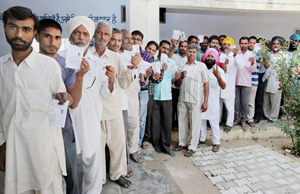
The bitter battle for Maharashtra ended Wednesday evening with over 64 percent of the 8.35 crore electorate voting. Polling also took place for the Beed Lok Sabha seat where a bypoll was necessitated following the death in June of central minister Gopinath Munde.

Sena youth leader Aditya Thackeray asserted that not only would his party form the government, but its president (his father) Uddhav Thackeray would be the next chief minister.

On the other hand, senior BJP leader and MP Poonam Mahajan confidently declared that "the people would support the vision of development propounded by Prime Minister Narendra Modi".

Stray incidents of violence marred an otherwise peaceful election. In Gadchiroli district, Maoists attempted to disrupt the polls by firing at a polling booth but security personnel returned fire and voting continued peacefully. Some incidents were also reported from Yavatmal, Thane and Mumbai.

Mumbai saw celebrities, including industrialists, Bollywood stars, television actors and cricketers, queueing up to vote and urging people to follow suit.

Among those seen were industrialists Anil Ambani and Adi Godrej, and film personalities Rekha, Shah Rukh Khan, Salman Khan, Sohail Khan, Jaya and Abhishek Bachchan, Javed Akhtar, Gulzar, Sonali Bendre, Anupam Kher, Hema Malini, Amol Palekar, Aamir Khan, Kiran Rao-Khan, Esha Deol, Nana Patekar, Prem Chopra, Govinda, Akshay Kumar, John Abraham, Rishi Kapoor and family, and Jeetendra and his family.

A total of 4,119 candidates were in the fray in the elections that saw Maharashtra's two main coalitions -- the BJP-Shiv Sena combine and the NCP-Congress alliance -- collapse, making the contest wide open but with advantage to BJP.

Prime Minister Narendra Modi led the BJP's campaign, addressing scores of heavily attended rallies and prompting a verbal assault from Shiv Sena. The Maharashtra Navnirman Sena (MNS) was also a key contender but surveys indicate it seemed to barely make an impact.

During the campaign, other parties attacked the BJP more than any other, making it a de facto BJP-versus-rest battle.

In Haryana, the voters Wednesday set a new record with over 75.5 percent of the 1.63 crore electorate exercising their franchise, perking up the BJP's hopes to come to power on its own.

This is the highest voting in Haryana assembly polls since 1967, chief electoral officer Shrikant Walgad said.The previous record of maximum polling was 72.65 percent in 1967. In 2009, Haryana recorded nearly 72.29 percent voting.

The BJP was confident of victory. "The BJP is all set to form the next government in Haryana on its own. We will get a clear majority and end scams and corruption," party leader Abhimanyu said.

Chief Minister Bhupinder Singh Hooda was not willing to give up easily, saying the "response of the voters" showed the Congress will form the government for a third term.

INLD leader Abhay Chautala claimed the heavy turnout was an indication that his party would form the next government.

Minor clashes at about 10 places marred the otherwise peaceful polling. Exit polls were unanimous in their prediction about major gains for BJP. Here is a state-wise prediction of some exit polls.

Maharashtra:

India TV C-Voter - BJP (124-134 seats), Shiv Sena (51-61), NCP (31-41), Congress (38-48), MNS (9-15).

Today's Chanakya - BJP 151 (+/- 9), Shiv Sena 71 (+/- 9), Congress 27 (+/-5), NCP 28 (+/- 5), MNS and others 11 (+/- 5).

ABP News-Nielsen - BJP+ (127 seats), Shiv Sena (77), Congress (40), NCP (34) and MNS (5).

C-voter poll - BJP (129), Congress (43), Shiv Sena (56), NCP (36).

Haryana:

India TV- C Voter - BJP (42-48), INLD (20-26), Congress (12-18).

ABP-Nielsen poll - BJP (54), Congress (10) and the INLD (22).

Today's Chanakya - BJP 52 (+/-7), INLD 23 (+/-7), Congress 10 (+/-5) and others five (+/-3).

Comments

Add new comment

  • Coastaldigest.com reserves the right to delete or block any comments.
  • Coastaldigset.com is not responsible for its readers’ comments.
  • Comments that are abusive, incendiary or irrelevant are strictly prohibited.
  • Please use a genuine email ID and provide your name to avoid reject.
News Network
December 16,2025

jordan.jpg

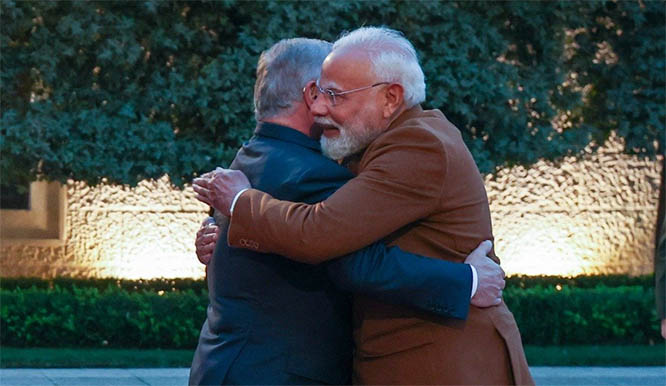
Prime Minister Narendra Modi on Monday held talks with Jordan’s King Abdullah II in Amman, during which the two leaders discussed ways to further strengthen bilateral relations, with the Prime Minister outlining an eight-point vision covering key areas of cooperation.

Describing the meeting as “productive”, PM Modi said he shared a roadmap focused on trade and economy, fertilisers and agriculture, information technology, healthcare, infrastructure, critical and strategic minerals, civil nuclear cooperation, and people-to-people ties.

In a post on social media platform X, the Prime Minister praised King Abdullah II’s personal commitment to advancing India–Jordan relations, particularly as both countries mark the 75th anniversary of the establishment of diplomatic ties this year.

“Held productive discussions with His Majesty King Abdullah II in Amman. His personal commitment towards vibrant India-Jordan relations is noteworthy. This year, we are celebrating the 75th anniversary of our bilateral diplomatic relations,” PM Modi said.

The meeting took place at the Al Husseiniya Palace, where the two leaders also exchanged views on regional and global issues of mutual interest. According to the Ministry of External Affairs (MEA), both sides agreed to further deepen cooperation in areas including trade and investment, defence and security, counter-terrorism and de-radicalisation, fertilisers and agriculture, infrastructure, renewable energy, tourism, and heritage.

The MEA said both leaders reaffirmed their united stand against terrorism.

PM Modi arrived in Amman earlier on Monday and was received by Jordanian Prime Minister Jafar Hassan, who accorded him a formal welcome. Following the talks, King Abdullah II hosted a banquet dinner in honour of the Prime Minister, reflecting the warmth of bilateral ties.

Jordan is the first leg of PM Modi’s three-nation tour. From Amman, the Prime Minister will travel to Ethiopia at the invitation of Prime Minister Abiy Ahmed Ali, marking his first official visit to the African nation. The tour will conclude with a visit to Oman.

Comments

Add new comment

  • Coastaldigest.com reserves the right to delete or block any comments.
  • Coastaldigset.com is not responsible for its readers’ comments.
  • Comments that are abusive, incendiary or irrelevant are strictly prohibited.
  • Please use a genuine email ID and provide your name to avoid reject.
News Network
December 6,2025

pilot.jpg

New Delhi: IndiGo, India’s largest airline, faced major operational turbulence this week after failing to prepare for new pilot-fatigue regulations issued by the Directorate General of Civil Aviation (DGCA). The stricter rules—designed to improve flight safety—took effect in phases through 2024, with the latest implementation on November 1. IndiGo has acknowledged that inadequate roster planning led to widespread cancellations and delays.

Below are the key DGCA rules that affected IndiGo’s operations:

1. Longer Mandatory Weekly Rest

Weekly rest for pilots has been increased from 36 hours to 48 hours.

The government says the extended break is essential to curb cumulative fatigue. This rule remains in force despite the current crisis.

2. Cap on Night Landings

Pilots can now perform only two night landings per week—a steep reduction from the earlier limit of six.

Night hours, defined as midnight to early morning, are considered the least alert period for pilots.

Given the disruptions, this rule has been temporarily relaxed for IndiGo until February 10.

3. Reduced Maximum Night Flight Duty

Flight duty that stretches into the night is now capped at 10 hours.

This measure has also been kept on hold for IndiGo until February 10 to stabilize operations.

4. Weekly Rest Cannot Be Replaced With Personal Leave

Airlines can no longer count a pilot’s personal leave as part of the mandatory 48-hour rest.

Pilots say this closes a loophole that previously reduced actual rest time.

Currently, all airlines are exempt from this rule to normalise travel.

5. Mandatory Fatigue Monitoring

Airlines must submit quarterly fatigue reports along with corrective actions to DGCA.

This system aims to create a transparent fatigue-tracking framework across the industry.

The DGCA has stressed that these rules were crafted to strengthen flight safety and align India with global fatigue-management standards. The temporary relaxations are expected to remain until February 2025, giving IndiGo time to stabilise its schedules and restore normal air travel.

Comments

Add new comment

  • Coastaldigest.com reserves the right to delete or block any comments.
  • Coastaldigset.com is not responsible for its readers’ comments.
  • Comments that are abusive, incendiary or irrelevant are strictly prohibited.
  • Please use a genuine email ID and provide your name to avoid reject.