



BJP wins big in MCD polls

April 26, 2017

New Delhi, Apr 26: BJP is cruising towards a huge victory in Delhi municipal elections by winning or leading in 185 wards out of 270 and pushing Aam Aadmi Party to a distant second.
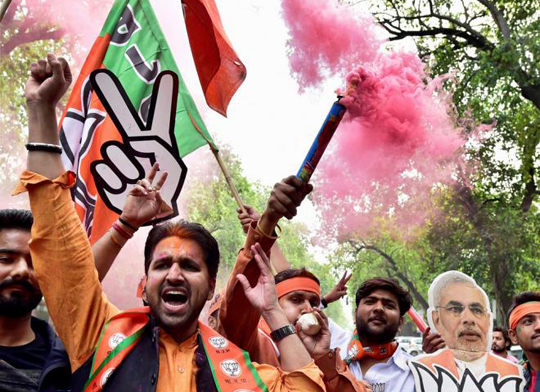
won

The counting is in progress and trends showed that BJP has won or is leading in 185 wards, AAP 47 and Congress 26. Other parties and independents won or leads in 19 seats.

According to the State Election Commission, BJP has so far won 103 seats while AAP has got 26. Congress has won eight seats so far.

AAP, which rules the state government, described its crushing defeat to "manipulation" of Electronic Voting Machines' (EVMs) while Congress' Delhi chief Ajay Maken has announced his resignation following his party's dismal show.

At one point of counting, AAP looked to fall below Congress but it managed to reverse the stand to emerge second.

BJP is upbeat as it has managed to win a third term in the civic polls, fighting against anti-incumbency. In 2007, the polls were held for undivided corporation while the 2012 polls were held after the Municipal Corporation of Delhi (MCD) was trifurcated.

Of the 272 wards in three corporations, 270 went to polls as elections to one each wards in North Delhi Muncipal Corporation (NDMC with total 104 wards ) and East Delhi Municipal Corporation (EMDC with 64 wards) were postponed due to death of candidates. South Delhi Municipal Corporation (SDMC) has 104 wards.

In SDMC, BJP has won or is ahead in 72 while AAP at second place is a distant second with 15 wards in its kitty. Congress has ten and Others in seven.

The NDMC also has similar numbers with BJP at 66. AAP has done better in NDMC winning or leading in 22 while Congress has 12 and Others three. In EDMC too, BJP is far ahead with 47 wards while AAP has an upper hand in 10 and Congress four. Others have an edge in two wards.

The victories in three corporations in the national capital would be a boost for the BJP, which continues its winning streak after the civic poll wins in Maharashtra and Odisha as well as the Assembly polls in Uttar Pradesh and Uttarakhand.

The biggest loser will be Arvind Kejriwal-led AAP, which would have to do a lot of explanation for the loss. Its candidate was relegated to third position in the recent bypoll to Rajouri Garden Assembly seats and had to forfeit deposit. For the AAP, the polls was an opportunity to prove that the electoral victories in the Assembly elections in Delhi were not a one-off incident.

Comments

Add new comment

  • Coastaldigest.com reserves the right to delete or block any comments.
  • Coastaldigset.com is not responsible for its readers’ comments.
  • Comments that are abusive, incendiary or irrelevant are strictly prohibited.
  • Please use a genuine email ID and provide your name to avoid reject.
News Network
December 13,2025

New Delhi: School-going children are picking up drug and smoking habits and engaging in consumption of alcohol, with the average age of introduction to such harmful substances found to be around 13 years, suggesting a need for earlier interventions as early as primary school, a multi-city survey by AIIMS-Delhi said.

The findings also showed substance use increased in higher grades, with grade XI/XII students two times more likely to report use of substances when compared with grade VIII students. This emphasised the importance of continued prevention and intervention through middle and high school.

The study led by Dr Anju Dhawan of AIIMS's National Drug Dependence Treatment Centre, published in the National Medical Journal of India this month, looks at adolescent substance use across diverse regions.

The survey included 5,920 students from classes 8, 9, 11 and 12 in urban government, private and rural schools across 10 cities -- Bengaluru, Chandigarh, Delhi, Dibrugarh, Hyderabad, Imphal, Jammu, Lucknow, Mumbai, and Ranchi. The data were collected between May 2018 and June 2019.

The average age of initiation for any substance was 12.9 (2.8) years. It was lowest for inhalants (11.3 years) followed by heroin (12.3 years) and opioid pharmaceuticals (without prescription; 12.5 years).

Overall, 15.1 per cent of participants reported lifetime use, 10.3 per cent reported past year use, and 7.2 per cent reported use in the past month of any substance, the study found.

The most common substances used in the past year, after tobacco (4 per cent) and alcohol (3.8 per cent), were opioids (2.8 per cent), followed by cannabis (2 per cent) and inhalants (1.9 per cent). Use of non-prescribed pharmaceutical opioids was most common among opioid users (90.2 per cent).

On being asked, 'Do you think this substance is easily available for a person of your age' separately for each substance category, nearly half the students (46.3 per cent) endorsed that tobacco products and more than one-third of the students (36.5 per cent) agreed that a person of their age can easily procure alcohol products.

Similarly, for Bhang (21.9 per cent), ganja/charas (16.1 per cent), inhalants (15.2 per cent), sedatives (13.7 per cent), opium and heroin (10 per cent each), the students endorsed that these can be easily procured.

About 95 per cent of the children, irrespective of their grade, agreed with the statement that 'drug use is harmful'.

The rates of substance use (any) among boys were significantly higher than those of girls for substance use (ever), use in the past year and use in the past 30 days. Compared to grade VIII students, grade IX students were more likely, and grade XI/XII students were twice as likely to have used any substance (ever).

The likelihood of past-year use of any substance was also higher for grade IX students and for grade XI/XII students as compared to grade VIII students.

About 40 per cent of students mentioned that they had a family member who used tobacco or alcohol each. The use of cannabis (any product) and opioid (any product) by a family member was reported by 8.2 per cent and 3.9 per cent of students, respectively, while the use of other substances, such as inhalants/sedatives by family was 2-3 per cent, the study found.

A relatively smaller percentage of students reported use of tobacco or alcohol among peers as compared to among family members, while a higher percentage reported inhalants, sedatives, cannabis or opioid use among peers.

Children using substances (past year) compared to non-users reported significantly higher any substance use by their family members and peers.

There were 25.7 per cent students who replied 'yes' to the question 'conflicts/fights often occur in your family'. Most students also replied affirmatively to 'family members are aware of how their time is being spent' and 'damily members are aware of with whom they spend their time'.

Comments

Add new comment

  • Coastaldigest.com reserves the right to delete or block any comments.
  • Coastaldigset.com is not responsible for its readers’ comments.
  • Comments that are abusive, incendiary or irrelevant are strictly prohibited.
  • Please use a genuine email ID and provide your name to avoid reject.