



BJP yet to decide on President candidate: Amit Shah

May 21, 2017

New Delhi, May 21: The BJP is yet to take a decision on its candidate for the upcoming Presidential poll, even as the party virtually rejected Shiv Sena's proposal for RSS chief Mohan Bhagwat to be the ruling combine's nominee.
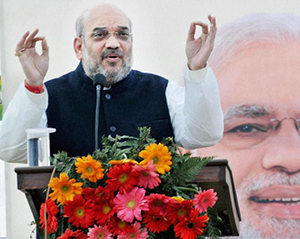
shah

Replying to a question on the BJP-led NDA's candidate for the Presidential polls in July as the opposition was already working on putting up a joint candidate, said BJP President Amit Shah told Aaj Tak channel in an interview that a decision is yet to be taken.

"Even if I have a name on my mind, it has to be discussed within the party first," he said.

He also rejected the Shiv Sena's proposal regarding Bhagwat, saying that party has itself ruled it out.

To questions on Kashmir, Shah said there was no need for even an "iota of concern" over the situation in the state which has witnessed months of unrest, and asserted that the Narendra Modi-led government will control it soon.

"There is a big gap between the reality and the projection" of the Kashmir situation and the trouble was confined to "three and a half districts", he said.

The government was keeping a sharp vigil over the situation and the Valley has witnessed many spells of such unrest in the past before the situation has normalised, he said.

Shah also attacked the Congress for criticising the government, claiming that it had no right to do so as the Kashmir problem was an outcome of the policies of its governments since independence.

Terming the lynching of seven persons in Jharkhand by a mob over abduction rumours as an "isolated and stray incident" which happens in a country of 125 crore people, the BJP chief said it would not be appropriate to link such cases of violence to his party.

People should look up the crime data to find out if cases of violence have increased under the BJP governments, he said.

To a question, if Tamil superstar Rajinikant will join the BJP, Shah said the decision has to be taken by the actor himself and his party welcomed all good people to its fold.

Ahead of the Modi government's third anniversary, he said it has won the people's trust and added that the poor have the belief that it was working for their welfare.

In a democracy the "biggest certificate is the people's verdict" and the masses have time and again underscored their support for the BJP-led NDA government, he said in a reference to the BJP's win in several state polls.

The Modi government has been able to rid the country of the politics of casteism, family rule and appeasement, and turned the focus on the politics of performance, he claimed.

While the UPA government was accused of scams running into Rs 12 lakh crore, even rivals of the NDA government have not levelled a single charge of corruption against it, Shah claimed.

Comments

Add new comment

  • Coastaldigest.com reserves the right to delete or block any comments.
  • Coastaldigset.com is not responsible for its readers’ comments.
  • Comments that are abusive, incendiary or irrelevant are strictly prohibited.
  • Please use a genuine email ID and provide your name to avoid reject.
News Network
December 13,2025

New Delhi: School-going children are picking up drug and smoking habits and engaging in consumption of alcohol, with the average age of introduction to such harmful substances found to be around 13 years, suggesting a need for earlier interventions as early as primary school, a multi-city survey by AIIMS-Delhi said.

The findings also showed substance use increased in higher grades, with grade XI/XII students two times more likely to report use of substances when compared with grade VIII students. This emphasised the importance of continued prevention and intervention through middle and high school.

The study led by Dr Anju Dhawan of AIIMS's National Drug Dependence Treatment Centre, published in the National Medical Journal of India this month, looks at adolescent substance use across diverse regions.

The survey included 5,920 students from classes 8, 9, 11 and 12 in urban government, private and rural schools across 10 cities -- Bengaluru, Chandigarh, Delhi, Dibrugarh, Hyderabad, Imphal, Jammu, Lucknow, Mumbai, and Ranchi. The data were collected between May 2018 and June 2019.

The average age of initiation for any substance was 12.9 (2.8) years. It was lowest for inhalants (11.3 years) followed by heroin (12.3 years) and opioid pharmaceuticals (without prescription; 12.5 years).

Overall, 15.1 per cent of participants reported lifetime use, 10.3 per cent reported past year use, and 7.2 per cent reported use in the past month of any substance, the study found.

The most common substances used in the past year, after tobacco (4 per cent) and alcohol (3.8 per cent), were opioids (2.8 per cent), followed by cannabis (2 per cent) and inhalants (1.9 per cent). Use of non-prescribed pharmaceutical opioids was most common among opioid users (90.2 per cent).

On being asked, 'Do you think this substance is easily available for a person of your age' separately for each substance category, nearly half the students (46.3 per cent) endorsed that tobacco products and more than one-third of the students (36.5 per cent) agreed that a person of their age can easily procure alcohol products.

Similarly, for Bhang (21.9 per cent), ganja/charas (16.1 per cent), inhalants (15.2 per cent), sedatives (13.7 per cent), opium and heroin (10 per cent each), the students endorsed that these can be easily procured.

About 95 per cent of the children, irrespective of their grade, agreed with the statement that 'drug use is harmful'.

The rates of substance use (any) among boys were significantly higher than those of girls for substance use (ever), use in the past year and use in the past 30 days. Compared to grade VIII students, grade IX students were more likely, and grade XI/XII students were twice as likely to have used any substance (ever).

The likelihood of past-year use of any substance was also higher for grade IX students and for grade XI/XII students as compared to grade VIII students.

About 40 per cent of students mentioned that they had a family member who used tobacco or alcohol each. The use of cannabis (any product) and opioid (any product) by a family member was reported by 8.2 per cent and 3.9 per cent of students, respectively, while the use of other substances, such as inhalants/sedatives by family was 2-3 per cent, the study found.

A relatively smaller percentage of students reported use of tobacco or alcohol among peers as compared to among family members, while a higher percentage reported inhalants, sedatives, cannabis or opioid use among peers.

Children using substances (past year) compared to non-users reported significantly higher any substance use by their family members and peers.

There were 25.7 per cent students who replied 'yes' to the question 'conflicts/fights often occur in your family'. Most students also replied affirmatively to 'family members are aware of how their time is being spent' and 'damily members are aware of with whom they spend their time'.

Comments

Add new comment

  • Coastaldigest.com reserves the right to delete or block any comments.
  • Coastaldigset.com is not responsible for its readers’ comments.
  • Comments that are abusive, incendiary or irrelevant are strictly prohibited.
  • Please use a genuine email ID and provide your name to avoid reject.