



Tokyo, Sep 2: Living up to the hopes and expectations of several watchers, the Japanese government on Monday announced a public-private investment of 3.5 trillion yen (Rs 2.03 lakh crore) in India. The two countries have set a target of doubling Japan's foreign direct investment and the number of Japanese companies in India within five years.
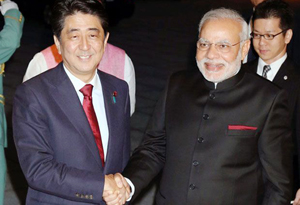
In a joint press conference, Indian Prime Minister Narendra Modi and his Japanese counterpart Shinzo Abe commented on a number of issues including strategic maritime cooperation, security cooperation and taking forward nuclear talks.
"The two prime ministers ... affirmed their shared commitment to maritime security, freedom of navigation and overflight, civil aviation safety, unimpeded lawful commerce, and the peaceful settlement of disputes in accordance with international law," the joint statement said.
They also agreed to accelerate talks on the possible sale of an amphibious aircraft to India's navy - likely to become Japan's first overseas military sale in nearly 50 years and a result of Abe's more muscular approach to defence in the face of an assertive China.
Abe and Modi agreed to look into upgrading a 'two-plus-two' format for security talks by bringing together their foreign and defence ministers, and directed officials to launch working level talks on defence equipment and technology cooperation.
They also agreed to hold regular maritime exercises, and that Japan would continue to participate in US-India drills.
The two leaders also welcomed a substantial agreement on a commercial deal on the manufacture and supply of rare earth chlorides, a key element of defence industry components and hi-tech wares, by India to Japan.
Here's a quick wrap-up on everything that happened since Modi began his five day official visit to Japan:
On Indo-Japanese relations:
The Indian Prime Minister said that better relations between the two countries would be better for the world and reiterated that the world was sure that the 20th century would belong to Asia.
"The 21st century belongs to Asia ... but how the 21st century will be depends on how strong and progressive India-Japan ties are," Modi said.
On Japanese investments in India:
Prime Minister Narendra Modi announced a special team in his office to fast-track investments from Japan.
"Two nominees selected by Japan will also be part of this decision-making team, which will evaluate the business proposals," he said.
The 3.5 trillion yen( $34 billion of investment from Japan to India including Official Development Assositance(ODA) during a 5-year period will be under the aegis of India-Japan Investment Promotion Partnership for development of projects including infrastructure and building of smart cities.
Thirdly, Japan will invest substantially in the Metro project in Ahmedabad
On a civil nuclear deal:
Modi said there had been progress on a civil nuclear deal and there had been discussions on the matter. "We have asked officials at our end to take it forward so that there can be strategic co-operation on the issue," Modi said.
The Prime Minister said he hoped that some sanctions on Indian companies would be lifted and said that the agreement on defence equipment showed that relations between the two countries had improved.
"Over nuclear co-operation there has been progress over the last several months. I was able to have discussions with PM Modi on the issue and we were able to deepen our understanding on both sides," Abe said.
Lifting of ban on HAL
Japan government also lifted ban on HAL and five other Indian entities, which had been imposed in the aftermath of the 1998 nuclear tests.The removal of the ban will enable these companies to have cooperation with Japanese firms, including transfer of technology.
On bullet trains:
Japan has also expressed readiness to provide financial, technical and operational support to introduce bullet trains in India.
On security and defence cooperation:
"We agreed to comprehensive agreements on defence and security co-operation," Abe said on Monday. Japan said it would remove six of India's space and defence-related entities from Japan's foreign fund user list.
On maritime cooperation:
The two countries agreed to hold regular maritime drills, and that Japan would continue to participate in U.S.-India drills.
On smart cities:
A pact was signed, at the start of Modi's visit, under which his constituency Varanasi will be developed as a 'smart city', with cooperation and experience of Kyoto, the Japanese 'smart city' which is a confluence of heritage and modernity.
There will also be public-private initiatives to set up Electronics Industrial Parks in India and Japan.
On cleaning Ganga:
Modi reportedly discussed his Ganga cleaning plans with Abe. The Japanese PM has asked him to suggest ways in which Japan can help the country in the issue.
On education:
India will promote Japanese language education. The two countries have discussed a big push for collaboration in information technology.
On Energy
On energy cooperation, the two countries decided to collaborate in the procurement of liquefied natural gas (LNG) and upstream development of oil and gas as well as clean coal technology.

Comments
Add new comment