


CAA Debate: Falsehoods to the Fore

Ram Puniyani
December 28, 2019

Citizenship Amendment Bill, while passed in both houses of Parliament has elicited diverse and negative responses all over India. On one hand we see massive protests in North East leading to death of four people. On the other there is a sever discomfort among those upholding Indian Constitution and among the Muslim community all over the country. This Bill in its present form gives the rights of citizenship to Hindus, Sikhs, Buddhists, Jains and Christians persecuted in Afghanistan, Pakistan and Bangle Desh. What is glaring is that Muslims are missing from the list. What is glaring and dangerous is that while those persecuted in these countries have been offered citizenship, the Countries like Myanmar, where worst persecution against Muslims has been seen in recent years, don’t fins any place in the list. Also even in the countries which are mentioned in the bill, there are sects of Muslims which are persecuted, but have been left out.

A lots has been written against the bill and its intention of converting our plural India into Hindu rashtra, what is also disturbing is that the defense of this Bill has been done by blaming Congress and by stating that partition was done on the basis of faith! Both these formulation are a total lie. Mr. Amit Shah while speaking in Rajya Sabha in an aggressive manner retorted that “Is desh ka vibhajan agar dharma ke aadhar par Congress na kari hoti to is Bill ka kaam nahin hota (Had the Congress not partitioned this country on the basis of religion, there would have been no need for this Bill).” In response Shahshi Tharoor of Congress said that Amit Shah was not paying attention to History class. The facts lie somewhere else.

Mr. Shah was a RSS worker who later joined RSS student wing ABVP. Contrary to what Shashi Tharoor is saying Shah has imbibed the history taught by RSS combine and seriously internalized it. We recall that even Nathuram Godse the murderer of Father of Nation, also held Gandhi, the patriarch of Congress, as being responsible for partition.  This is believed by most of the Hindu nationalists. Religion as the basis of Nationhood is by and large attributed to begin with Savarkar and then Jinnah. As such the story is much older. Before coming to roots of genesis of the idea of religion as the root of Nationhood, we also need to remember that, the British, the colonial masters, were the prime force in encouraging Muslim League on one side and Hindu Mahasabha-RSS on the other.

The British, to begin with, saw these organizations as helpful in the pursuing their ‘divide and rule’ policy. Later close to the peaking of National movement in 1942, they started keeping yet another angle in their mind. This was the geo-political realities of those times. Russia had emerged as the major other pole in the power politics of the World. It was posing the challenge to British-American hegemony of the World. Russia was also inspiring the anti colonial movements. Many of the leaders of freedom movement were influenced by socialist ideology. Keeping this in mind, division of India was one of the steps in the mind of British. The idea behind this was that they can retain their hold in the region through yet to be formed Pakistan.

Coming to the genesis of nationalism in the name of religion, it was the reaction of declining classes’, landlords and Kings, to the changing scenario, where through Industrialization, communication and modern education, India was emerging as a secular democratic nation. Different groups, Madras Mahajan Sabha, Pune Sarvjakik Sabha, Bombay Association, representing the emerging classes and newer social changes started coming up and as they formed the political organization Indian National Congress in 1885. In response to this declining classes became very uncomfortable with the changes which were the root of equality. The feudal classes, Landlords-Kings of both religions were deeply shaken as the system of birth based hierarchy, on which they were presiding, started crumbling.

At this point of time the Muslim section started saying that Islam is in danger and Hindu sections presented as if Hindu religion is in danger. As Indian National organizations and parallel activities of education for dalits and women started picking up, the feudal classes saw it as an assault on the religiously ordained inequality. While these organizations initially had the participation of landlord-kings, later they succeeded in winning over other elite and still later sections of average people. This is the foundation of religious nationalism-Muslim and Hindu. So on one hand we had Indian nationalism, which can broadly be identified with Gandhi, Ambedkar and Bhagat Singh, on the other Muslim League formed in 1906, Hindu Mahasabha in 1915 and RSS in 1925. The latter group harped on ancient glorious past while the India nationalist stream saw the need for struggle against the prevalent inequality.

The articulation of religious nationalism comes with Savarkar, who saw Hindus and Muslims as two opponents, and Muslim League which saw that Hindu majority will not let them have equal rights. Hindu nationalists spread hatred against Muslims and Muslim nationalists, forming the base of intense communal violence in times to come.

It was the gravity of communal violence which forced Congress to gradually accept the Mountbatten’s (March 1947) proposal of partitioning the country. Congress in its resolution accepting the partition stated that though it opposes the ‘Two Nation theory’ (of Savrakar, Jinnah, Golwalkar-Muslim League, Hindu Mahasabha and RSS), in the given circumstances it seems to be lesser evil than the communal venom which is engulfing the nation. Here again VP Menon, the architect of the Partition Plan, points out that Patel 'accepted the division of India in December 1946, while Nehru would only acquiesce six months later'."

Maulana Azad and Gandhi, did not accept the idea at all, but in the face of the rising communal tide, they had to keep quiet about it. In Amit Shah-RSS narrative Congress is blamed as Congress, leading the freedom movement, never accepted the idea of religion as the basis of nation.

Comments

Add new comment

  • Coastaldigest.com reserves the right to delete or block any comments.
  • Coastaldigset.com is not responsible for its readers’ comments.
  • Comments that are abusive, incendiary or irrelevant are strictly prohibited.
  • Please use a genuine email ID and provide your name to avoid reject.
News Network
November 21,2025

Bantwal: A domestic dispute appears to have led to a violent confrontation in BC Road area, where the owner of a textile shop was allegedly attacked with a knife by his wife on Wednesday evening.

Krishna Kumar Somayaji, the owner of Somayaji Textiles, sustained serious injuries in the incident and was immediately taken to a hospital for treatment. He is currently receiving care in the intensive care unit and is reported to have survived the assault, according to police.

The Bantwal Town police have registered a case against Somayaji's wife, Jyothi KT, who has since been taken into custody.

Police stated that the complainant, Namita, an employee at the shop, reported the sequence of events. She stated that around 7 p.m. on Wednesday, the suspect entered the shop, wearing a burqa and disguised as a customer, before attacking Somayaji with a knife. The employee then transported the injured owner to a local hospital via an autorickshaw.

Superintendent of Police Arun K confirmed that an ongoing domestic dispute between Somayaji and his wife reportedly preceded the attack. Police noted that Jyothi KT had previously visited the shop and issued threats.

Based on the complaint, Bantwal Town police have registered a case under relevant sections of the Bharatiya Nyaya Sanhita (BNS) and the Indian Arms Act-1959. An investigation into the incident is currently underway.

Comments

Add new comment

  • Coastaldigest.com reserves the right to delete or block any comments.
  • Coastaldigset.com is not responsible for its readers’ comments.
  • Comments that are abusive, incendiary or irrelevant are strictly prohibited.
  • Please use a genuine email ID and provide your name to avoid reject.
News Network
November 27,2025

siddDKS.jpg

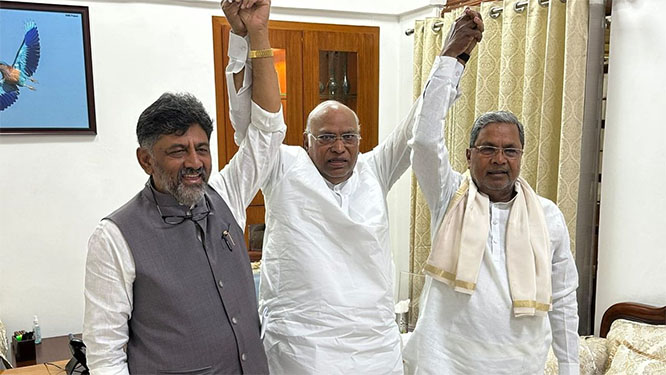
Congress president Mallikarjun Kharge on Thursday announced that he will convene a high-level meeting in New Delhi with senior leaders — including Rahul Gandhi, Karnataka Chief Minister Siddaramaiah and Deputy Chief Minister D.K. Shivakumar — to resolve the escalating leadership turmoil in Karnataka and “put an end to the confusion.”

Kharge said the discussions would focus on the way forward for the ruling party, as rumours of a possible leadership change continue to swirl. The speculation has intensified after the Congress government crossed the halfway mark of its five-year term on November 20, reviving talk of an alleged 2023 “power-sharing agreement” between Siddaramaiah and Shivakumar.

“After reaching Delhi, I will call three or four important leaders and hold discussions. Once we talk, we will decide how to move ahead and end this confusion,” Kharge told reporters in Bengaluru, according to PTI.

When asked specifically about calling Siddaramaiah and Shivakumar to Delhi, he responded: “Certainly, we should call them. We will discuss with them and settle the issue.”

He confirmed that Rahul Gandhi, the Chief Minister, the Deputy Chief Minister and other senior members would be part of the deliberations. “After discussing with everyone, a decision will be made,” he said.

Meanwhile, Siddaramaiah held a separate strategy meeting at his Bengaluru residence with ministers and leaders seen as his close confidants, including G. Parameshwara, Satish Jarkiholi, H.C. Mahadevappa, K. Venkatesh and K.N. Rajanna.
Signalling calm, the Chief Minister told reporters, “Will go to Delhi if the high command calls.”

Shivakumar echoed a similar stance, saying he too would head to the national capital if summoned by the party leadership.

Comments

Add new comment

  • Coastaldigest.com reserves the right to delete or block any comments.
  • Coastaldigset.com is not responsible for its readers’ comments.
  • Comments that are abusive, incendiary or irrelevant are strictly prohibited.
  • Please use a genuine email ID and provide your name to avoid reject.
News Network
November 26,2025

students.jpg

Bengaluru, Nov 26: Karnataka is taking its first concrete steps towards lifting a three-decade-old ban on student elections in colleges and universities. Deputy Chief Minister D.K. Shivakumar announced Wednesday that the state government will form a small committee to study the reintroduction of campus polls, a practice halted in 1989 following incidents of violence.

Speaking at a 'Constitution Day' event organised by the Karnataka Congress, Mr. Shivakumar underscored the move's aim: nurturing new political leadership from the grassroots.

"Recently, (Leader of the Opposition in Lok Sabha) Rahul Gandhi wrote a letter to me and Chief Minister (Siddaramaiah) asking us to think about restarting student elections," Shivakumar stated. "I'm announcing today that we'll form a small committee and seek a report on this."

Student elections were banned in Karnataka in 1989, largely due to concerns over violence and the infiltration of political party affiliates into campus life. The ban effectively extinguished vibrant student bodies and the pipeline of young leaders they often produced.

Mr. Shivakumar, who also serves as the Karnataka Congress president, said that former student leaders will be consulted to "study the pros and cons" of the re-introduction.

Acknowledging the history of the ban, he added, "There were many criminal activities taking place back then. We’ll see how we can conduct (student) elections by regulating such criminal activities."

The Deputy CM reminisced about his own journey, which began on campus. He recalled his political activism at Sri Jagadguru Renukacharya College leading to his first Assembly ticket in 1985 at the age of 23. "That's how student leadership was at the time. Such leadership has gone today. College elections have stopped," he lamented, adding that for many, college elections were "like a big movement" where leaders were forged.

The move, driven by the Congress high command's push to cultivate young talent, will face scrutiny from academics and university authorities who have, in the past, expressed concern that the return of polls could disrupt the peaceful academic environment and turn campuses into political battlegrounds.

Comments

Add new comment

  • Coastaldigest.com reserves the right to delete or block any comments.
  • Coastaldigset.com is not responsible for its readers’ comments.
  • Comments that are abusive, incendiary or irrelevant are strictly prohibited.
  • Please use a genuine email ID and provide your name to avoid reject.