


Can Hindi be the ‘Uniting Language’ of India?

Ram Puniyani
September 19, 2019

Modi 2.0 has emerged as a very powerful Government. It has not only the numerical majority; it is also facing a weak and divided opposition. That is one of the reasons for it stream rolling over people’s opinions and imposing the agenda of RSS-BJP of Hindu nationalism in a blatant way. On one side it has brought in a law banning triple talaq, on the other it has revoked article 370. Encouraged by these easy successes, now it seems to be unfolding it’s other agendas one by one.

Speaking on occasion of Hindi day, the BJP President and Union Home minister Amit Shah went on to speak his party mind on the subject Hindi as the national language. Mr. Shah said, it was necessary to have one language which could represent India in the world…and that Hindi was widely spoken and could be the language to keep India 'united'…"To preserve our ancient philosophy, our culture and the memory of our freedom struggle,…there is at least one language, Hindi, that the nation knows. If Hindi is taken out of our freedom struggle, the entire soul of the struggle is lost." He tweeted this to emphasize his point: "I want to appeal to people to promote their native languages but also use Hindi to make the dream of Bapu and Sardar Patel of one language come true."

The intentions behind this statement were not so hidden though the language is very clever. The idea is to relegate English and regional languages to the margins and to give more prominence to Hindi all through. Sensing the intentions of Mr. Shah, many a leaders from South India, M K Stalin, Shashi Tharoor, Pinrayi Vijayan and Kamal Haasan have openly come against his statement. All of them see this as an attempt to impose Hindi on these states. Vijayan put it bluntly through his tweet, “That language (Hindi) is not the mother tongue of majority of Indians. The move to inflict Hindi upon them amounts to enslaving them.” While Kamal Haasasn, in a video uploaded with him standing next to the Ashoka pillar and the Preamble, says India became a republic in 1950 with a promise to the people that their language and culture will be protected. "No Shah, Sultan or Samrat can suddenly break that promise. We respect all languages but our mother language will always be Tamil… The battle for our language will be exponentially bigger…"

As such our country has been very diverse in all the matters related to language, culture, religion and ethnicity. The freedom movement was the real reflector of this diversity. People cutting across all these considerations stood as a single fraternity, respecting the diversity and the rich heritage coming from different religions and languages in particular. In all the languages, India’s aspirations of becoming a single nation got expressed. Hindi along with other regional languages have inherited rich lineage of becoming the mirror of Indian society. Though English was introduced primarily as administrative language, it soon became part of Indian culture, and all these also became a mirror of Indian society and aspirations.

In contrast to national movement for freedom from British slavery, which stood to reflect all the languages, the communal forces had different ideas. Muslim communalism came up with the slogan, ‘Urdu, Muslim, Pakistan’, and on parallel lines Hindu nationalism threw up the slogan, ‘Hindi, Hindu, Hindustan’. When Pakistan was formed in the Muslim majority areas (East Pakistan and West Pakistan) their languages were very diverse. Muslim League’s insistence that Urdu should become the national language of Pakistan did precipitate the feeling of separation of East Pakistan from West Pakistan leading to formation Bangla Desh with Bengali as the major language.

Interestingly the Constitution makers concluded that "Hindustani, written either in Devanagari or the Persian script at the option of the citizen, shall, as the national language, be the first official language of the Union. English shall be the second official language for such period as the Union may, by law, determine."  The three language formula envisaged English, Hindi and regional language as the fulcrum of education. During sixties there was an attempt to introduce Hindi in Southern states, and this led to massive protests all over, with the result the policy was put on hold. Again with new Education Policy under consideration wanted to make Hindi as mandatory. The argument continues that Hindi is language of the majority of Indians. The latest data shows that it is mother tongue of 25% of Indians and 44% people say they know Hindi. The massive opposition to this language part of New Education Policy yet again led to holding back of Hindi as mandatory. One recalls that even during 1940s when Congress Government came to power in Tamilnadu (Madras at that time.), attempt was made to introduce Hindi there. The resistance to this was articulated by Periyar Ramasamy Naicker, who raised the slogan 'Tamil Nadu for Tamilians' and accused Hindi of being a tool of the Aryans for infiltrating Dravidian culture.

How does one deal with the complex language issue. Country has been running well with English, Hindi and regional languages being used in different proportions at different levels. While there have been conscious efforts to spread Hindi to Southern states, there are no parallel steps to popularize regional languages in Hindi speaking states. One must say Hindi has definitely made long strides in spreading into southern and other states all over the country but this task has been achieved not by impositions from top but by the spread of Hindi films, and popular Hindi serials apart from the efforts of organizations promoting Hindi.

Issue of Urdu as national language contributed to split of Pakistan. In contrast India has done a remarkable balancing act in matters of languages so far. The reorganization of states on linguistic lines has given a unique strength to us. With Amit Shah unfolding their agenda of imposing homogeneity all over, including in matters of language, one hopes this present sanity will prevail and sentiments and aspirations of all non Hindi speaking states will be given due weight age in deciding the national language policy.

Comments

Add new comment

  • Coastaldigest.com reserves the right to delete or block any comments.
  • Coastaldigset.com is not responsible for its readers’ comments.
  • Comments that are abusive, incendiary or irrelevant are strictly prohibited.
  • Please use a genuine email ID and provide your name to avoid reject.
News Network
November 28,2025

ministerPM.jpg

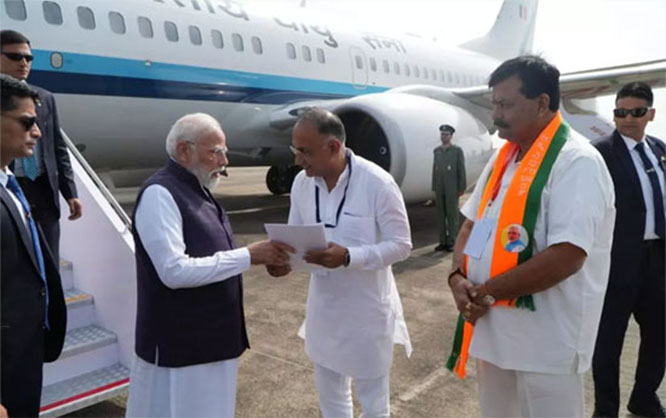
Mangaluru, Nov 28: Karnataka Health Minister and Dakshina Kannada district in-charge minister Dinesh Gundu Rao on Friday handed over Chief Minister Siddaramaiah’s letter to Prime Minister Narendra Modi, highlighting the severe distress faced by farmers due to crashing crop prices.

PM Modi arrived at the Mangaluru International Airport en route to Udupi, where Gundu Rao welcomed him and submitted the letter. The chief minister’s message stressed that farmers are suffering heavy losses because maize and green gram are being bought far below the Minimum Support Price (MSP). The state urged the Centre to immediately begin procurement at MSP.

According to the letter, Karnataka has a bumper harvest this year—over 54.74 lakh metric tons of maize and 1.98 lakh metric tons of green gram—yet farmers are unable to secure fair prices. Against the MSP of ₹2,400/MT for maize and ₹8,768/MT for green gram, market rates have plunged to ₹1,600–₹1,800 and ₹5,400 respectively.

The chief minister has requested the Centre to:

• Direct NAFED, FCI and NCCF to start MSP procurement immediately.
• Ensure ethanol units purchase maize directly from farmers or FPOs.
• Increase Karnataka’s ethanol allocation, citing high production capacity.
• Stop maize imports, which have depressed domestic prices.
• Relax quality norms for green gram, allowing up to 10% discoloration due to rains.

The letter stresses that MSP is crucial for farmer dignity and income stability and calls for swift central intervention to prevent a deepening crisis.

Comments

Add new comment

  • Coastaldigest.com reserves the right to delete or block any comments.
  • Coastaldigset.com is not responsible for its readers’ comments.
  • Comments that are abusive, incendiary or irrelevant are strictly prohibited.
  • Please use a genuine email ID and provide your name to avoid reject.
News Network
November 21,2025

Bengaluru, Nov 21: The Karnataka government is facing pressure to overhaul its employment system after a high-level Cabinet sub-committee recommended the complete phase-out of job outsourcing in government offices, boards, and corporations by March 2028. The move is aimed at tackling a systemic issue that has led to the potential violation of constitutional reservation policies and the exploitation of workers.

The Call for Systemic Change

With over three lakh vacant posts currently being filled through private agencies on an outsource, insource, or daily wage basis, the sub-committee highlighted a significant lapse. "As a result, reservations are not being followed as per the Constitution and state laws. It’s an urgent need to take serious steps to change the system. It has been recommended to completely stop the system of outsourcing by March 2028," the panel stated in a document.

The practice of outsourcing involves private companies hiring workers to perform duties for a government agency. Critics argue this model results in lesser salaries, a lack of social security benefits (otherwise available to permanent government employees), and a failure to adhere to the provisions of Articles 14 and 15 of the Constitution, which guarantee equality before the law and prohibit discrimination.

The 'Bidar Model' as a Stop-Gap Solution

To regulate the current mode of employment and reduce worker exploitation until the 2028 deadline, the government plans to establish workers’ services multi-purpose cooperative societies across all districts, following the successful "Bidar Model."

The Bidar District Services of Labour Multi-purpose Cooperative Society Ltd., which operates under the District Commissioner, is cited as a successful example of providing a measure of social security to outsourced staff. Labour Department officials argue this society ensures workers receive their due wages and statutory facilities like ESI (Employees' State Insurance) and PF (Provident Fund), in exchange for a 1% service fee collected from the employees.

legislative push and Priority Insourcing

The recommendations, led by the sub-committee headed by Law and Parliamentary Affairs Minister H K Patil, are set to be discussed at the next Cabinet meeting. The committee has proposed the introduction of the Karnataka Outsourced Employees (Regulation, Placement and Welfare) Bill 2025.

In a move addressing immediate concerns, Labour Minister Santosh Lad, a member of the sub-committee, has reportedly assured that steps will be taken over the next 2-3 years to insource workers in "life-threatening services" on a priority basis. This includes essential personnel like pourakarmikas (sanitation workers), drivers, electrical staff in the Energy Department, and Health Department staff handling contagious diseases. The transition aims to grant these workers the long-term security and benefits they currently lack under the outsourcing system. 

Comments

Add new comment

  • Coastaldigest.com reserves the right to delete or block any comments.
  • Coastaldigset.com is not responsible for its readers’ comments.
  • Comments that are abusive, incendiary or irrelevant are strictly prohibited.
  • Please use a genuine email ID and provide your name to avoid reject.
News Network
December 4,2025

Mangaluru: Chaos erupted at Mangaluru International Airport (MIA) after IndiGo flight 6E 5150, bound for Mumbai, was repeatedly delayed and ultimately cancelled, leaving around 100 passengers stranded overnight. The incident highlights the ongoing country-wide operational disruptions affecting the airline, largely due to the implementation of new Flight Duty Time Limitations (FDTL) norms for crew.

The flight was initially scheduled for 9:25 PM on Tuesday but was first postponed to 11:40 PM, then midnight, before being cancelled around 3:00 AM. Passengers expressed frustration over last-minute communication and the lack of clarity, with elderly and ailing travellers particularly affected. “Though the airline arranged food, there was no proper communication, leaving us confused,” said one family member.

An IndiGo executive at MIA cited the FDTL rules, designed to prevent pilot fatigue by limiting crew working hours, as the cause of the cancellation. While alternative arrangements, including hotel stays, were offered, about 100 passengers chose to remain at the airport, creating tension. A replacement flight was arranged but also faced delays due to the same constraints, finally departing for Mumbai around 1:45 PM on Wednesday. Passengers either flew, requested refunds, or postponed their travel.

The Mangaluru delay is part of a broader crisis for IndiGo. The airline has been forced to make “calibrated schedule adjustments”—a euphemism for widespread cancellations and delays—after stricter FDTL norms came into effect on November 1.

While an IndiGo spokesperson acknowledged unavoidable flight disruptions due to technology issues, operational requirements, and the updated crew rostering rules, the DGCA has intervened, summoning senior airline officials to explain the chaos and outline corrective measures.

The ripple effect has been felt across the country, with major hubs like Bengaluru and Mumbai reporting numerous cancellations. The Mangaluru incident underscores the systemic operational strain currently confronting India’s largest carrier, leaving passengers nationwide grappling with uncertainty and delays.

Comments

Add new comment

  • Coastaldigest.com reserves the right to delete or block any comments.
  • Coastaldigset.com is not responsible for its readers’ comments.
  • Comments that are abusive, incendiary or irrelevant are strictly prohibited.
  • Please use a genuine email ID and provide your name to avoid reject.