Cauvery: Karnataka, TN facing water shortage, says SC panel

October 17, 2016

New Delhi, Oct 17: A day before the crucial hearing on Cauvery dispute in the Supreme Court, a high level panel today suggested doing away with "outdated and unscientific water application techniques" to resolve the wrangle, saying both Karnataka and Tamil Nadu were facing water shortage, creating unemployment and financial hardship for the people.

cauv

The apex court-appointed Supervisory Committee, formed to inspect Cauvery basin to assess the ground realities in the region, said the neighbouring riparian states needed to appreciate interest of Tamil Nadu and Puducherry to protect their established irrigation and Karnataka's aspirations for development and educate their people accordingly.

The 9-member committee's report will come up for perusal before a three-judge bench of justices Dipak Misra, Amitava Roy and A M Khanwilkar which will hear a long pending appeal against the award of the Cauvery Water Dispute Tribunal and other related contentious issues arising out of the dispute.

The panel in its 40-page report has noted that farmers in both states were in severe distress and adequate crop compensation must be provided to them.

"There has been large number of suicides reported in Karnataka's Mandya district," the report said in its assessment of the social aspects of the situation in the Cauvery basin.

However, the technical assessment of the ground reality stated that "the water application techniques are outdated and unscientific and the value of water is not realised. The water applied to the field is on the concept of flooding from one field to another adjacent field and as such the water consumption is on the higher side and during period of distress, this becomes very significant depending upon the soil condition".

"The infrastructure to deliver water to the farmers is century old and has very low conveyance efficiency. This needs to be modernised for optimal use of scarce water. The conveyance efficiency can be further improved by piped distribution network and application efficiency by micro irrigation and precision irrigation.

"In addition, on-farm development works may be provided to ensure equitable distribution of water to individual farmer’s field," the report said.

The Supervisory Committee headed by G S Jha, chairperson of the Central Water Commission, agreed that both states have been facing water shortage and "in the absence of required water, the labour employment for farming and fishing is also limited, creating a scenario of unemployment and financial hardship to them".

"It has been seen from the data that this year is the consecutive low flow year. During the last five years it has been witnessed that three years are low flow years. In such a situation, the uncertainty prevails and farmers of the basin states suffer in the process...

"Both the States of Karnataka and Tamil Nadu need to appreciate interest of Tamil Nadu and Puducherry in protection of their established irrigation and Karnataka's aspirations for development respectively and should educate their people accordingly," the report said.

Karnataka has declared 42 out of 48 talukas under the Cauvery basin as drought-affected. The state has also been at the receiving end of at least six interim rulings by the apex court to release water to Tamil Nadu, which it has unwillingly complied with, it said.

The panel, after interacting with farmers and public representatives, also said that due to lack of water for irrigation in Karnataka, there is heavy impact on economy and many people have left villages seeking work in urban areas.

With regard to Tamil Nadu, it said agricultural labourers have been migrating from Cauvery Delta districts and many of them pushed to committing suicide due to financial burden.

Earlier, the bench had directed Karnataka to release 2,000 cusecs of Cauvery water per day to Tamil Nadu from October 7-18, while deferring its order asking the Centre to set up the Cauvery Management Board till it finally decided on appeals relating to the dispute.

It had also agreed to the suggestion that a Supervisory Committee, comprising officials and technical experts from the Centre, Tamil Nadu, Karnataka, Kerala and Puducherry, be set up to inspect the Cauvery basin for assessing the ground realities.


Comments

Add new comment

  • Coastaldigest.com reserves the right to delete or block any comments.
  • Coastaldigset.com is not responsible for its readers’ comments.
  • Comments that are abusive, incendiary or irrelevant are strictly prohibited.
  • Please use a genuine email ID and provide your name to avoid reject.
News Network
December 6,2025

pilot.jpg

New Delhi: IndiGo, India’s largest airline, faced major operational turbulence this week after failing to prepare for new pilot-fatigue regulations issued by the Directorate General of Civil Aviation (DGCA). The stricter rules—designed to improve flight safety—took effect in phases through 2024, with the latest implementation on November 1. IndiGo has acknowledged that inadequate roster planning led to widespread cancellations and delays.

Below are the key DGCA rules that affected IndiGo’s operations:

1. Longer Mandatory Weekly Rest

Weekly rest for pilots has been increased from 36 hours to 48 hours.

The government says the extended break is essential to curb cumulative fatigue. This rule remains in force despite the current crisis.

2. Cap on Night Landings

Pilots can now perform only two night landings per week—a steep reduction from the earlier limit of six.

Night hours, defined as midnight to early morning, are considered the least alert period for pilots.

Given the disruptions, this rule has been temporarily relaxed for IndiGo until February 10.

3. Reduced Maximum Night Flight Duty

Flight duty that stretches into the night is now capped at 10 hours.

This measure has also been kept on hold for IndiGo until February 10 to stabilize operations.

4. Weekly Rest Cannot Be Replaced With Personal Leave

Airlines can no longer count a pilot’s personal leave as part of the mandatory 48-hour rest.

Pilots say this closes a loophole that previously reduced actual rest time.

Currently, all airlines are exempt from this rule to normalise travel.

5. Mandatory Fatigue Monitoring

Airlines must submit quarterly fatigue reports along with corrective actions to DGCA.

This system aims to create a transparent fatigue-tracking framework across the industry.

The DGCA has stressed that these rules were crafted to strengthen flight safety and align India with global fatigue-management standards. The temporary relaxations are expected to remain until February 2025, giving IndiGo time to stabilise its schedules and restore normal air travel.

Comments

Add new comment

  • Coastaldigest.com reserves the right to delete or block any comments.
  • Coastaldigset.com is not responsible for its readers’ comments.
  • Comments that are abusive, incendiary or irrelevant are strictly prohibited.
  • Please use a genuine email ID and provide your name to avoid reject.
News Network
December 6,2025

indigoticket.jpg

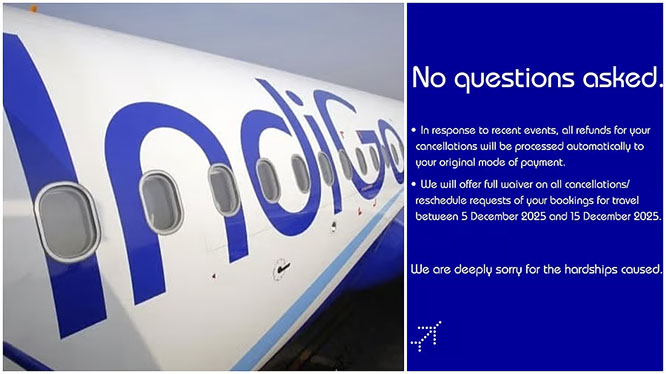
With IndiGo flight disruptions impacting thousands of passengers, the airline on Saturday said that it will offer full waiver on all cancellations/reschedule requests for travel bookings between December 5, 2025 and December 15, 2025.

Earlier in the day, the civil aviation ministry had directed the airline to complete the ticket refund process for the cancelled flights by Sunday evening, as well as ensure baggage separated from the travellers are delivered in the next two days.

In a post on X, titled 'No questions asked', IndiGo wrote, "In response to recent events, all refunds for your cancellations will be processed automatically to your original mode of payment."

"We are deeply sorry for the hardships caused," it further added.

Several passengers, however, complained of not getting full refund as promised by the airline.

Netizens have shared screenchots of getting charged for airline cancellation fee and convenience fee.

"Please tell me why u have did this airline cancellation charges when u say full amount will be refunded (sic)," a user wrote sharing a screenshot of the refund page.

"Well, but you have still debited the convenience charges," wrote another.

Passengers have also raised concerns about the "cancel" option being disabled on the IndiGo app. "First enable the 'Cancel' button on your App & offer full refund on tickets cancelled by customers between the said dates," wrote a user.

A day after the country's largest airline, IndiGo, cancelled more than 1,000 flights and caused disruptions for the fifth day on Saturday, the ministry said that any delay or non-compliance in refund processing will invite immediate regulatory action.

The refund process for all cancelled or disrupted flights must be completed by 8 pm on Sunday, the ministry said in a statement.

"Airlines have also been instructed not to levy any rescheduling charges for passengers whose travel plans were affected by cancellations," it said.

On Saturday, more than 400 flights were cancelled at various airports.

IndiGo has also been instructed to set up dedicated passenger support and refund facilitation cells.

Comments

Add new comment

  • Coastaldigest.com reserves the right to delete or block any comments.
  • Coastaldigset.com is not responsible for its readers’ comments.
  • Comments that are abusive, incendiary or irrelevant are strictly prohibited.
  • Please use a genuine email ID and provide your name to avoid reject.