



Citizenship Bill passed in LS amid protests

Agencies
January 8, 2019

New Delhi, Jan 8: A bill seeking to provide Indian citizenship to non-Muslims from Bangladesh, Pakistan and Afghanistan was approved by the Lok Sabha on Tuesday.
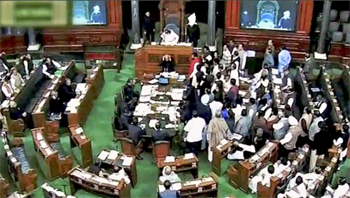
Piloting the contentious Citizenship (Amendment) Bill 2019, Home Minister Rajnath Singh told the Opposition that the bill was not against the provisions of the Constitution and would give succour to persecuted minorities in the three neighbouring countries.

The Bill provides for according Indian citizenship to the Hindus, Jains, Christians, Sikhs, Buddhists and Parsis from Bangladesh, Pakistan and Afghanistan after six years of residence in India instead of 12 years even if they do not possess any document.

"They have no place to go to, except India," he said, adding several leaders including first Prime Minister Jawaharlal Nehru were in favour of giving shelter to persecuted minorities in the neighbouring countries.

Seeking to assuage the concerns in the Northeast, which saw an 11-hour bandh on Tuesday against the legislation, Singh said the proposed law will not be confined to Assam alone.

"The burden of those persecuted migrants will be shared by the whole country. Assam alone should not have to bear the entire burden. The government of India is committed to give all help to the State Government and people of Assam," he said.

The BJP appears to have been isolated over the issue. The Asom Gana Parishad (AGP), a partner in the BJP-led Assam government, broke up with the saffron party while the NDA allies, the Shiv Sena and the JD(U), have opposed this legislation.

Mizoram and Meghalaya governments have opposed the bill by adopting a resolution against it in their respective cabinet meetings.

The home minister said the Union Cabinet has also approved the grant of ST status to six communities of Assam namely Tai Ahom, Koch Rajbongshi, Chutia, Tea Tribes, Moran and Matak.

The Union Cabinet's decision can be seen as a balancing act by the central government to strong opposition to the bill in Assam.

According to the Home Minister, "At the same time, full safeguards will be provided to protect the interests, rights and privileges of existing Scheduled Tribes of Assam.

"A separate Bill will be brought to grant ST status to Bodo Kacharis in Hill districts of Assam and Karbis in the rest of Assam. Sixth Schedule of the Constitution is also proposed to be amended to strengthen the Autonomous District Councils," he said.

Singh said the migrants - Hindus, Jains, Christians, Sikhs, Buddhists and Parsis - were earlier given protection against legal action in 2015 and 2016.

"Long term visa provision was made for them. The proposed amendment will make these persecuted migrants eligible to apply for citizenship," he said.

Singh said citizenship will be given to them only after due scrutiny and recommendation of district authorities and the state government.

The minimum residency period for citizenship is proposed to be reduced from the existing 12 years under the present law to seven years.

The legislation also seeks to provide relief to persecuted migrants who have come through western borders of the country to states like Gujarat, Rajasthan, Delhi, Madhya Pradesh and other states, the Home Minister said.

The bill will apply to all States and Union Territories of the country and the beneficiaries of the Citizenship Amendment Bill will be able to reside in any state of the country.

The bill was originally introduced in 2016 and was later sent to the JPC, which submitted its report on Monday.

On the basis of the recommendations of the JPC, a fresh bill was introduced on Tuesday.

Opposition parties have raised objections to the bill.

The Congress said many states have opposed the bill and it should be sent to a select committee. As the government did not heed to the demand, the Congress staged a walkout.

TMC's Saugata Roy dubbed the bill as "divisive" and "insidious" that goes against the basic tenets of the constitution.

"This is the worst form of vote-bank politics", Roy said.

Comments

Add new comment

  • Coastaldigest.com reserves the right to delete or block any comments.
  • Coastaldigset.com is not responsible for its readers’ comments.
  • Comments that are abusive, incendiary or irrelevant are strictly prohibited.
  • Please use a genuine email ID and provide your name to avoid reject.
News Network
December 6,2025

pilot.jpg

New Delhi: IndiGo, India’s largest airline, faced major operational turbulence this week after failing to prepare for new pilot-fatigue regulations issued by the Directorate General of Civil Aviation (DGCA). The stricter rules—designed to improve flight safety—took effect in phases through 2024, with the latest implementation on November 1. IndiGo has acknowledged that inadequate roster planning led to widespread cancellations and delays.

Below are the key DGCA rules that affected IndiGo’s operations:

1. Longer Mandatory Weekly Rest

Weekly rest for pilots has been increased from 36 hours to 48 hours.

The government says the extended break is essential to curb cumulative fatigue. This rule remains in force despite the current crisis.

2. Cap on Night Landings

Pilots can now perform only two night landings per week—a steep reduction from the earlier limit of six.

Night hours, defined as midnight to early morning, are considered the least alert period for pilots.

Given the disruptions, this rule has been temporarily relaxed for IndiGo until February 10.

3. Reduced Maximum Night Flight Duty

Flight duty that stretches into the night is now capped at 10 hours.

This measure has also been kept on hold for IndiGo until February 10 to stabilize operations.

4. Weekly Rest Cannot Be Replaced With Personal Leave

Airlines can no longer count a pilot’s personal leave as part of the mandatory 48-hour rest.

Pilots say this closes a loophole that previously reduced actual rest time.

Currently, all airlines are exempt from this rule to normalise travel.

5. Mandatory Fatigue Monitoring

Airlines must submit quarterly fatigue reports along with corrective actions to DGCA.

This system aims to create a transparent fatigue-tracking framework across the industry.

The DGCA has stressed that these rules were crafted to strengthen flight safety and align India with global fatigue-management standards. The temporary relaxations are expected to remain until February 2025, giving IndiGo time to stabilise its schedules and restore normal air travel.

Comments

Add new comment

  • Coastaldigest.com reserves the right to delete or block any comments.
  • Coastaldigset.com is not responsible for its readers’ comments.
  • Comments that are abusive, incendiary or irrelevant are strictly prohibited.
  • Please use a genuine email ID and provide your name to avoid reject.
News Network
December 16,2025

jordan.jpg

Prime Minister Narendra Modi on Monday held talks with Jordan’s King Abdullah II in Amman, during which the two leaders discussed ways to further strengthen bilateral relations, with the Prime Minister outlining an eight-point vision covering key areas of cooperation.

Describing the meeting as “productive”, PM Modi said he shared a roadmap focused on trade and economy, fertilisers and agriculture, information technology, healthcare, infrastructure, critical and strategic minerals, civil nuclear cooperation, and people-to-people ties.

In a post on social media platform X, the Prime Minister praised King Abdullah II’s personal commitment to advancing India–Jordan relations, particularly as both countries mark the 75th anniversary of the establishment of diplomatic ties this year.

“Held productive discussions with His Majesty King Abdullah II in Amman. His personal commitment towards vibrant India-Jordan relations is noteworthy. This year, we are celebrating the 75th anniversary of our bilateral diplomatic relations,” PM Modi said.

The meeting took place at the Al Husseiniya Palace, where the two leaders also exchanged views on regional and global issues of mutual interest. According to the Ministry of External Affairs (MEA), both sides agreed to further deepen cooperation in areas including trade and investment, defence and security, counter-terrorism and de-radicalisation, fertilisers and agriculture, infrastructure, renewable energy, tourism, and heritage.

The MEA said both leaders reaffirmed their united stand against terrorism.

PM Modi arrived in Amman earlier on Monday and was received by Jordanian Prime Minister Jafar Hassan, who accorded him a formal welcome. Following the talks, King Abdullah II hosted a banquet dinner in honour of the Prime Minister, reflecting the warmth of bilateral ties.

Jordan is the first leg of PM Modi’s three-nation tour. From Amman, the Prime Minister will travel to Ethiopia at the invitation of Prime Minister Abiy Ahmed Ali, marking his first official visit to the African nation. The tour will conclude with a visit to Oman.

Comments

Add new comment

  • Coastaldigest.com reserves the right to delete or block any comments.
  • Coastaldigset.com is not responsible for its readers’ comments.
  • Comments that are abusive, incendiary or irrelevant are strictly prohibited.
  • Please use a genuine email ID and provide your name to avoid reject.
News Network
December 16,2025

Mangaluru, Dec 16: The Mangaluru City police have significantly escalated their campaign against drug trafficking, arresting 25 individuals and booking 12 cases under the Narcotic Drugs and Psychotropic Substances (NDPS) Act between November 30 and December 13. The crackdown resulted in the seizure of a substantial quantity of illicit substances, including 685.6 grams of MDMA and 1.5 kg of ganja.

The success of this recent drive has been significantly boosted by the city’s innovative, QR code-based anonymous reporting system.

"The anonymous reporting system has received an encouraging response. Several recent arrests were made based on inputs received through this system, helping police tighten the noose around drug peddlers," said the City Police Commissioner.

The latest arrests contribute to a robust year-to-date record, underscoring the police's relentless commitment to combating the drug menace.

Up to December 14 this year, the police have registered a total of 107 cases of drug peddling, leading to the arrest of 219 peddlers. Furthermore, they have booked 562 cases of drug consumption, resulting in the arrest of 671 individuals.

The scale of the seizure for the year reflects the magnitude of the problem being tackled: police have seized 320.6 kg of ganja worth ₹88.7 lakh and 1.4 kg of MDMA valued at ₹1.2 crore. Other significant seizures include hydro-weed ganja worth ₹94.7 lakh and cocaine worth ₹1.9 lakh, among others.

The Commissioner emphasized a policy of rigorous enforcement: "We ensure that peddlers are caught red-handed so that they cannot later dispute the case or claim innocence."

To counter the rising trend of substance abuse among youth, the Mangaluru City police have rolled out uniform guidelines for random drug testing across educational institutions.

As part of the drive, tests were conducted in approximately 100 institutions, screening an estimated 5,500 to 6,000 students in the first phase. 20 students tested positive for drug consumption during the initial screening.

Students who tested positive have been provided counselling and are scheduled for re-testing in the second quarter. The testing will also be expanded to students not covered in the first phase. In a move to ensure strict implementation, police personnel were deployed in mufti in some institutions. Reiterating a zero-tolerance stance, the Commissioner confirmed that random testing will continue, and colleges have also been instructed to conduct drug tests at the time of admission to deter substance abuse from an early stage.

Comments

Add new comment

  • Coastaldigest.com reserves the right to delete or block any comments.
  • Coastaldigset.com is not responsible for its readers’ comments.
  • Comments that are abusive, incendiary or irrelevant are strictly prohibited.
  • Please use a genuine email ID and provide your name to avoid reject.

