Deluge, destruction in Jammu and Kashmir

September 14, 2014

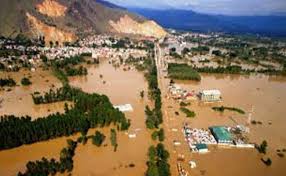
Srinagar, Sep 14: These are unprecedented times. Generations of people of Jammu and Kashmir had not seen the kind of devastation that the floods of September second week have wrought on the Himalayan state.
jk
The deluge has left a trail of destruction in almost every district of this already vexed state. The flood havoc has left the Jammu region and the Kashmir Valley equally ruined. A week of thunderous rainfall has breached canals and lakes and flooded the rivers, pushing the state, not known for its administrative efficiency, backward by a couple of decades. There is hardly any family which has not been affected by this completely unpredicted misery.

Days of rainfall and flooding have impacted every walk of life. After the thunder storm that started on September 6, only now Srinagar has started getting electricity supply, that too only in parts of the state capital. There is hardly any telephone connectivity. With mobile networks non-functional and power intermittent, the problem of contacting the near and dear ones is a tall order. There are tales of parents not knowing the whereabouts of the family members, mothers having lost children and brothers unaware what happened to the uncontactable cousins.

Take anything in J&K, they are under water. Shops and establishments, hospitals, banks, government and private offices, telephone exchanges, police stations, schools and colleges, power plants, petrol pumps and newspaper offices are under water and will remain closed for days to come. Of the seven hospitals in the city, only one – Sher-e-Kashmir - is functional. Godowns are under water. Petrol pumps are empty.

The HP and IOC oil storage tanks located in Pulwama district along the closed Srinagar-Jammu highway are submerged. Most of the buildings and houses are under at least 10 ft of water. There is a level-playing field here though. Chief Minister Omar Abdullah’s office, secretariat, Assembly building, areas like the posh Jawahar Nagar - where leading politicians and top bureaucrats live - have been under water. So much so that the chiefminister could not contact his own ministers or officials for days on end.

There are no stocks in ration shops. Left over stocks are looted by thieves who came in boats. There is an acute shortage of food across the affected districts. Medicine is urgently needed as receding flood waters may bring in diseases. The biggest problem is acute shortage of medicine and drinking water. Some temporary hospitals are set up as voluntary doctors are working but are devoid of medical facilities. Without water, there is the danger of people getting dehydrated. In the only paediatric hospital of Srinagar, 14 newborns died. There are reports that some bodies are lying on trees.

Relief camps have been set up but the condition there is sub-human. While seven of the 10 north Kashmir districts were affected, rain has started pounding south Kashmir since Friday. People’s anger is against both the state and the Central governments.

Affected residents say while the state government completely failed to come to the rescue of the flood-hit, the Centre could have done more. Instead of pressing just 100 boats in to service, what was needed was 1000 boats as lakhs were waiting to be rescued over six days without proper food or water. In Sringar alone, of the 6 lakh trapped in waters, only 1 lakh have been rescued.

Said Riaz Ahmed, a businessman: “This is the time when the rest of the country can really show that Kashmir is part of India, that they are ready to embrace us in this hour of tragedy. Help is coming, but it is insufficient, not streamlined.”

Cries of woe

Many have lost their lives and also savings and property. Says Mohd Mazan Bhat, a retired government official: “I constructed a house in Bemina out of my life savings. The house has been washed away in the floods. I lost everything in a matter of a few hours.” Bhat, now in a relief camp, weeps: “I don’t know how to restart my life.”

Four days after he was rescued from his house which is under 15 ft of water in Karan Nagar, advocate Jawed is not able to live down the horror he went through. “I was saved by an army boat after three days and two nights. I am still terrified, I am not able to sleep. I get hallucinations of the violent waves lashing my house engulfing it and the neighbourhood.”

Senior journalist Arshad Hussian of Kashmir Times and his mother are not traceable. He has three small children and all are rescued from his house at Shivpura on the banks of the Jhelum river. His wife, a doctor, was at her hospital when the tragedy struck and is safe. I have been trying to locate them at relief camps but am not successful.

There are hundreds of such stories here. As for my relatives, there is no information about dozens of them. Same with scores of journalist colleagues and friends.

But many have not left their homes despite army boats reaching them. They are scared that the moment they leave, whatever that is left at home would be taken away by the gangs of thieves.

Lack of connectivity is one of the biggest logistical problems. Authorities claim that 50 per cent of mobile connectivity is restored but in reality, it is not even 10 per cent. BSNL and Airtel connections are not working. Aircel network is available but only in some areas.

There is apprehension as to what will happen to the cash deposits in scores of banks across the state as well as the cash in the main state treasury situated on Residency Road in Lal Chowk which are under water. The chiefminister has assured the people that cash in banks as well as treasury is safe.

In south Kashmir, Anant Nag, Pulwama and Pehlgam have been devastated by floods. Almost 90 per cent of people there are affected. In north Kashmir, parts of Badgam, Baramulla and Bandipore districts are badly hit. In north, only Ganderbal, Kupwara and Shopean districts remain largely unaffected. On Friday, 40 bodies were retrieved from Pancheri village in Udhampur district in Jammu division, devastated by landslide. There are reports that several bodies are lying in different police stations in Srinagar. No one knows about the identity of these bodies.

Rehabilitation in J&K will take years. Public infrastructure is badly affected. In hospitals, all equipment, be it CT scan, x-ray, MRI machines etc are badly damaged under muddy water. Even if water recedes, it won’t be of much help.


Comments

Add new comment

  • Coastaldigest.com reserves the right to delete or block any comments.
  • Coastaldigset.com is not responsible for its readers’ comments.
  • Comments that are abusive, incendiary or irrelevant are strictly prohibited.
  • Please use a genuine email ID and provide your name to avoid reject.
News Network
December 6,2025

pilot.jpg

New Delhi: IndiGo, India’s largest airline, faced major operational turbulence this week after failing to prepare for new pilot-fatigue regulations issued by the Directorate General of Civil Aviation (DGCA). The stricter rules—designed to improve flight safety—took effect in phases through 2024, with the latest implementation on November 1. IndiGo has acknowledged that inadequate roster planning led to widespread cancellations and delays.

Below are the key DGCA rules that affected IndiGo’s operations:

1. Longer Mandatory Weekly Rest

Weekly rest for pilots has been increased from 36 hours to 48 hours.

The government says the extended break is essential to curb cumulative fatigue. This rule remains in force despite the current crisis.

2. Cap on Night Landings

Pilots can now perform only two night landings per week—a steep reduction from the earlier limit of six.

Night hours, defined as midnight to early morning, are considered the least alert period for pilots.

Given the disruptions, this rule has been temporarily relaxed for IndiGo until February 10.

3. Reduced Maximum Night Flight Duty

Flight duty that stretches into the night is now capped at 10 hours.

This measure has also been kept on hold for IndiGo until February 10 to stabilize operations.

4. Weekly Rest Cannot Be Replaced With Personal Leave

Airlines can no longer count a pilot’s personal leave as part of the mandatory 48-hour rest.

Pilots say this closes a loophole that previously reduced actual rest time.

Currently, all airlines are exempt from this rule to normalise travel.

5. Mandatory Fatigue Monitoring

Airlines must submit quarterly fatigue reports along with corrective actions to DGCA.

This system aims to create a transparent fatigue-tracking framework across the industry.

The DGCA has stressed that these rules were crafted to strengthen flight safety and align India with global fatigue-management standards. The temporary relaxations are expected to remain until February 2025, giving IndiGo time to stabilise its schedules and restore normal air travel.

Comments

Add new comment

  • Coastaldigest.com reserves the right to delete or block any comments.
  • Coastaldigset.com is not responsible for its readers’ comments.
  • Comments that are abusive, incendiary or irrelevant are strictly prohibited.
  • Please use a genuine email ID and provide your name to avoid reject.
News Network
December 20,2025

train.jpg

At least seven elephants were killed and one calf injured after a herd collided with the Sairang-New Delhi Rajdhani Express in Assam's Hojai on Saturday morning, leading to disruption of rail services. 

The Sairang-New Delhi Rajdhani Express struck a herd of elephants, resulting in the derailment of the locomotive and five coaches. No passenger casualties or injuries were reported, officials said.

The New Delhi-bound train met with the accident around 2.17 am, PTI reported. The Sairang-New Delhi Rajdhani Express connects Mizoram's Sairang (near Aizawl) to Anand Vihar Terminal (Delhi). 

Railway has issued helpline numbers at the Guwahati Railway Station:-

•    0361-2731621
•    0361-2731622
•    0361-2731623

The accident site is located about 126 km from Guwahati. Following the incident, accident relief trains and railway officials rushed to the spot to initiate rescue operations.

Train Services Disrupted

Sources said that due to the derailment and elephant body parts scattered on the tracks, train services to Upper Assam and other parts of the Northeast were affected.

Passengers from the affected coaches were temporarily accommodated in vacant berths available in other coaches of the train. Once the train reaches Guwahati, additional coaches will be attached to accommodate all passengers, after which the train will resume its onward journey.

The incident occurred at a location that is not a designated elephant corridor. The loco pilot, upon spotting the herd on the tracks, applied emergency brakes. Despite this, the elephants dashed into the train, leading to the collision and derailment.

Last month, an elephant was killed after being hit by a train in Dhupguri in West Bengal's Jalpaiguri district. The incident took place on November 30. 

The adult elephant was killed on the spot, and a calf was discovered lying injured beside the tracks. 

Over 70 Elephants Killed In Train Collisions Over Last 5 Years

At least 79 elephants have died in train collisions across the country in the last five years, the Environment Ministry had informed Parliament in August.

In a written reply in the Lok Sabha, Minister of State for Environment Kirti Vardhan Singh had said the figure is based on reports from state governments and Union Territory administrations for the period 2020-21 to 2024-25.

He said that the ministry does not maintain consolidated data on the deaths of other wild animals on railway tracks, including in designated elephant corridors.

Singh confirmed that three elephants, including a mother and her calf, were killed on July 18 this year after being hit by a speeding express train on the Kharagpur-Tatanagar section in West Bengal's Paschim Midnapore district. The incident took place near Banstala between Jhargram and Banstala stations.

The minister said several measures have been taken jointly by the Environment Ministry and the Railways to prevent such accidents.

These include imposing speed restrictions in elephant habitats, pilot projects such as seismic sensor-based detection of elephants near tracks and construction of underpasses, ramps and fencing at vulnerable points.

The Wildlife Institute of India, in consultation with the ministry and other stakeholders, has also issued guidelines titled 'Eco-friendly Measures to Mitigate Impacts of Linear Infrastructure' to help agencies design railways and other projects in ways that reduce human-animal conflicts.

Singh added that capacity-building workshops were conducted for railway officials at the Wildlife Institute of India in 2023 and 2024 to raise awareness on elephant conservation and protection.

A detailed report titled 'Suggested Measures to Mitigate Elephant & Other Wildlife Train Collisions on Vulnerable Railway Stretches in India' had also been prepared after surveys across 127 railway stretches covering 3,452 km.

Of these, 77 stretches spanning 1,965 km in 14 states were prioritised for mitigation, with site-specific interventions suggested. 

Comments

Add new comment

  • Coastaldigest.com reserves the right to delete or block any comments.
  • Coastaldigset.com is not responsible for its readers’ comments.
  • Comments that are abusive, incendiary or irrelevant are strictly prohibited.
  • Please use a genuine email ID and provide your name to avoid reject.
News Network
December 21,2025

hadith.jpg

Invoking the teachings of Prophet Muhammad—“pay the worker before his sweat dries”—the Madras High Court has directed a municipal corporation to settle long-pending legal dues owed to a former counsel. The court observed that this principle reflects basic fairness and applies equally to labour and service-related disputes.

Justice G. R. Swaminathan made the observation while hearing a petition filed by advocate P. Thirumalai, who claimed that the Madurai City Municipal Corporation failed to pay him legal fees amounting to ₹13.05 lakh. Earlier, the High Court had asked the corporation to consider his representation. However, a later order rejected a major portion of his claim, prompting the present petition.

The court allowed Thirumalai to approach the District Legal Services Authority (DLSA) and submit a list of cases in which he had appeared. It also directed the corporation to settle the verified fee bills within two months, without interest. The court noted that the petitioner had waited nearly 18 years before challenging the non-payment and that the corporation could not be fully blamed, as the fee bills were not submitted properly.

‘A Matter of Embarrassment’

Justice Swaminathan described it as a “matter of embarrassment” that the State has nearly a dozen Additional Advocate Generals. He observed that appointing too many law officers often leads to unnecessary allocation of work and frequent adjournments, as government counsel claim that senior officers are engaged elsewhere.

He expressed hope that such practices would end at least in the Madurai Bench of the High Court and added that Additional Advocate Generals should “turn a new leaf” from 2026 onwards.

‘Scandalously High Amounts’

While stating that the court cannot examine the exact fees paid to senior counsel or law officers, Justice Swaminathan stressed that good governance requires public funds to be used prudently. He expressed concern over the “scandalously high amounts” paid by government and quasi-government bodies to a few favoured law officers.

In contrast, the court noted that Thirumalai’s total claim was “a pittance” considering the large number of cases he had handled.

Background

Thirumalai served as the standing counsel for the Madurai City Municipal Corporation for more than 14 years, from 1992 to 2006. During this period, he represented the corporation in about 818 cases before the Madurai District Courts.

As the former counsel was unable to hire a clerk to obtain certified copies of judgments in all 818 cases, the court directed the District Legal Services Authority to collect the certified copies within two months. The court further ordered the corporation to bear the cost incurred by the DLSA and deduct that amount from the final settlement payable to the petitioner.

Comments

Add new comment

  • Coastaldigest.com reserves the right to delete or block any comments.
  • Coastaldigset.com is not responsible for its readers’ comments.
  • Comments that are abusive, incendiary or irrelevant are strictly prohibited.
  • Please use a genuine email ID and provide your name to avoid reject.