



New Delhi, Feb 13: India and the UAE have strongly condemned state sponsors of terrorism and use of terrorism as a state policy, according to a joint issued on Friday, the concluding day of the three-day visit to India of Crown Prince of Abu Dhabi and Deputy Commander of the USE Armed Force Sheikh Mohamed bin Zayed Al Nahyan.
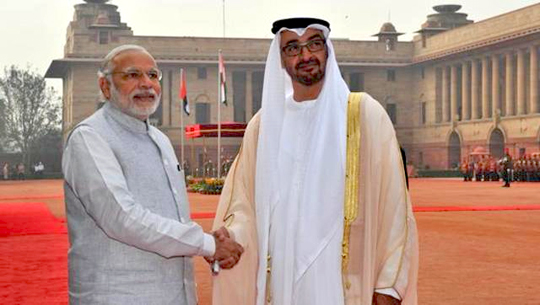
The statement said that both Prime Minister Narendra Modi and Sheikh Mohamed “strongly condemned extremism and terrorism in all of their forms and manifestations, irrespective of who the perpetrators are and of their motivations”.
“They reiterated that any justification for terrorism and any link between extremism or terrorism and religion should be strongly rejected by the international community,” it stated.
“They reiterated their condemnation for efforts, including by states, to use religion to justify, support and sponsor terrorism against other countries, or to use terrorism as instrument of state policy.”
The statement also deplored efforts by countries to give religious and sectarian colour to political issues and pointed out the responsibility of all states to control the activities of the so-called “non-state actors”, and to cut all support to terrorists operating and perpetrating terrorism from their territories against other states.
“The two sides deplored the use of double standards in addressing the menace of international terrorism and agreed to strengthen cooperation in combating terrorism both at the bilateral level and within the multilateral system,” it stated.
“In the context of the growing phenomenon of religious intolerance and radicalisation being witnessed worldwide, the two leaders commended each other on their efforts to build pluralistic societies based on universal values of humanity and peaceful co-existence among different faiths and communities.”
On the business and economic front, the Gulf nation expressed its interest in investing in infrastructure development in India, especially in priority areas such as railways, roads, ports, and shipping.
During the visit of Modi to the UAE in August last year, the first by an Indian prime minister in 34 years, the Gulf nation committed $75 billion in investments in India’s infrastructure sector.
In Friday’s statement, the two leaders welcomed the signing of a framework memorandum of understanding (MoU) between which would serve to facilitate and expand the participation of UAE investors in infrastructure projects in India.
“The two sides described these developments as important steps towards reaching the USD 75 billion target for UAE investments in India’s infrastructure development plans,” it said.
India also thanked the UAE for showing interest in the proposal for establishing a semiconductor fabrication facility in India.
“The two sides agreed to further business-to-business cooperation in information technology (IT), information technology-enabled services (ITeS), and electronics system design and manufacturing (ESDM),” the statement said.
Both countries also agreed to enhance cooperation in space science and space technology and to explore a long-term plan to identify cooperation projects in areas of mutual interest.
With energy being the central pillar of the economic relationship between the two countries, the Modi and Sheikh Mohamed expressed satisfaction at their growing bilateral trade in the energy sector.
“They welcomed the intention of the Abu Dhabi National Oil Company (Adnoc) and the Indian Strategic Petroleum Reserves Ltd. (ISPRL) to sign a memorandum of understanding on the establishment of a strategic petroleum eeserve in India, and agreed to conclude negotiations in the near future,” the statement said.
“The two sides looked forward to increased cooperation in the crude oil sector, including through training, and human resources development. The Indian side conveyed the keen interest of Indian oil companies in forming joint ventures with and offering equity participation to UAE companies, as well as in seeking participation in prospective exploration rounds in the UAE and in opportunities for joint exploration in third countries.”
On climate change, the two leaders noted that the development of sustainable sources of energy was a shared strategic priority.
In the area of defence cooperation, the two sides renewed their commitment to strengthening the existing cooperation in training, and joint exercises as well as identifying opportunities to cooperate on the production of defence equipment in India.
“The two leaders agreed to enhance cooperation to strengthen maritime security in the Gulf and the Indian Ocean region, which is vital for the security and prosperity of both countries,” the statement said.
The Abu Dhabi also appreciated the role and contribution that the Indian community has made to the UAE’s development, noting that Indian citizens in the UAE were highly respected for their peaceful and hard-working ethics.
There are around 2.6 million expatriate Indians in the UAE, around 60 percent of whom are blue collar workers.



Comments
US asks Pak to stop state sponsored terrorism. But sells it latest fighter-planes. It just means: You can beat your donkey & feed it too
India welcomes Pak's pledge to fight militants, but does not believe state sponsored Terrorism via Taliban will stop
If u want to defeat terrorism fight state sponsored first . Stop arming .identify terror groups & expose warmongers .make peace strategic option
Indians are already a victims of similar attack bcoz of state sponsored terrorism by Pakistan, cowardly act must stop, saddening
You have to stop state sponsored terrorism before any peace is viable-you have to get off your backside & fight for it.
India stop state sponsored terrorism in Nepal.
won't stop until state sponsored terrorism stops which won't happen anytime soon.
All countries of the world must oppose the terrorism in one voice.It is time to stop state sponsored all types of terrorism too
0 retweets 0 likes
we must demand that our government stop the state sponsored terrorism in order to achieve political goals
No one who ever cites the UN resolution ever calls for one to stop state sponsored terrorism, which begs the question who started what & when
how is that feasible to stop when terrorism is state sponsored option & actors have been getting away with it 4 decades
First stop state-sponsored #terrorism and human rights abuses in SaudiArabia
Let's seriously STOP funding State-Sponsored Terrorism Israel lobbies to cut ICC funding
Stop state sponsored terrorism & corruption. Live and let live.
Remember that: For the first time a country asked India to stop state sponsored terrorism. Bangladesh pointed out at WB Gov.
U.S must stop repeating this rotten statement n pressurize Pakistan to end state sponsored cross border terrorism
Add new comment