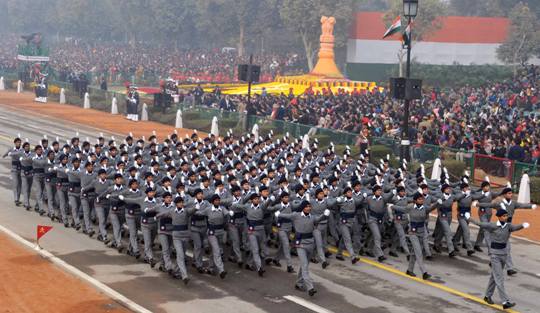
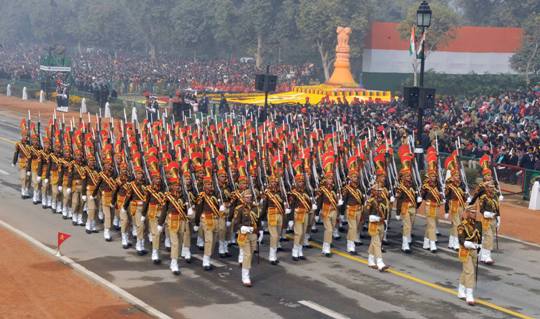
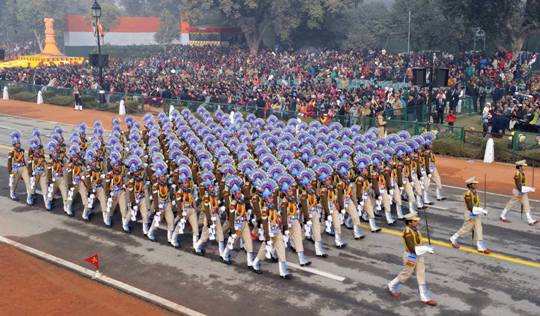
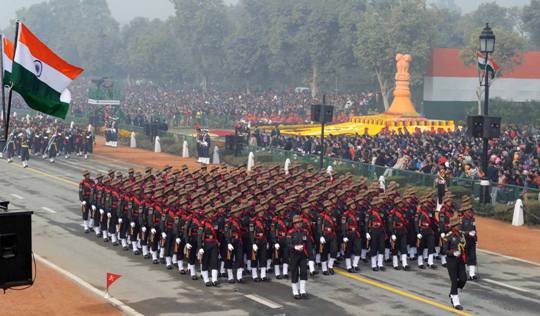
India celebrates 67th Republic Day with majestic parade

January 26, 2016

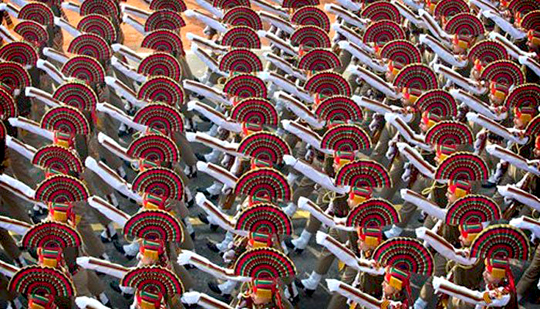
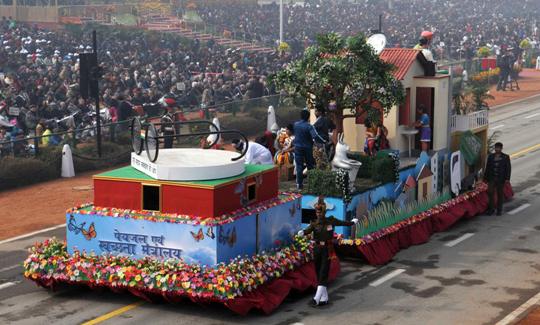
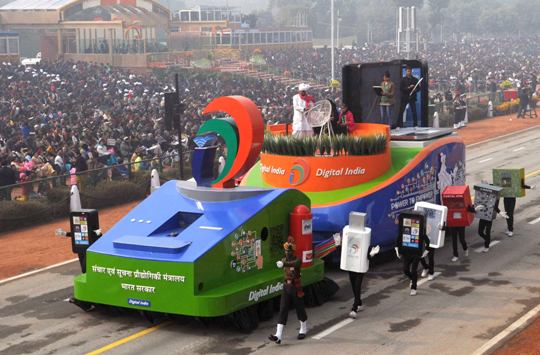
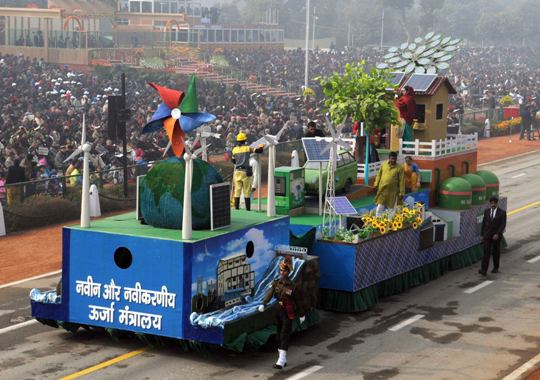
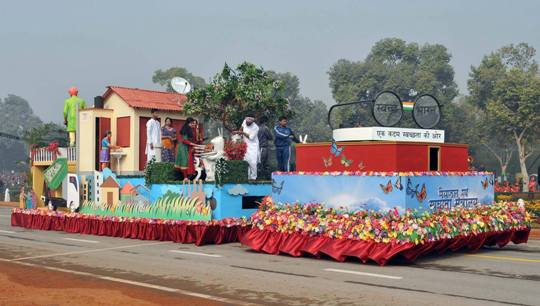
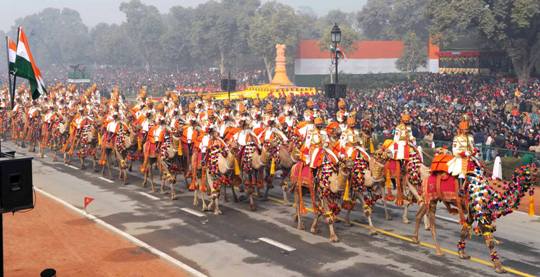
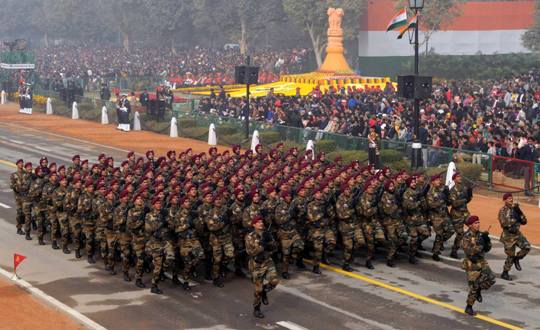
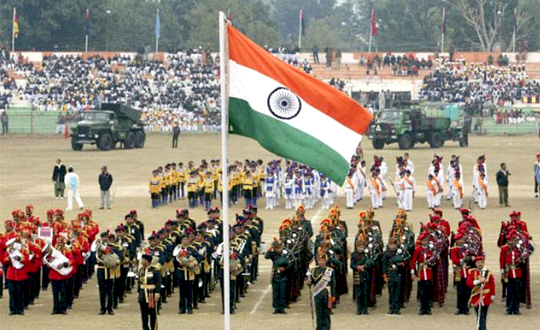
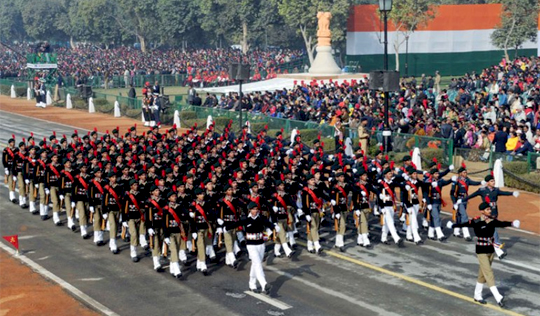
New Delhi, Jan 26: India's military prowess and multi-hued images of the country's rich cultural diversity and achievements in various fields were on display at the majestic Rajpath today during 67th Republic Day parade which was graced by French President Francois Hollande as the chief guest.
renew1

Thousands of people on both sides of the imposing Rajpath, India's ceremonial boulevard facing the seat of power Raisina Hills, braved the winter chill and cheered loudly as the marching contingents and tableux went past them.

The national capital, particularly the Central and New Delhi areas, were brought under unprecedented security blanket as thousands of personnel kept a hawk-eye vigil to thwart any untoward incident. There were intelligence inputs that terror groups may target some important installations in the city.

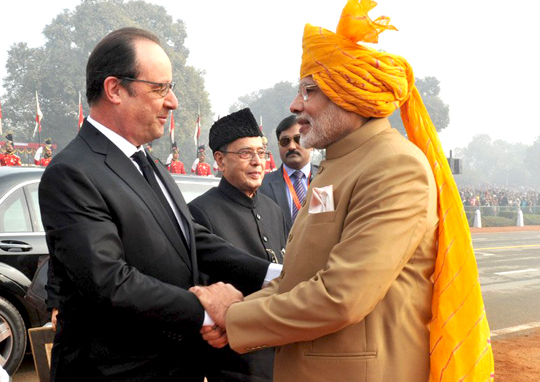
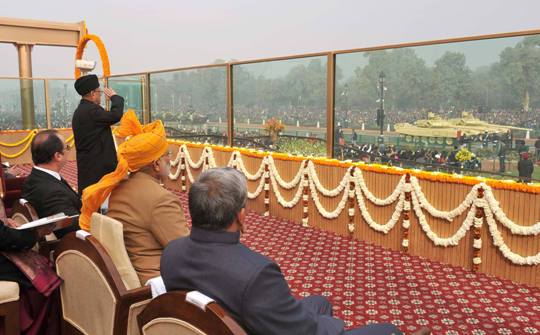
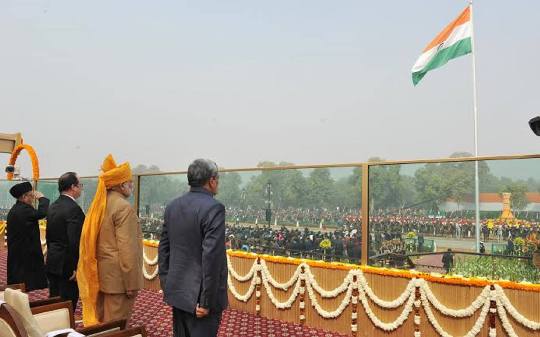
Hollande was seated between President Pranab Mukherjee and Prime Minister Narendra Modi who wore a marigold coloured 'safa'(turban). Modi was seen explaining things to Hollande on several occasions during the one-and-a-half-hour-long event. This year the duration of the parade has been curtailed from more than two hours to 90 minutes.

A French military contingent also marched down the Rajpath, a first by any foreign armed force. In 2009, an Indian contingent had also participated in France's annual Bastille Day parade.

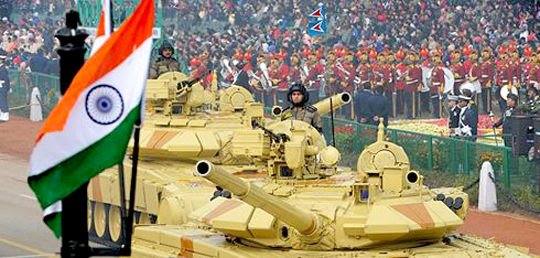
Apart from India's missile firing capability T-90 'Bhishma' tank, Infantry Combat Vehicle BMP II (Sarath), Mobile Autonomous Launcher of the BrahMos Missile System, Akash Weapon System, Smerch Launcher Vehicles, the highlights of the parade also included a canine squad.

The synchronised military and police contingents led by General Officer Commanding (Delhi), Lt General Rajan Ravindran marched proudly to the lilting tunes of the bands through Rajpath where Mukherjee, the Supreme Commander of the Armed Forces, took the salute from a specially erected dais.

Earlier, Hollande, who is on a three-day state visit, arrived with Mukherjee and was received by Modi who introduced him to the three services chief -- Army, Air Force and Navy.

Alongside Hollande, the fifth French President to attend the celebrations, the parade was watched by Vice-President Hamid Ansari, former Prime Minister Manmohan Singh, Congress president Sonia Gandhi, BJP president Amit Shah and the country's top political and military brass, besides the diplomatic community.

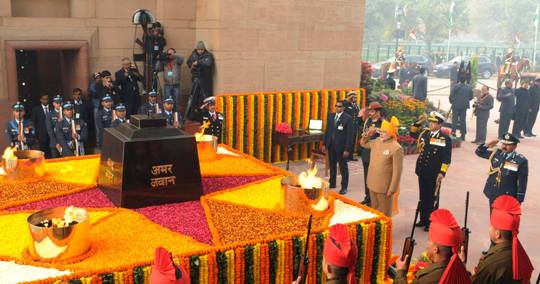
Minutes before the parade began, Modi, Defence Minister Manohar Parrikar and the three service chiefs laid wreaths at 'Amar Jawan Jyoti', the war memorial at the India Gate where an eternal flame burns in memory of those who laid down their lives defending the frontiers of the nation.

Before the start of the ceremonial parade, Mukherjee presented the Ashok Chakra (Posthumous), highest peacetime gallentry award, to Lance Naik Mohan Nath Goswami of 9 Para (Special Force) for his bravery in fighting with terrorists on the intervening night of September 2/3 last year in Haphruda forest at Kupwara district of Jammu and Kashmir. The award was received by his wife Bhavna Goswami.
renew2

renew3

renew4

renew5

reparade1

reparade2

reparade3

reparade4

reparade5

reparade6

reparade8

reparade9

reparade10

reparade11

reparade12

reparade13

reparade17

Comments

Roslyn
 - 
Tuesday, 16 Feb 2016

h my goodness! an amazing article dude. Thank you However I'm experiencing matter with ur rss.
Don’t know why Unable to subscribe to it. Is there anyone finding equivalent rss issue?
Anyone who knows please respond.Thanks

My web page: call
of champions hack free download: http://Www.genhacks24.com/call-of-champions-hack/

Add new comment

  • Coastaldigest.com reserves the right to delete or block any comments.
  • Coastaldigset.com is not responsible for its readers’ comments.
  • Comments that are abusive, incendiary or irrelevant are strictly prohibited.
  • Please use a genuine email ID and provide your name to avoid reject.
News Network
December 6,2025

pilot.jpg

New Delhi: IndiGo, India’s largest airline, faced major operational turbulence this week after failing to prepare for new pilot-fatigue regulations issued by the Directorate General of Civil Aviation (DGCA). The stricter rules—designed to improve flight safety—took effect in phases through 2024, with the latest implementation on November 1. IndiGo has acknowledged that inadequate roster planning led to widespread cancellations and delays.

Below are the key DGCA rules that affected IndiGo’s operations:

1. Longer Mandatory Weekly Rest

Weekly rest for pilots has been increased from 36 hours to 48 hours.

The government says the extended break is essential to curb cumulative fatigue. This rule remains in force despite the current crisis.

2. Cap on Night Landings

Pilots can now perform only two night landings per week—a steep reduction from the earlier limit of six.

Night hours, defined as midnight to early morning, are considered the least alert period for pilots.

Given the disruptions, this rule has been temporarily relaxed for IndiGo until February 10.

3. Reduced Maximum Night Flight Duty

Flight duty that stretches into the night is now capped at 10 hours.

This measure has also been kept on hold for IndiGo until February 10 to stabilize operations.

4. Weekly Rest Cannot Be Replaced With Personal Leave

Airlines can no longer count a pilot’s personal leave as part of the mandatory 48-hour rest.

Pilots say this closes a loophole that previously reduced actual rest time.

Currently, all airlines are exempt from this rule to normalise travel.

5. Mandatory Fatigue Monitoring

Airlines must submit quarterly fatigue reports along with corrective actions to DGCA.

This system aims to create a transparent fatigue-tracking framework across the industry.

The DGCA has stressed that these rules were crafted to strengthen flight safety and align India with global fatigue-management standards. The temporary relaxations are expected to remain until February 2025, giving IndiGo time to stabilise its schedules and restore normal air travel.

Comments

Add new comment

  • Coastaldigest.com reserves the right to delete or block any comments.
  • Coastaldigset.com is not responsible for its readers’ comments.
  • Comments that are abusive, incendiary or irrelevant are strictly prohibited.
  • Please use a genuine email ID and provide your name to avoid reject.
News Network
December 20,2025

train.jpg

At least seven elephants were killed and one calf injured after a herd collided with the Sairang-New Delhi Rajdhani Express in Assam's Hojai on Saturday morning, leading to disruption of rail services. 

The Sairang-New Delhi Rajdhani Express struck a herd of elephants, resulting in the derailment of the locomotive and five coaches. No passenger casualties or injuries were reported, officials said.

The New Delhi-bound train met with the accident around 2.17 am, PTI reported. The Sairang-New Delhi Rajdhani Express connects Mizoram's Sairang (near Aizawl) to Anand Vihar Terminal (Delhi). 

Railway has issued helpline numbers at the Guwahati Railway Station:-

•    0361-2731621
•    0361-2731622
•    0361-2731623

The accident site is located about 126 km from Guwahati. Following the incident, accident relief trains and railway officials rushed to the spot to initiate rescue operations.

Train Services Disrupted

Sources said that due to the derailment and elephant body parts scattered on the tracks, train services to Upper Assam and other parts of the Northeast were affected.

Passengers from the affected coaches were temporarily accommodated in vacant berths available in other coaches of the train. Once the train reaches Guwahati, additional coaches will be attached to accommodate all passengers, after which the train will resume its onward journey.

The incident occurred at a location that is not a designated elephant corridor. The loco pilot, upon spotting the herd on the tracks, applied emergency brakes. Despite this, the elephants dashed into the train, leading to the collision and derailment.

Last month, an elephant was killed after being hit by a train in Dhupguri in West Bengal's Jalpaiguri district. The incident took place on November 30. 

The adult elephant was killed on the spot, and a calf was discovered lying injured beside the tracks. 

Over 70 Elephants Killed In Train Collisions Over Last 5 Years

At least 79 elephants have died in train collisions across the country in the last five years, the Environment Ministry had informed Parliament in August.

In a written reply in the Lok Sabha, Minister of State for Environment Kirti Vardhan Singh had said the figure is based on reports from state governments and Union Territory administrations for the period 2020-21 to 2024-25.

He said that the ministry does not maintain consolidated data on the deaths of other wild animals on railway tracks, including in designated elephant corridors.

Singh confirmed that three elephants, including a mother and her calf, were killed on July 18 this year after being hit by a speeding express train on the Kharagpur-Tatanagar section in West Bengal's Paschim Midnapore district. The incident took place near Banstala between Jhargram and Banstala stations.

The minister said several measures have been taken jointly by the Environment Ministry and the Railways to prevent such accidents.

These include imposing speed restrictions in elephant habitats, pilot projects such as seismic sensor-based detection of elephants near tracks and construction of underpasses, ramps and fencing at vulnerable points.

The Wildlife Institute of India, in consultation with the ministry and other stakeholders, has also issued guidelines titled 'Eco-friendly Measures to Mitigate Impacts of Linear Infrastructure' to help agencies design railways and other projects in ways that reduce human-animal conflicts.

Singh added that capacity-building workshops were conducted for railway officials at the Wildlife Institute of India in 2023 and 2024 to raise awareness on elephant conservation and protection.

A detailed report titled 'Suggested Measures to Mitigate Elephant & Other Wildlife Train Collisions on Vulnerable Railway Stretches in India' had also been prepared after surveys across 127 railway stretches covering 3,452 km.

Of these, 77 stretches spanning 1,965 km in 14 states were prioritised for mitigation, with site-specific interventions suggested. 

Comments

Add new comment

  • Coastaldigest.com reserves the right to delete or block any comments.
  • Coastaldigset.com is not responsible for its readers’ comments.
  • Comments that are abusive, incendiary or irrelevant are strictly prohibited.
  • Please use a genuine email ID and provide your name to avoid reject.