



Outsider tries to assault student leader Kanhaiya Kumar on JNU campus

March 10, 2016

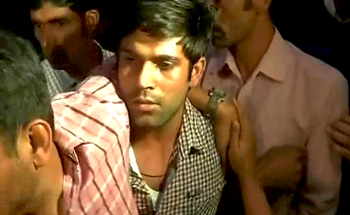
New Delhi, Mar 10: A man tried to attack Kanhaiya Kumar inside the JNU campus, as per media reports on Thursday.

His name is Vikas Chaudhary and he tried to slap the JNUSU president. The man was later detained by security officials.
JNU1
As per initial reports, he is an outsider and native of Ghaziabad. Some reports said that JNU students rescued the JNUSU president.

Also Kanhaiya is said to be out of danger.

Later, talking to the press, Vikas said that he was upset with Kumar over his remarks regarding the Army.

"He wants to be a leader. I wanted to teach him a lesson," he said.

Meanwhile, the Supreme court today asked the parties to two petitions, pertaining to incidents of violence in the Patiala House court complex during the hearing related to Kanhaiya, to complete pleadings by March 29.

In one such petition, filed by advocate Kamini Jaiswal, an SIT probe had been sought into the incidents on February 15 and 17 in which three lawyers were allegedly caught on camera "bragging and boasting" they had beaten up the student leader and others.

The court had, on February 26, sought response from the Centre and Delhi Police on Jaiswal's plea which has also sought initiation of contempt action against the lawyers for allegedly beating Kanhaiya and others in the district courts complex.

The plea has sought "suo motu contempt proceeding" against lawyers Vikram Singh Chauhan, Yashpal Singh and Om Sharma on the ground that they have allegedly been caught on camera talking about the attacks, claiming that the three interfered in the "administration of justice" and willfully violated the orders passed by the apex court on February 17.

In the earlier petition, an alumnus of JNU who was hurt in the violence on February 15, N D Jaiprakash, had complained of inaction of police against those were allegedly involved in thrashing journalists, students and teachers in a city court and sought a fair trial "free from fear of violence and prejudice".

It had alleged that police were a "mute spectator to this brazen display of violence and brute force being perpetrated on innocent persons" who had gathered in the Court premises.


Comments

ramesh
 - 
Saturday, 12 Mar 2016

bajrang dhal should be banned. and chaddi group also.

Gyan Gun Sagar
 - 
Friday, 11 Mar 2016

rightly done, hit him more, he deserves more boot hits.

Kalndar
 - 
Thursday, 10 Mar 2016

Ban ABVP that is the only solution....

Add new comment

  • Coastaldigest.com reserves the right to delete or block any comments.
  • Coastaldigset.com is not responsible for its readers’ comments.
  • Comments that are abusive, incendiary or irrelevant are strictly prohibited.
  • Please use a genuine email ID and provide your name to avoid reject.
News Network
December 7,2025

SHRIMP.jpg

Mangaluru, Dec 7: A rare bamboo shrimp has been rediscovered on mainland India more than 70 years after it was last reported, confirming for the first time the presence of Atyopsis spinipes in the country. The find was made by researchers from the Centre for Climate Change Studies at Sathyabama Institute of Science and Technology, Chennai, during surveys in Karnataka and Odisha.

The team — shrimp expert Dr S Prakash, PhD scholar K Kunjulakshmi, and Mangaluru-based researcher Maclean Antony Santos — combined field surveys, ecological assessments and DNA analysis to identify the elusive species. Their findings, published in Zootaxa, resolve decades of taxonomic confusion stemming from a 1951 report that misidentified the species as Atyopsis moluccensis without strong evidence.

The shrimp has now been confirmed at two locations: the Mulki–Pavanje estuary near Mangaluru and the Kuakhai River in Bhubaneswar. Historical specimens from the Andaman Islands, previously labelled as A. moluccensis, were also found to be misidentified and actually belong to A. spinipes.

The rediscovery began after an aquarium hobbyist in Odisha spotted a shrimp in 2022, prompting systematic surveys across Udupi, Karwar and Mangaluru. Four female specimens were collected in Mulki and one in Odisha, all genetically matching.

Researchers warn the species may exist in very small, vulnerable populations as freshwater habitats face increasing pressure from pollution, sand mining and infrastructure development. All verified specimens have been deposited with the Zoological Survey of India for future reference.

Comments

Add new comment

  • Coastaldigest.com reserves the right to delete or block any comments.
  • Coastaldigset.com is not responsible for its readers’ comments.
  • Comments that are abusive, incendiary or irrelevant are strictly prohibited.
  • Please use a genuine email ID and provide your name to avoid reject.