



Diesel deregulated, prices cut by Rs 3.37 a litre

October 18, 2014

New Delhi, Oct 18: In much-awaited reform, the government on Saturday deregulated diesel prices, a move that will result in a price cut of Rs 3.37 a litre with effect from midnight tonight.
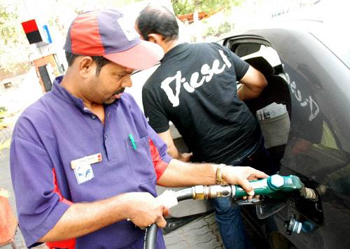
Diesel deregulated
Finance Minister Arun Jaitely said the Cabinet in its meeting today decided to deregulate or free diesel prices. Retail rates will now reflect international movement in oil prices.

As a result, rates will be cut by Rs 3.37 a litre with effect from midnight tonight.

This is the first reduction in diesel rates in over five years. Diesel rates were last cut on January 29, 2009 when they were reduced by Rs 2 a litre to Rs 30.86.

Diesel prices were last raised by 50 paisa on September 1 and cumulatively risen by Rs 11.81 per litre in 19 instalments since January 2013.

There couldn't have been more opportune time for the decision. Oil prices are near a four-year low and two major state elections are out of the way.

Reserve Bank Governor Raghuram Rajan has recently called on the government to "seize this moment", while inflation is the lowest in five years and refiners are selling at a profit for the first time ever.

Brent crude has fallen 25 percent this year to around USD 83 per barrel and expectation is that it may not cross USD 100 barrel anytime soon.

The process was set in motion by the previous UPA government when it eliminated controls on petrol prices in 2010 and in January last year decided to raise diesel prices by up to 50 paisa a litre every month.

The result has been that petrol prices have moved in tandem with global cost and retail rates being reduced on five occasions since August on falling oil rates. Prices have cumulative come down by close to Rs 7 per litre in last two-and-half months.

On diesel, the entire under-recovery or loss has been eliminated and oil firms started making profit from second half of September. The over-recovery or profit has since reached Rs 3.56 per litre.

Deregulation would mean that the government and state-owned explorers including Oil and Natural Gas Corp (ONGC) are no longer subsidising diesel.

Finance Minister Arun Jaitley had budgeted Rs 63,400 crore for petroleum subsidies which was 25 per cent lower than previous fiscal. But unlike past, the subsidy bill is unlikely to overshoot the budgeted amount due to fall in oil rates.

Oil subsidy account for a quarter of Rs 2.51 lakh crore.

Originally, petrol and diesel prices were deregulated in April 2002 when the NDA government was in power. Administered pricing regime, however, made a back-door entry towards the end of NDA regime in the first quarter of 2004 when crude prices started inching up.

The Congress-led UPA controlled rates as international oil prices went through the roof. In June 2010, however, it freed petrol price from its control and rates have since then moved more or less in tandem with cost.

It had in-principle decided to deregulate diesel, which is used in everything from cars and trucks to back-up power generators and agricultural water pumps. The fuel accounts for 43 per cent of the nation's fuel consumption.

In January 2013, the then UPA government decided to deregulate diesel prices in stages through a monthly 50 paise a litre increase. Rates were last hike on September 1 after which losses have been wiped off.

It is estimated that under-recovery or revenue loss on selling diesel, LPG and kerosene at prices lower than imported cost this fiscal will be around Rs 86,080 crore.

This will have to be met by cash subsidy from government as well as dole from upstream oil producers like ONGC.

The under-recovery estimate for the current fiscal is lower than Rs 1,39,869 crore of last fiscal. In 2013-14, the government had provided Rs 70,772 crore by way of cash subsidy while upstream firms picked up Rs 67,021 crore tab.

Sources said the under-recovery in (April-June) was Rs 28,691 crore. This was mostly met by Rs 11,000 crore cash subsidy from the government and Rs 15,547 crore coming from ONGC, Oil India Ltd and GAIL. The remaining Rs 2,144 crore was absorbed by fuel retailers (IOC, BPCL and HPCL).

In second quarter, the under-recovery is estimated at Rs 21,198 crore with diesel accounting for Rs 2,848 crore as compared to Rs 9,037 crore in the June quarter. Kerosene under-recovery was Rs 6,950 crore (Rs 7,524 crore in Q1) and LPG was Rs 11,400 crore (Rs 12,129 crore in Q1).

While diesel losses have been wiped off, oil firms lose Rs 31.22 a litre on kerosene and Rs 404.64 per 14.2-kg LPG cylinder.

Sources said government had provided Rs 1,00,000 crore cash subsidy in 2012-13 when under-recoveries touched an all- time high of Rs 1,61,029 crore. In the preceding year, Rs 83,500 crore was given. Upstream firms had chipped in with Rs 60,000 crore in 2012-13 and Rs 55,000 crore in 2011-12.


Comments

Floy
 - 
Tuesday, 22 Mar 2016

Hi there, just became aware of your blog through Google, and found that it's
truly informative. I'm gonna watch out for brussels.
I'll be grateful iif you continue this in future. Many people will be
benefited from your writing. Cheers!

my web page - self storage hiram ga: http://www.brownbook.net/business/39277916/harry-chesney-llc

Add new comment

  • Coastaldigest.com reserves the right to delete or block any comments.
  • Coastaldigset.com is not responsible for its readers’ comments.
  • Comments that are abusive, incendiary or irrelevant are strictly prohibited.
  • Please use a genuine email ID and provide your name to avoid reject.
News Network
December 13,2025

New Delhi: School-going children are picking up drug and smoking habits and engaging in consumption of alcohol, with the average age of introduction to such harmful substances found to be around 13 years, suggesting a need for earlier interventions as early as primary school, a multi-city survey by AIIMS-Delhi said.

The findings also showed substance use increased in higher grades, with grade XI/XII students two times more likely to report use of substances when compared with grade VIII students. This emphasised the importance of continued prevention and intervention through middle and high school.

The study led by Dr Anju Dhawan of AIIMS's National Drug Dependence Treatment Centre, published in the National Medical Journal of India this month, looks at adolescent substance use across diverse regions.

The survey included 5,920 students from classes 8, 9, 11 and 12 in urban government, private and rural schools across 10 cities -- Bengaluru, Chandigarh, Delhi, Dibrugarh, Hyderabad, Imphal, Jammu, Lucknow, Mumbai, and Ranchi. The data were collected between May 2018 and June 2019.

The average age of initiation for any substance was 12.9 (2.8) years. It was lowest for inhalants (11.3 years) followed by heroin (12.3 years) and opioid pharmaceuticals (without prescription; 12.5 years).

Overall, 15.1 per cent of participants reported lifetime use, 10.3 per cent reported past year use, and 7.2 per cent reported use in the past month of any substance, the study found.

The most common substances used in the past year, after tobacco (4 per cent) and alcohol (3.8 per cent), were opioids (2.8 per cent), followed by cannabis (2 per cent) and inhalants (1.9 per cent). Use of non-prescribed pharmaceutical opioids was most common among opioid users (90.2 per cent).

On being asked, 'Do you think this substance is easily available for a person of your age' separately for each substance category, nearly half the students (46.3 per cent) endorsed that tobacco products and more than one-third of the students (36.5 per cent) agreed that a person of their age can easily procure alcohol products.

Similarly, for Bhang (21.9 per cent), ganja/charas (16.1 per cent), inhalants (15.2 per cent), sedatives (13.7 per cent), opium and heroin (10 per cent each), the students endorsed that these can be easily procured.

About 95 per cent of the children, irrespective of their grade, agreed with the statement that 'drug use is harmful'.

The rates of substance use (any) among boys were significantly higher than those of girls for substance use (ever), use in the past year and use in the past 30 days. Compared to grade VIII students, grade IX students were more likely, and grade XI/XII students were twice as likely to have used any substance (ever).

The likelihood of past-year use of any substance was also higher for grade IX students and for grade XI/XII students as compared to grade VIII students.

About 40 per cent of students mentioned that they had a family member who used tobacco or alcohol each. The use of cannabis (any product) and opioid (any product) by a family member was reported by 8.2 per cent and 3.9 per cent of students, respectively, while the use of other substances, such as inhalants/sedatives by family was 2-3 per cent, the study found.

A relatively smaller percentage of students reported use of tobacco or alcohol among peers as compared to among family members, while a higher percentage reported inhalants, sedatives, cannabis or opioid use among peers.

Children using substances (past year) compared to non-users reported significantly higher any substance use by their family members and peers.

There were 25.7 per cent students who replied 'yes' to the question 'conflicts/fights often occur in your family'. Most students also replied affirmatively to 'family members are aware of how their time is being spent' and 'damily members are aware of with whom they spend their time'.

Comments

Add new comment

  • Coastaldigest.com reserves the right to delete or block any comments.
  • Coastaldigset.com is not responsible for its readers’ comments.
  • Comments that are abusive, incendiary or irrelevant are strictly prohibited.
  • Please use a genuine email ID and provide your name to avoid reject.
News Network
December 16,2025

jordan.jpg

Prime Minister Narendra Modi on Monday held talks with Jordan’s King Abdullah II in Amman, during which the two leaders discussed ways to further strengthen bilateral relations, with the Prime Minister outlining an eight-point vision covering key areas of cooperation.

Describing the meeting as “productive”, PM Modi said he shared a roadmap focused on trade and economy, fertilisers and agriculture, information technology, healthcare, infrastructure, critical and strategic minerals, civil nuclear cooperation, and people-to-people ties.

In a post on social media platform X, the Prime Minister praised King Abdullah II’s personal commitment to advancing India–Jordan relations, particularly as both countries mark the 75th anniversary of the establishment of diplomatic ties this year.

“Held productive discussions with His Majesty King Abdullah II in Amman. His personal commitment towards vibrant India-Jordan relations is noteworthy. This year, we are celebrating the 75th anniversary of our bilateral diplomatic relations,” PM Modi said.

The meeting took place at the Al Husseiniya Palace, where the two leaders also exchanged views on regional and global issues of mutual interest. According to the Ministry of External Affairs (MEA), both sides agreed to further deepen cooperation in areas including trade and investment, defence and security, counter-terrorism and de-radicalisation, fertilisers and agriculture, infrastructure, renewable energy, tourism, and heritage.

The MEA said both leaders reaffirmed their united stand against terrorism.

PM Modi arrived in Amman earlier on Monday and was received by Jordanian Prime Minister Jafar Hassan, who accorded him a formal welcome. Following the talks, King Abdullah II hosted a banquet dinner in honour of the Prime Minister, reflecting the warmth of bilateral ties.

Jordan is the first leg of PM Modi’s three-nation tour. From Amman, the Prime Minister will travel to Ethiopia at the invitation of Prime Minister Abiy Ahmed Ali, marking his first official visit to the African nation. The tour will conclude with a visit to Oman.

Comments

Add new comment

  • Coastaldigest.com reserves the right to delete or block any comments.
  • Coastaldigset.com is not responsible for its readers’ comments.
  • Comments that are abusive, incendiary or irrelevant are strictly prohibited.
  • Please use a genuine email ID and provide your name to avoid reject.