



Apr 14: The company, which is striking fear into its current and potential competitors, expects to report revenue of $750 million in the fiscal year that ended in March, more than double the previous year’s $300 million.
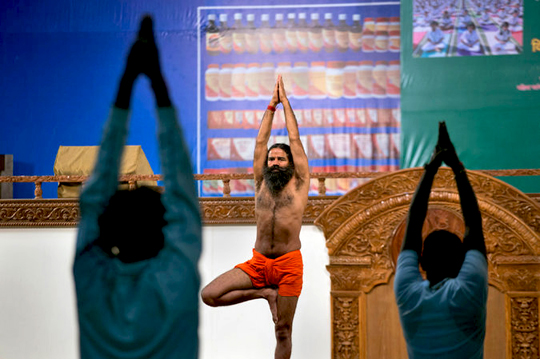
The Sitting on an orange sofa set over a Persian carpet, in a gated office park of freshly painted tan buildings and manicured lawns, Baba Ramdev is surrounded by the trappings of any major corporate leader almost anywhere in the world.
But Ramdev is also an Indian swami, having renounced all worldly pleasures and possessions, and he sits cross-legged on the couch, his face fringed by an untamed beard, his body draped in the saffron cloth of a Hindu holy man.
Famous for bringing yoga to the Indian masses, Ramdev, 50, is also the leader of what has become known as the “Baba Cool Movement” — a group of spiritual men, known as “babas.”
They are marketing health-based consumer items based on the ancient Indian medicinal system of herbal treatments, known as Ayurveda. His rapidly expanding business empire of packaged food, cosmetics and home-care products is eating into the sales of both multinational and Indian corporations.
The babas’ message about the value of traditional Indian ingredients is particularly resonant in the current environment in India, where a prime minister and his political party have built a narrative around the value of ancient Hindu practices, from yoga to reverence for cows.
Ramdev is the most prominent of a growing group of brand-building babas, whose ranks include Sri Sri Ravi Shankar, the founder of the Art of Living, an Indian spiritual practice, who promotes a line of creams, soaps and shampoos also called Ayurveda.
“There is truly a tectonic shift” in the consumer products business in India, said Harish Bijoor, a brand strategy specialist and former head of marketing at a subsidiary of the big conglomerate Tata Group.
Ramdev and his friend and business partner, Acharya Balakrishna, 44, run Patanjali Ayurved Limited from a corporate headquarters in Haridwar, ancient city on the banks of River Ganga in Uttarakhand. In an interview, Ramdev said he was the creative force and public face of Patanjali, even though, as a swami, he does not have an official title or hold any shares of the privately held company.
Rising at 3:30 am each day to drink the juice of the amla fruit, berry rich in vitamin C and considered the top immunity booster in Ayurveda medicine, he unleashes a torrent of new product ideas — an herbal energy bar, an herbal hair dye, a sugar-free immune booster — that he records in large Hindi script in a spiral bound notebook. Then he plunges into three hours of yoga, followed by a 12-hour day that is split between Patanjali business and the public meetings of a spiritual and political leader.
Balakrishna, as the managing director, runs day-to-day operations. “Without him, nothing would be possible,” Ramdev said of his partner, who paced in the office as the interview with the loquacious swami spilled over its one-hour allotment.
The two men met in the 1990s when they studied at the same gurukul, a residential school that was the norm for Indian Hindus before the British arrived. Both the sons of farmers, they went on together to study in the Himalayas, Ramdev focusing on yoga and Balakrishna on Ayurveda.
In 1994, they founded the first of three charitable trusts, to run a hospital and a university dealing in Ayurvedic medicine, and an ashram. There, they held yoga camps and free health checkups at which they dispensed Ayurveda treatments, which are largely herbal. Before long, they had set up a manufacturing plant for Ayurveda products.
Around the same time, Ramdev began his televised yoga classes. Lean and muscular, Ramdev proved to be a telegenic tour de force, bringing yoga to India’s poor and the growing middle class. He gradually ventured beyond yoga to become a public critic of government corruption, leading a mass protest in New Delhi in 2011 and later endorsing Prime Minister Narendra Modi during the election in 2014.
Modi and his BJP swept to power soon after, unleashing a strong Hindu nationalist sentiment that Ramdev says has created “an ideal ecosystem” to support his business. Modi pushed the United Nations to create International Yoga Day, and he inaugurated it last year, with Ramdev by his side, in a nationally televised ceremony involving 35,000 people.
Ramdev, given to raucous laughter and bouts of giggles that make him seem disarmingly humble, can just as suddenly overflow with bravado, as he did when asked about the source of Patanjali’s popularity and power. “People buy our products because they believe I will only sell them good things,” he said. Beyond Ramdev’s appeal, Patanjali products are attractive because they are high quality and prices are about 20% lower than the competition, analysts said.
It is not clear how Patanjali is able to charge such low prices, given that its profit margin of 13% is within the industry range of 13 to 16%. Ramdev ventured that, with his fame, his advertising costs are much lower than those of his competitors, who spend as much as 15% of their revenue promoting their products.
The faces of Ramdev and Balakrishna adorn almost every building, billboard and truck connected to the company, which is expanding so fast it is striking fear into its current and potential competitors. The company expects to report revenue of $750 million in the fiscal year that ended in March, more than double the previous year’s $300 million, the two men said.
Meteoric rise
Credit-Suisse Securities, in a report early this year, said Patanjali’s “meteoric rise” had hurt Colgate-Palmolive (India) Ltd, which is majority owned by the US-based Colgate-Palmolive. Sales of Colgate’s toothpastes slowed from growing at about 10% annually just 1% in the quarter ending in December, in the face of competition from Patanjali, Rohit Kadam, the analyst who wrote the report, said in an interview.
The report said sales of health supplements at Dabur India Ltd, one of the country’s largest consumer goods companies, had been growing at close to 20% annually but began falling at the end of last year, hurt by competition from Patanjali. In the face of that threat, Patanjali’s competitors “are working on overdrive to create similar types of product options,” Bijoor, the brand strategist, said.
Colgate has introduced toothpastes containing the extract of neem and charcoal, both still used by villagers to clean their teeth. Spokesmen for Colgate and Dabur did not respond to requests for comment. Experts say that for the foreseeable future, the only danger signs for Patanjali is the enthusiasm of its founder, Ramdev.
If he takes it “a bit too far, he’ll lose new customers,” said Sunil Alagh, a business consultant and formerly chief executive of Britannia Industries Ltd, famous for packaged cookies. In the past, Ramdev had dived into controversial conservative causes without hesitation. Last year, for example, he claimed that he could cure homosexuality by treating a person with yoga.
Ramdev was also outspoken in his condemnation of a student at a New Delhi university who faced sedition charges after the authorities accused him of participating in a pro-Pakistan campus rally. “The traitors,” Ramdev said, “must be arrested.”
Controversy aside, Bijoor has predicted that the “Baba Cool Movement” would eventually outsell both multinationals and top Indian companies alike. “It’s about a good connect,” he said. “It’s about becoming the umbilical cord connecting the past to the present.”

Comments
Ache din effect.
Add new comment