



Police suspect ISI hand in two rail accidents in Uttar Pradesh

January 18, 2017

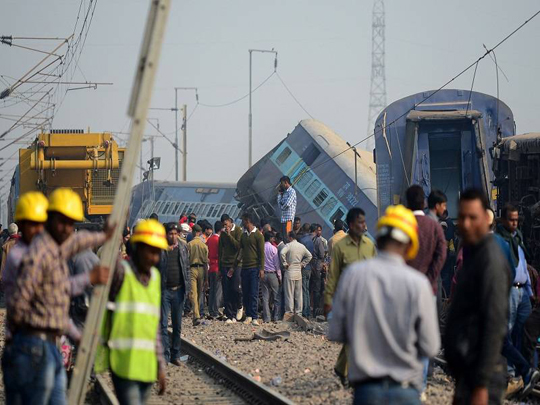
Patna/Delhi, Jan 18: Two major train accidents near Kanpur which resulted in deaths of 151 passengers and injuries to 200 others, were carried out on the instructions of Pakistan's external spy agency ISI, according to the Bihar police.
ISI

The ISI hand was exposed following the arrest of three criminals Umashankar Patel, Motilal Paswan and Mukesh Yadav from Motihari on the Indo-Nepal border who were working at the instance of an ISI agent, a Nepalese citizen based in Dubai.

"These criminals were arrested for their involvement in placing a cooker bomb on the railway track near Ghorasahan in the district on October 1 last year. They have confessed to having worked for an ISI agent," district SP Jitender Rana told TOI over phone, adding one of them confessed to his involvement in planting explosives to derail the Indore-Patna Express and Ajmer-Sealdah Express trains near Kanpur last year.

The disclosure marks a new dimension of the subversion carried out by ISI, and has exposed the vulnerability of railways to terrorists. With the case throwing up clear external linkages with conspirators based in Nepal, Pakistan and UAE, the NIA is closely following the investigation by the Bihar police.

"Our team of investigators are in touch with the local police and will examine the disclosures made by the arrested accused. If our preliminary conclusions vet the ISI-link theory, there is a possibility of NIA taking over the investigation," said an NIA official.

Those involved in the plot could have killed many more if they had succeeded in derailing a passenger train by setting off an explosion on a rail track. Also, a major train accident was foiled on January 1 by the railway patrolling staff, who detected that 50 elastic rail clips and three pairs of fishplates were removed and deliberate damage caused by a hacksaw on the track between Kalyanpur and Mandhana stations in the Farrukhabad-Kanpur Anwarganj section.

Railways has already asked CBI to inquire into the incident which happened a day before Prime Minister Narendra Modi was scheduled to address a political rally in Lucknow.

"Fortunately, the bomb at Ghorasahan was detected with the help of villagers and defused," Rana said about the attempt by the trio to cause an accident in East Champaran district of Bihar on October 1 last year.

Passengers of the Indore-Patna Express were not so lucky. At least 151 were killed when the train flew off the track on November 21 last year. Just over a month later, more than 50 people were injured when Ajmer-Sealdah Express derailed, again near Kanpur, on December 28.

Rana said the trio had received around Rs 3 lakh till now from Brij Kishore Giri for engineering train accidents. Brij is a Nepali citizen. He along with Shambhu Giri and Mujahir Ansari was arrested by Nepal police recently. "The Nepal police have shared vital information with us regarding their ISI links," Rana said, adding that the state ATS (anti-terrorism squad) and other security agencies have been informed about their confession. RPF is also in touch with the Bihar police and is coordinating efforts to reach the bottom of the conspiracy.

Rana said Motilal was earlier a Maoist operating in Adapur block of East Champaran district. "Umashankar has at least four criminals cases against him while 12 cases are lodged against Motilal and Mukesh," the SP said, adding investigations were on to gather information on the main handler of the gang.

Police officials are verifying if Motilal was the area commander of an extremist group, an assumption which if proved correct, will suggest that concerns over ISI enlisting local disaffected groups may have come true.

Sources said Motilal told police he had planted explosives on the tracks near Kanpur for derailing the two trains. "Brij had received funds from Dubai for the purpose. Brij had promised flats, vehicles and finances to produce a Bhojpuri movie to the trio arrested from Motihari," said a police officer involved in the interrogation.

Police have now launched a manhunt for two others, identified as Gajendra Sharma and Rakesh Yadav, who are said to be hiding in East Champaran, the sources said.

Incidentally, Indian Mujahideen chief Yasin Bhatkal was arrested from Raxaul in East Champaran district in August 2013.


Comments

Rashid
 - 
Wednesday, 18 Jan 2017

Agencies gathering some stuff to capitalize in coming election.

shaji
 - 
Wednesday, 18 Jan 2017

Keep on telling false so that other person can feel that you are telling the truth.

Add new comment

  • Coastaldigest.com reserves the right to delete or block any comments.
  • Coastaldigset.com is not responsible for its readers’ comments.
  • Comments that are abusive, incendiary or irrelevant are strictly prohibited.
  • Please use a genuine email ID and provide your name to avoid reject.
News Network
December 16,2025

bengal.jpg

The deletion of over 58 lakh names from West Bengal’s draft electoral rolls following a Special Intensive Revision (SIR) has sparked widespread concern and is likely to deepen political tensions in the poll-bound state.

According to the Election Commission, the revision exercise has identified 24 lakh voters as deceased, 19 lakh as relocated, 12 lakh as missing, and 1.3 lakh as duplicate entries. The draft list, published after the completion of the first phase of SIR, aims to remove errors and duplication from the electoral rolls.

However, the scale of deletions has raised fears that a large number of eligible voters may have been wrongly excluded. The Election Commission has said that individuals whose names are missing can file objections and seek corrections. The final voter list is scheduled to be published in February next year, after which the Assembly election announcement is expected. Notably, the last Special Intensive Revision in Bengal was conducted in 2002.

The development has intensified the political row over the SIR process. Chief Minister Mamata Banerjee and her Trinamool Congress have strongly opposed the exercise, accusing the Centre and the Election Commission of attempting to disenfranchise lakhs of voters ahead of the elections.

Addressing a rally in Krishnanagar earlier this month, Banerjee urged people to protest if their names were removed from the voter list, alleging intimidation during elections and warning of serious consequences if voting rights were taken away.

The BJP, meanwhile, has defended the revision and accused the Trinamool Congress of politicising the issue to protect what it claims is an illegal voter base. Leader of the Opposition Suvendu Adhikari alleged that the ruling party fears losing power due to the removal of deceased, fake, and illegal voters.

The controversy comes amid earlier allegations by the Trinamool Congress that excessive work pressure during the SIR led to the deaths by suicide of some Booth Level Officers (BLOs), for which the party blamed the Election Commission. With the draft list now out, another round of political confrontation appears imminent.

As objections begin to be filed, the focus will be on whether the correction mechanism is accessible, transparent, and timely—critical factors in ensuring that no eligible voter is denied their democratic right ahead of a crucial election.

Comments

Add new comment

  • Coastaldigest.com reserves the right to delete or block any comments.
  • Coastaldigset.com is not responsible for its readers’ comments.
  • Comments that are abusive, incendiary or irrelevant are strictly prohibited.
  • Please use a genuine email ID and provide your name to avoid reject.
News Network
December 13,2025

New Delhi: School-going children are picking up drug and smoking habits and engaging in consumption of alcohol, with the average age of introduction to such harmful substances found to be around 13 years, suggesting a need for earlier interventions as early as primary school, a multi-city survey by AIIMS-Delhi said.

The findings also showed substance use increased in higher grades, with grade XI/XII students two times more likely to report use of substances when compared with grade VIII students. This emphasised the importance of continued prevention and intervention through middle and high school.

The study led by Dr Anju Dhawan of AIIMS's National Drug Dependence Treatment Centre, published in the National Medical Journal of India this month, looks at adolescent substance use across diverse regions.

The survey included 5,920 students from classes 8, 9, 11 and 12 in urban government, private and rural schools across 10 cities -- Bengaluru, Chandigarh, Delhi, Dibrugarh, Hyderabad, Imphal, Jammu, Lucknow, Mumbai, and Ranchi. The data were collected between May 2018 and June 2019.

The average age of initiation for any substance was 12.9 (2.8) years. It was lowest for inhalants (11.3 years) followed by heroin (12.3 years) and opioid pharmaceuticals (without prescription; 12.5 years).

Overall, 15.1 per cent of participants reported lifetime use, 10.3 per cent reported past year use, and 7.2 per cent reported use in the past month of any substance, the study found.

The most common substances used in the past year, after tobacco (4 per cent) and alcohol (3.8 per cent), were opioids (2.8 per cent), followed by cannabis (2 per cent) and inhalants (1.9 per cent). Use of non-prescribed pharmaceutical opioids was most common among opioid users (90.2 per cent).

On being asked, 'Do you think this substance is easily available for a person of your age' separately for each substance category, nearly half the students (46.3 per cent) endorsed that tobacco products and more than one-third of the students (36.5 per cent) agreed that a person of their age can easily procure alcohol products.

Similarly, for Bhang (21.9 per cent), ganja/charas (16.1 per cent), inhalants (15.2 per cent), sedatives (13.7 per cent), opium and heroin (10 per cent each), the students endorsed that these can be easily procured.

About 95 per cent of the children, irrespective of their grade, agreed with the statement that 'drug use is harmful'.

The rates of substance use (any) among boys were significantly higher than those of girls for substance use (ever), use in the past year and use in the past 30 days. Compared to grade VIII students, grade IX students were more likely, and grade XI/XII students were twice as likely to have used any substance (ever).

The likelihood of past-year use of any substance was also higher for grade IX students and for grade XI/XII students as compared to grade VIII students.

About 40 per cent of students mentioned that they had a family member who used tobacco or alcohol each. The use of cannabis (any product) and opioid (any product) by a family member was reported by 8.2 per cent and 3.9 per cent of students, respectively, while the use of other substances, such as inhalants/sedatives by family was 2-3 per cent, the study found.

A relatively smaller percentage of students reported use of tobacco or alcohol among peers as compared to among family members, while a higher percentage reported inhalants, sedatives, cannabis or opioid use among peers.

Children using substances (past year) compared to non-users reported significantly higher any substance use by their family members and peers.

There were 25.7 per cent students who replied 'yes' to the question 'conflicts/fights often occur in your family'. Most students also replied affirmatively to 'family members are aware of how their time is being spent' and 'damily members are aware of with whom they spend their time'.

Comments

Add new comment

  • Coastaldigest.com reserves the right to delete or block any comments.
  • Coastaldigset.com is not responsible for its readers’ comments.
  • Comments that are abusive, incendiary or irrelevant are strictly prohibited.
  • Please use a genuine email ID and provide your name to avoid reject.