Horrific Achhe Din: India 100th on hunger index; worse than Nepal, Bangladesh

Agencies
October 13, 2017

New Delhi, Oct 13: India has a “serious” hunger problem and ranks 100th out of 119 countries on the global hunger index — behind North Korea, Bangladesh and Iraq but ahead of Pakistan, according to a report.

The country’s serious hunger level is driven by high child malnutrition and underlines need for stronger commitment to the social sector, the International Food Policy Research Institute (IFPRI) said in its report.

India stood at 97th position in last year’s rankings.

“India is ranked 100th out of 119 countries, and has the third highest score 
in all of Asia — only Afghanistan and Pakistan are ranked worse,” IFPRI said in a statement.

“At 31.4, India’s 2017 GHI (Global Hunger Index) score is at the high end of the ‘serious’ category, and is one of the main factors pushing South Asia to the category of worst performing region on the GHI this year, followed closely by Africa South of the Sahara,” it added.

As per the report, India ranks below many of its neighbouring countries such as China (29th rank), Nepal (72), Myanmar (77), Sri Lank (84) and Bangladesh (88). It is ahead of Pakistan (106) and Afghanistan (107).

North Korea ranks 93rd while Iraq is at 78th position.

The GHI, now in its 12th year, ranks countries based on four key indicators — undernourishment, child mortality, child wasting and child stunting.

The report ranked 119 countries in the developing world, nearly half of which have ‘extremely alarming,’ ‘alarming’ or ’serious’ hunger levels.

“India’s high ranking on the Global Hunger Index [GHI] again this year brings to the fore the disturbing reality of the country’s stubbornly high proportions of malnourished children,” the statement said.

IFPRI pointed out that more than one-fifth of Indian children under five weigh too little for their height and over a third are too short for their age.

“Even with the massive scale up of national nutrition-focused programmes in India, drought and structural deficiencies have left large number of poor in India at risk of malnourishment in 2017,” said P.K. Joshi, IFPRI Director for South Asia.

However, he said that the on-going efforts are expected to make significant changes in improving the existing situation.

Mr. Joshi appreciated that India has developed and launched an action plan on ‘undernourishment free India’ by 2022. The plan shows stronger commitment and greater investments in tackling malnutrition in the coming years.

“As of 2015-16, more than a fifth [21%] of children in India suffer from wasting [low weight for height] — up from 20% in 2005-2006,” IFPRI said.

Only three other countries in this year’s GHI — Djibouti, Sri Lanka and South Sudan — show child wasting above 20%. India’s child wasting rate has not shown any substantial improvement over the past 25 years.

However, India has made considerable improvement in reducing its child stunting rate, down 29% since 2000, but even that progress leaves India with a relatively high stunting rate of 38.4.

Comments

Indian
 - 
Friday, 13 Oct 2017

No corruption itself is achhe din for me,..There may be incorrect decisions but govt is not sleeping , every day they take decision
This is achhe din for me

D'souza
 - 
Friday, 13 Oct 2017

Finally the voters deserve what they get. The bjp can easily inflame communal passions and is already nurturing its vote bank. It has now understood the arithmetic behind winning election. It won a brute majority with only 30 percent of votes. Now with a nonexistent opposition it might win more seats with lesser votes. The door buster sale of India will truly be over by them. One nation, one market.. for whom exactly? We all know it is for the corporates.

Kumar
 - 
Friday, 13 Oct 2017

Both Republic TV and NDTV are cheddi TV. They proved it many times

Unknown
 - 
Friday, 13 Oct 2017

Just 2 days back a media was showing how the GREAT INDIAN BANK LOOT took place under the previous UPA govt where state owned Banks were asked to disburse LOANS IN LAKHS OF CRORES and how corporates took advantage of this system.

Jay
 - 
Friday, 13 Oct 2017

Ha...This is what from day one of Modi his baiters have been telling ...some acting as though they voted and now changed mind ...are you guys serious about contesting Modi...give a good reason to change and show a better cleaner politician to depend on else this will be the same old story repeated even in 2024 ...

Rudresh
 - 
Friday, 13 Oct 2017

To those who are painting rosy picture , its not about Modi or BJP its about Indian Economy , we failed to take advantage of lower oil price for past three years . Just turn around and see how many children of friends and relatives who came out of college are jobless . Those who have graduated in last two years are struggling to find job and those who are already in job are looking scary . Is this not enough to understand how economy is doing ? Also look at the small businesses and see how they are impacted . RBI Governor escapes parliamentary committee meeting like a student escaping class exams .

Add new comment

  • Coastaldigest.com reserves the right to delete or block any comments.
  • Coastaldigset.com is not responsible for its readers’ comments.
  • Comments that are abusive, incendiary or irrelevant are strictly prohibited.
  • Please use a genuine email ID and provide your name to avoid reject.
News Network
November 21,2025

Bengaluru, Nov 21: The Karnataka government is facing pressure to overhaul its employment system after a high-level Cabinet sub-committee recommended the complete phase-out of job outsourcing in government offices, boards, and corporations by March 2028. The move is aimed at tackling a systemic issue that has led to the potential violation of constitutional reservation policies and the exploitation of workers.

The Call for Systemic Change

With over three lakh vacant posts currently being filled through private agencies on an outsource, insource, or daily wage basis, the sub-committee highlighted a significant lapse. "As a result, reservations are not being followed as per the Constitution and state laws. It’s an urgent need to take serious steps to change the system. It has been recommended to completely stop the system of outsourcing by March 2028," the panel stated in a document.

The practice of outsourcing involves private companies hiring workers to perform duties for a government agency. Critics argue this model results in lesser salaries, a lack of social security benefits (otherwise available to permanent government employees), and a failure to adhere to the provisions of Articles 14 and 15 of the Constitution, which guarantee equality before the law and prohibit discrimination.

The 'Bidar Model' as a Stop-Gap Solution

To regulate the current mode of employment and reduce worker exploitation until the 2028 deadline, the government plans to establish workers’ services multi-purpose cooperative societies across all districts, following the successful "Bidar Model."

The Bidar District Services of Labour Multi-purpose Cooperative Society Ltd., which operates under the District Commissioner, is cited as a successful example of providing a measure of social security to outsourced staff. Labour Department officials argue this society ensures workers receive their due wages and statutory facilities like ESI (Employees' State Insurance) and PF (Provident Fund), in exchange for a 1% service fee collected from the employees.

legislative push and Priority Insourcing

The recommendations, led by the sub-committee headed by Law and Parliamentary Affairs Minister H K Patil, are set to be discussed at the next Cabinet meeting. The committee has proposed the introduction of the Karnataka Outsourced Employees (Regulation, Placement and Welfare) Bill 2025.

In a move addressing immediate concerns, Labour Minister Santosh Lad, a member of the sub-committee, has reportedly assured that steps will be taken over the next 2-3 years to insource workers in "life-threatening services" on a priority basis. This includes essential personnel like pourakarmikas (sanitation workers), drivers, electrical staff in the Energy Department, and Health Department staff handling contagious diseases. The transition aims to grant these workers the long-term security and benefits they currently lack under the outsourcing system. 

Comments

Add new comment

  • Coastaldigest.com reserves the right to delete or block any comments.
  • Coastaldigset.com is not responsible for its readers’ comments.
  • Comments that are abusive, incendiary or irrelevant are strictly prohibited.
  • Please use a genuine email ID and provide your name to avoid reject.
News Network
November 27,2025

siddDKS.jpg

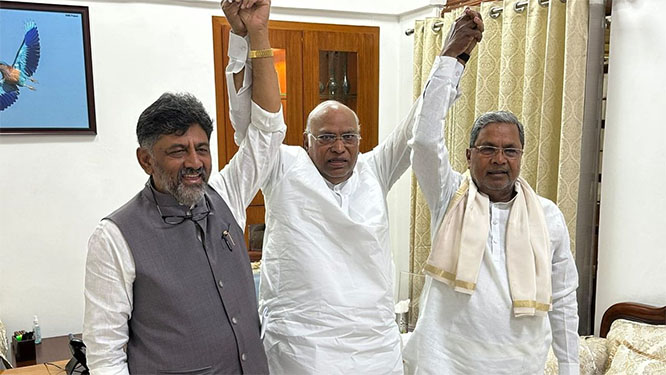
Congress president Mallikarjun Kharge on Thursday announced that he will convene a high-level meeting in New Delhi with senior leaders — including Rahul Gandhi, Karnataka Chief Minister Siddaramaiah and Deputy Chief Minister D.K. Shivakumar — to resolve the escalating leadership turmoil in Karnataka and “put an end to the confusion.”

Kharge said the discussions would focus on the way forward for the ruling party, as rumours of a possible leadership change continue to swirl. The speculation has intensified after the Congress government crossed the halfway mark of its five-year term on November 20, reviving talk of an alleged 2023 “power-sharing agreement” between Siddaramaiah and Shivakumar.

“After reaching Delhi, I will call three or four important leaders and hold discussions. Once we talk, we will decide how to move ahead and end this confusion,” Kharge told reporters in Bengaluru, according to PTI.

When asked specifically about calling Siddaramaiah and Shivakumar to Delhi, he responded: “Certainly, we should call them. We will discuss with them and settle the issue.”

He confirmed that Rahul Gandhi, the Chief Minister, the Deputy Chief Minister and other senior members would be part of the deliberations. “After discussing with everyone, a decision will be made,” he said.

Meanwhile, Siddaramaiah held a separate strategy meeting at his Bengaluru residence with ministers and leaders seen as his close confidants, including G. Parameshwara, Satish Jarkiholi, H.C. Mahadevappa, K. Venkatesh and K.N. Rajanna.
Signalling calm, the Chief Minister told reporters, “Will go to Delhi if the high command calls.”

Shivakumar echoed a similar stance, saying he too would head to the national capital if summoned by the party leadership.

Comments

Add new comment

  • Coastaldigest.com reserves the right to delete or block any comments.
  • Coastaldigset.com is not responsible for its readers’ comments.
  • Comments that are abusive, incendiary or irrelevant are strictly prohibited.
  • Please use a genuine email ID and provide your name to avoid reject.
News Network
December 3,2025

indigo.jpg

IndiGo, India’s largest airline, is battling one of its worst operational disruptions in recent years, with hundreds of delays and cancellations throwing domestic travel into chaos.

Government data on Tuesday showed its on-time performance plunging to 35%, an unusual dip for a carrier long associated with punctuality.

By Wednesday afternoon, airports in Delhi, Mumbai, Bengaluru and Hyderabad had collectively reported close to 200 cancellations, stranding travellers across the country.

Crew Shortage After New Duty Norms

A major trigger behind the meltdown is a severe crew shortage, especially among pilots, following the rollout of revised Flight Duty Time Limitation (FDTL) norms last month.

The rules mandate longer rest hours and more humane rosters — a shift IndiGo has struggled to incorporate across its vast network.

Sources said several flights were grounded due to lack of cabin crew, while some delays stretched upwards of eight hours.

With IndiGo controlling over 60% of India’s domestic aviation market, the ripple effect has impacted airports nationwide.

IndiGo Issues Apology, Lists “Compounding Factors”

In a statement, IndiGo acknowledged the large-scale disruption:

“We sincerely apologise to customers. A series of unforeseen operational challenges — technology glitches, winter schedule changes, adverse weather, system congestion and updated FDTL norms — created a compounding impact that could not have been anticipated.”

To stabilise operations, the airline has begun calibrated schedule adjustments for the next 48 hours, aiming to restore punctuality. Affected passengers are being offered refunds or alternate travel arrangements, IndiGo said.

What the FDTL Rules Require

The FDTL norms, designed to reduce pilot fatigue, cap duty and flying hours as follows:
•    Maximum 8 hours of flying per day
•    35 hours per week
•    125 hours per month
•    1,000 hours per year

Crew must also receive rest equalling twice the flight duration, with a minimum 10-hour rest period in any 24-hour window.

The DGCA introduced these limits to enhance flight safety.

Hyderabad: 33 Flights Cancelled, Long Queues Reported

Hyderabad’s Rajiv Gandhi International Airport saw heavy early-morning crowds as 33 IndiGo flights (arrivals and departures) were cancelled.

The airport clarified on X that operations were normal, advising passengers to contact IndiGo directly for latest flight status.

Cancellations included flights to and from Visakhapatnam, Goa, Ahmedabad, Delhi, Bengaluru, Chennai, Madurai, Hubli, Bhopal and Bhubaneswar.

Bengaluru: 42 Flights Disrupted

Bengaluru’s Kempegowda International Airport recorded 42 cancellations — 22 arrivals and 20 departures — affecting routes to Delhi, Mumbai, Chennai, Hyderabad, Goa, Kolkata and Lucknow.

Passengers Vent on Social Media

Irate travellers took to X to share their experiences. One passenger stranded in Hyderabad wrote: “I have been here since 3 a.m. and missed an important meeting.”

Another said: “My flight was pushed from 1:55 PM to 2:55 PM and now 4:35 PM. I was informed only three minutes before entering the airport.”

Delhi Airport Hit by Tech Glitch

At Delhi Airport, the disruption deepened due to a slowdown in the Amadeus system — used for reservations, check-ins and departure control.

The technical issue led to longer queues and sluggish processing, adding to delays already worsened by staff shortages.

Comments

Add new comment

  • Coastaldigest.com reserves the right to delete or block any comments.
  • Coastaldigset.com is not responsible for its readers’ comments.
  • Comments that are abusive, incendiary or irrelevant are strictly prohibited.
  • Please use a genuine email ID and provide your name to avoid reject.