



RBI gives a makeover to Rs 10 note with chocolate-brown shade

News Network
January 5, 2018

After the big Indian notes, now it's time for 10 rupee note to get a new makeover. According to reports, the Reserve Bank of India is all set to issue new Rs 10 notes under the Mahatma Gandhi series with chocolate brown colour as the base.
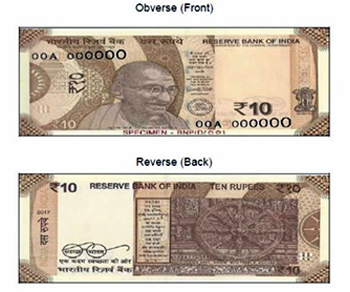
A picture of Konark Sun Temple will be a new addition to the Rs 10 note. As per various news reports, the central bank has already minted around 1 billion pieces of the new Rs 10 note.

The existing Rs 10 note had a design change in 2005. It currently has a picture of Mahatma Gandhi on the front side while a combo picture of an elephant, a tiger and a rhinoceros is printed on the backside.

The new note may also receive a makeover in its numbering pattern as seen in the new notes. In the new notes, ascending size of numerals can be seen from left to right.

In August last year, RBI had introduced the new Rs 200 and Rs 50 notes under the Mahatma Gandhi series. An RBI spokesperson declined to comment.

The move to reintroduce lower denomination notes in a new design comes after the government’s move to rework the currency mix in order to combat counterfeiting and promote a less-cash economy.

On 8 November 2016, the government announced demonetisation to withdraw Rs 1,000 and Rs 500 currency notes, amounting to around 86% of the currency in circulation of Rs 17.9 trillion. Since then, RBI has replaced these with the new Rs 2000 notes and redesigned Rs 500 notes.

RBI has printed 16.96 billion pieces of Rs 500 notes and 3.6 billion pieces of Rs 2000 notes as on 8 December, according to information given by the finance ministry in Lok Sabha. The total value of such notes translates into Rs 15.79 trillion.

Separately, the regulator had also reissued around 12 billion soiled banknotes of Rs 10, Rs 20 and Rs 50 denomination after the demonetisation resulted in a currency crunch. According to RBI, a soiled note is a currency note which has become dirty due to normal wear and tear.

RBI data show currency in circulation was Rs 16.71 trillion as on 22 December. This is about 94.4% of the Rs 17.7 trillion that was in circulation on 4 November 2016.

RBI’s annual report for fiscal 2016-17 also showed that the volume of banknotes increased by 11.1% mainly due to higher infusion of banknotes of lower denomination following demonetisation. The government’s rationale behind the move is to check fake notes which had seen a significant jump since 2008. From 195,000 pieces in fiscal year 2008, the number of counterfeit notes increased to 632,000 pieces in 2015-16.

“The idea is to increase supply of lower denomination to encourage day to day transactions and for larger transactions, people should move to digital mode of payment. Printing of lower denomination notes in new design will ensure soiled notes will be taken out from the system,” said Soumya Kanti Ghosh, group chief economic adviser at State Bank of India.

RBI has still not finished counting the old Rs 500 and Rs 1000 notes after demonetisation.

Comments

Danish
 - 
Friday, 5 Jan 2018

Modi trying to create more issues. He wont stop making problems to people

Suresh Kalladka
 - 
Friday, 5 Jan 2018

All because of feku ji.. 

Ganesh
 - 
Friday, 5 Jan 2018

Feku wants all notes in same color of his jackets..

Add new comment

  • Coastaldigest.com reserves the right to delete or block any comments.
  • Coastaldigset.com is not responsible for its readers’ comments.
  • Comments that are abusive, incendiary or irrelevant are strictly prohibited.
  • Please use a genuine email ID and provide your name to avoid reject.
News Network
December 19,2025

Mangaluru: The Mangaluru CEN police have arrested a 23-year-old man for allegedly posting provocative and misleading content on an Instagram page named “mr_a_titude”, targeting the Bajpe police.

Mangaluru Commissioner of Police Sudheer Kumar Reddy C H identified the arrested as Abhishek M, a resident of Katipalla in Mangaluru.

A case has been registered at the Bajpe Police Station under Sections 353(1)(c), 353(2), 56, and 57 read with Section 189 of the Bharatiya Nyaya Sanhita (BNS) in connection with the post.

According to police, the accused uploaded a photograph of a hotel on the Instagram page and alleged that accused persons in a murder case under the Bajpe police jurisdiction were being given “royal treatment” by the police, including being served beef meals daily from the hotel.

The post further accused the police of supporting criminals, misusing their authority, and betraying public trust. Police said the content was provocative in nature and aimed at inciting public outrage against the police.

Following the post, a case was registered at the Bajpe police station, and further investigation was transferred to the CEN police station.

Police records indicate that the accused has a criminal history, with multiple cases registered against him, including murder, attempt to murder, assault, and robbery at the Surathkal Police Station, and one case at the Kaup Police Station.

The Commissioner said the accused was traced and arrested using technical evidence.

Comments

Add new comment

  • Coastaldigest.com reserves the right to delete or block any comments.
  • Coastaldigset.com is not responsible for its readers’ comments.
  • Comments that are abusive, incendiary or irrelevant are strictly prohibited.
  • Please use a genuine email ID and provide your name to avoid reject.
News Network
December 19,2025

Mangaluru: In a decisive move to tackle the city’s deteriorating sanitation infrastructure, the Mangaluru City Corporation (MCC) has announced a massive ₹1,200 crore action plan to overhaul its underground drainage (UGD) network.

The initiative, spearheaded by Deputy Commissioner and MCC Administrator Darshan HV, aims to bridge "missing links" in the current system that have left residents grappling with overflowing sewage and environmental hazards.

The Breaking Point

The announcement follows a high-intensity phone-in session on Thursday, where the DC was flooded with grievances from frustrated citizens. Residents, including Savithri from Yekkur, described a harrowing reality: raw sewage from apartments leaking into stormwater drains, creating a "permanent stink" and turning residential zones into mosquito breeding grounds.

"We are facing immense difficulties due to the stench and the health risks. Local officials have remained silent until now," one resident reported during the session.

The Strategy: A Six-Year Vision

DC Darshan HV confirmed that the proposed plan is not a temporary patch but a comprehensive six-year roadmap designed to accommodate Mangaluru’s projected population growth. Key highlights of the plan include:

•    Infrastructure Expansion: Laying additional pipelines to connect older neighborhoods to the main grid.

•    STP Crackdown: Stricter enforcement of Sewage Treatment Plant (STP) regulations. While new apartments are required to have functional STPs, many older buildings lack them entirely, and several newer units are reportedly non-functional.

•    Budgetary Push: The plan has already been discussed with the district in-charge minister and the Secretary of the Urban Development Department. It is slated for formal presentation in the upcoming state budget.

Comments

Add new comment

  • Coastaldigest.com reserves the right to delete or block any comments.
  • Coastaldigset.com is not responsible for its readers’ comments.
  • Comments that are abusive, incendiary or irrelevant are strictly prohibited.
  • Please use a genuine email ID and provide your name to avoid reject.
News Network
December 7,2025

Mangaluru, Dec 7: A 34-year-old fruit and vegetable trader in Mangaluru has reportedly lost ₹33.1 lakh after falling victim to an online investment scam run through a fake mobile app.

Police said the scam began in September, when the victim received a link on Facebook. Clicking it connected him to a WhatsApp number, where an unidentified person introduced a high-return investment scheme and instructed him to download an app.

To build trust, the fraudster asked him to invest ₹30,000 on September 24. The trader soon received ₹34,000 as “profit,” convincing him the scheme was genuine. Over the next two months, he transferred money in multiple instalments via Google Pay and IMPS to different scanner codes and bank accounts shared by the scammers. Between September 24 and December 3, he ended up sending a total of ₹33.1 lakh.

When he later requested a refund of his investment and promised returns, the scammers demanded additional payments, claiming he needed to pay a “service tax” first. Even after he paid a small amount, no money was returned, and the scammers continued pressuring him for more.

A case has been registered at the CEN Crime Police Station.

Comments

Add new comment

  • Coastaldigest.com reserves the right to delete or block any comments.
  • Coastaldigset.com is not responsible for its readers’ comments.
  • Comments that are abusive, incendiary or irrelevant are strictly prohibited.
  • Please use a genuine email ID and provide your name to avoid reject.